Gold Price Forecast: XAU/USD struggle with $2,400 extends amid market caution
- Gold price clings to $2,400, snapping a four-day downtrend early Tuesday.
- The US Dollar turns south with US Treasury bond yields, despite risk-off returning.
- China’s economic worries could act as a headwind for Gold price.
- The daily technical setup continues to favor Gold buyers but $2,425 holds the key.

Gold price is making another attempt to reclaim $2,400 on a sustained basis, replicating the moves seen during Monday’s Asian trading. Gold price appears to be benefiting from a typical market caution and renewed China’s economic worries and ahead of key US earnings reports.
Gold price awaits fresh catalysts for a clear direction
Despite the return of risk-off flows, the US Dollar (USD) turns defensive, tracking the retreat in the US Treasury bond yields from two-week highs. Reports that US Vice President Kamala Harris secured 1976 delegates to become the Democratic Party’s presumptive nominee for November’s presidential election exert downward pressure on the Greenback.
It’s worth noting that Donald Trump’s chances of winning the election have narrowed after Joe Biden stepped down to allow Harris to run for the White House. A Democratic win in the US presidency would imply higher taxes and the need for lower borrowing costs, suggesting that the US Federal Reserve (Fed) would have to keep the policy accommodative. This, in turn, would be bearish for the US Dollar in the long term.
Traders turn risk-averse, as worries over China’s economic slowdown mount while nervousness sets in before earnings at Tesla and Alphabet are due after Tuesday’s New York close. Investors scurry for safety in the traditional safe-haven Gold during such times. However, China is the world’s top yellow metal consumer and the slowing growth raises concerns over its physical demand for Gold.
According to Goldman Sachs, “Chinese gold demand is now cyclically soft due to recent price surges, but central banks in emerging markets including China are likely to continue to buy gold frequently, whether disclosed or not,” per Reuters.
Traders also eagerly await the US Gross Domestic Product (GDP) report for the second quarter on Thursday and Personal Consumption Expenditures (PCE) inflation data for June on Friday before placing any directional bets on the Gold price.
In the meantime, the mid-tier US housing data, the political developments and the corporate earnings will drive risk trends, eventually impacting the USD-denominated Gold price.
From a broader perspective, Gold price remains supported by the Fed interest-rate cut expectations, with a September easing almost a done deal. Markets are currently pricing in a September rate cut, as futures show a 97% chance, according to the CME Group’s FedWatch Tool.
Gold price technical analysis: Daily chart
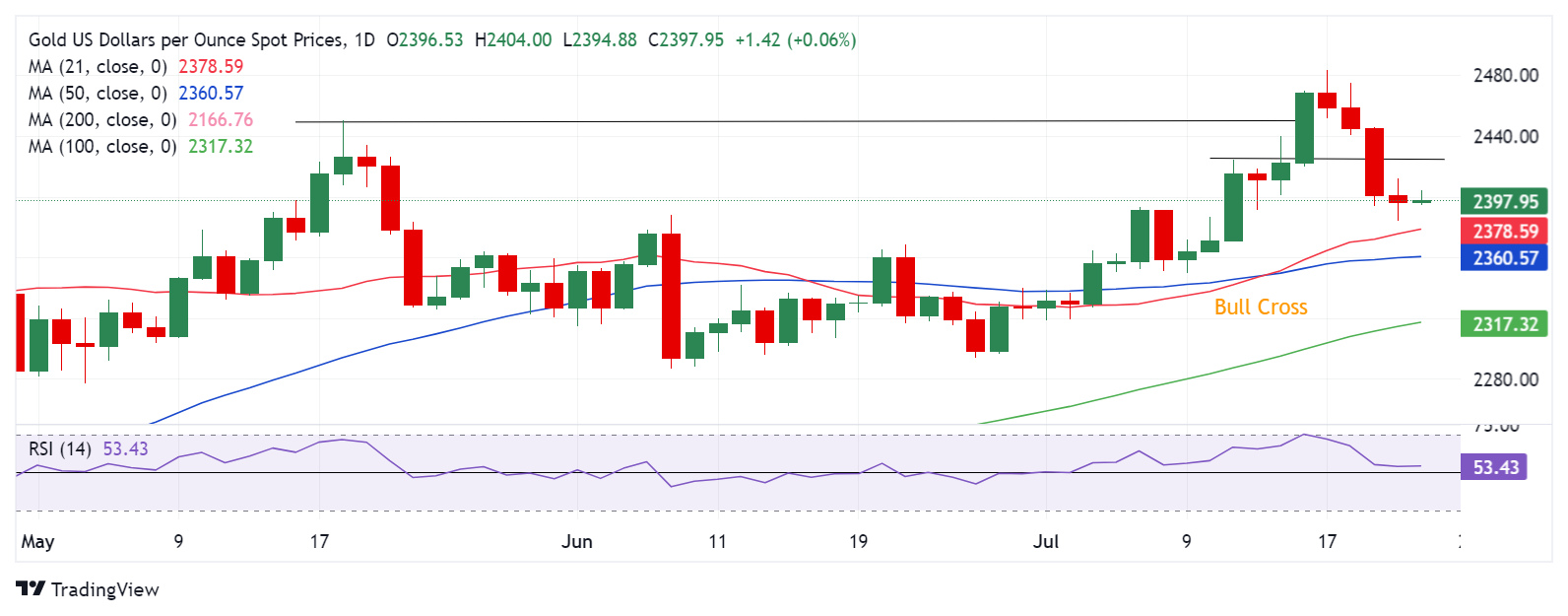
Gold price stays supported so long as the 14-day Relative Strength Index (RSI) holds above the 50 level. The indicator is currently at 53.50.
The 21-day and 50-day Simple Moving Averages (SMA) Bull Cross also remains in play, justifying the constructive outlook for Gold price.
if the Gold price rebound gathers strength, the $2,425 static resistance will be tested. The next topside barrier is seen at the previous lifetime high at $2,450, above which buyers will target the new all-time high of $2,484 reached last week.
On the other side, should sellers return, Gold price could test the 21-day SMA at $2,379 before falling further to the 50-day SMA support at $2,361.
The last line of defense for Gold optimists is seen at the $2,350 psychological level.
Gold FAQs
Gold has played a key role in human’s history as it has been widely used as a store of value and medium of exchange. Currently, apart from its shine and usage for jewelry, the precious metal is widely seen as a safe-haven asset, meaning that it is considered a good investment during turbulent times. Gold is also widely seen as a hedge against inflation and against depreciating currencies as it doesn’t rely on any specific issuer or government.
Central banks are the biggest Gold holders. In their aim to support their currencies in turbulent times, central banks tend to diversify their reserves and buy Gold to improve the perceived strength of the economy and the currency. High Gold reserves can be a source of trust for a country’s solvency. Central banks added 1,136 tonnes of Gold worth around $70 billion to their reserves in 2022, according to data from the World Gold Council. This is the highest yearly purchase since records began. Central banks from emerging economies such as China, India and Turkey are quickly increasing their Gold reserves.
Gold has an inverse correlation with the US Dollar and US Treasuries, which are both major reserve and safe-haven assets. When the Dollar depreciates, Gold tends to rise, enabling investors and central banks to diversify their assets in turbulent times. Gold is also inversely correlated with risk assets. A rally in the stock market tends to weaken Gold price, while sell-offs in riskier markets tend to favor the precious metal.
The price can move due to a wide range of factors. Geopolitical instability or fears of a deep recession can quickly make Gold price escalate due to its safe-haven status. As a yield-less asset, Gold tends to rise with lower interest rates, while higher cost of money usually weighs down on the yellow metal. Still, most moves depend on how the US Dollar (USD) behaves as the asset is priced in dollars (XAU/USD). A strong Dollar tends to keep the price of Gold controlled, whereas a weaker Dollar is likely to push Gold prices up.
Author

Dhwani Mehta
FXStreet
Residing in Mumbai (India), Dhwani is a Senior Analyst and Manager of the Asian session at FXStreet. She has over 10 years of experience in analyzing and covering the global financial markets, with specialization in Forex and commodities markets.