Gold Price Forecast: XAU/USD set to capture $2,500 on Fed easing bets
- Gold price sits at a new record high above $2,480 early Wednesday.
- The US Dollar licks wounds with Treasury bond yields as a September Fed rate cut is a done deal.
- India Gold demand stands resilient, despite elevated prices – ANZ.
- The daily RSI prods 50 level, suggesting more upside for Gold price.

Gold price is consolidating the three-day uptrend to a new record high above $2,480 in Asian trades on Wednesday, as buyers take a breather before resuming the winning momentum.
Gold price looks to $2,500 and beyond
With a US Federal Reserve (Fed) interest-rate cut in September inevitable, a fresh lifetime high for the non-interest-bearing Gold price comes as a little surprise. Markets are fully pricing in the September Fed rate cut while odds of another cut in December stand at above 60%, according to the CME Group’s FedWAtch Tool.
Data on Tuesday showed that US Retail Sales stagnated in the month to June, down from a 0.3% growth in May. The Retail Sales Control Group for June came in at 0.9% versus the previous increase of 0.4%. The readings showed US economic resilience however, that failed to alter market bets for a Fed cut in September.
Therefore, the US Dollar downtrend resumed, following a temporary bounce, helping Gold price attain fresh levels on record above $2,450. Fed Governor Adriana Kugler’s comments added to the recent dovishness from several Fed policymakers, including Chairman Jerome Powell, and accentuated the Gold price bullish momentum.
Gold traders also cheered robust physical demand for Gold in India even though prices remain elevated. Analysts at the Australian and New Zealand (ANZ) Banking Group said in their research note that “higher prices are still dampening demand, but sensitivity has diminished over the past year. Despite a rise in gold’s price of more than 10 percent in 2023, consumer demand stayed buoyant at 760 tons, a marginal decline of only 2 percent y/y. The demand was also in line with the long-term (2013–22) average of 755 tons.”
“Higher capital gains and income growth have helped gold demand weather elevated prices,” ANZ analysts added.
Looking ahead, upside risks remain intact for Gold price, as dovish sentiment around the Fed’s interest rate outlook will continue to boost the appeal of the non-yielding Gold price. Meanwhile, any stimulus rollout by China to stimulate its economic growth could also act as a tailwind for Gold price.
Gold traders will closely scrutinize the mid-tier US industrial and housing data, as well as, the speech from Fed Governor Christopher Waller for fresh trading directives.
Gold price technical analysis: Daily chart
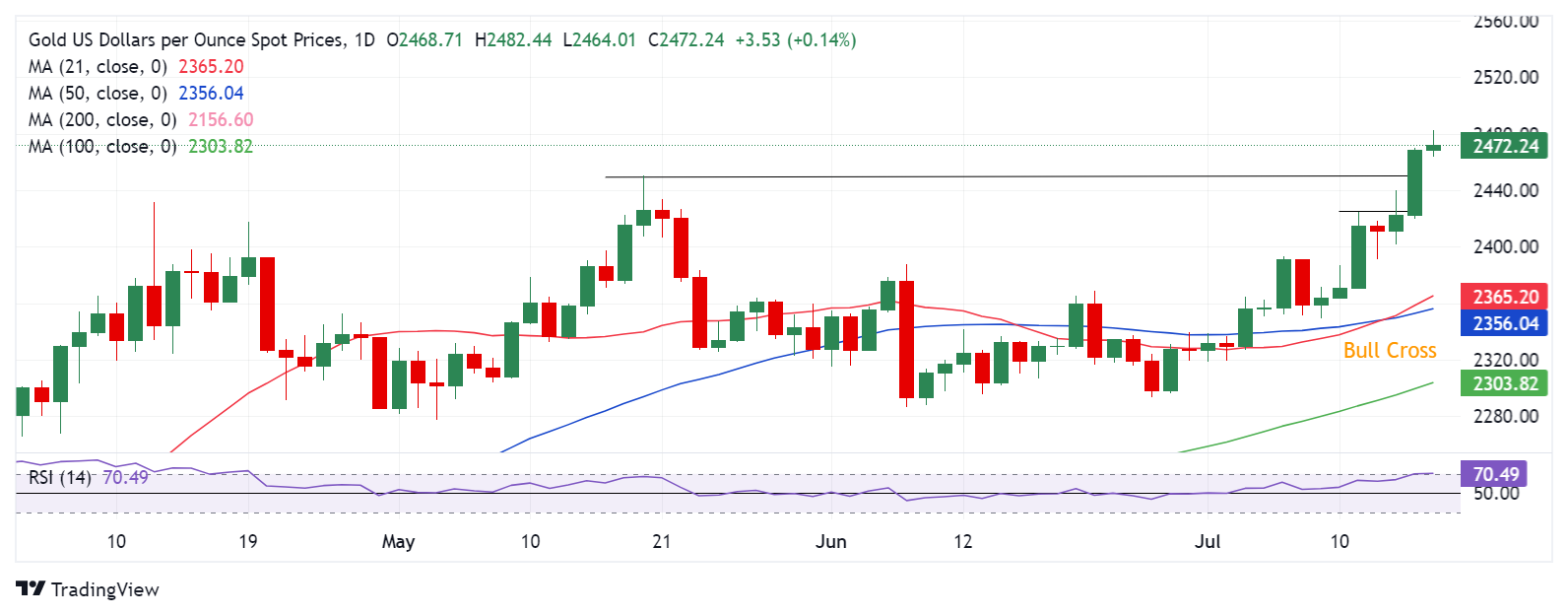
The path of least resistance for Gold price remains to the upside, as the 14-day Relative Strength Index (RSI) tests the overbought threshold while the previous week’s Bull Cross remains in play.
The 21-day Simple Moving Average (SMA) closed above the 50-day SMA on Friday, portraying the bullish crossover.
Gold buyers look to capture the $2,500 level on a retest of the record highs at $2,482. The next contention level is seen at the $2,550 psychological mark.
However, any pullback in Gold price could challenge the previous lifetime high at $2,450, below the $2,400 figure will be put to the test again.
The next relevant support levels are seen at the July 11 low of $2,371 and the $2,350 psychological levels.
Economic Indicator
Fed's Waller speech
Christopher J. Waller is a member of the Board of Governors of the Federal Reserve system. He took office on December 18, 2020, to fill an unexpired term ending January 31, 2030. Dr. Waller had served as executive vice president and director of research at the Federal Reserve Bank of St. Louis prior to his Fed board appointment.
Read more.Next release: Wed Jul 17, 2024 13:35
Frequency: Irregular
Consensus: -
Previous: -
Source: Federal Reserve
Author

Dhwani Mehta
FXStreet
Residing in Mumbai (India), Dhwani is a Senior Analyst and Manager of the Asian session at FXStreet. She has over 10 years of experience in analyzing and covering the global financial markets, with specialization in Forex and commodities markets.