Gold Price Forecast: XAU/USD seems vulnerable, $1,775 area holds the key for bulls
- Gold witnessed some follow-through selling on Wednesday and dived to two-week lows.
- Sustained USD buying continued exerting pressure on the dollar-denominated commodity.
- COVID-19 jitters, the risk-off impulse in the markets extended some support to the metal.

Gold struggled to capitalize on its modest intraday uptick or find acceptance above the $1,800 mark and dropped to two-week lows on Wednesday. This comes on the back of the previous session's sharpest one-day percentage decline since August 9 and was sponsored by a stronger US dollar. Despite disappointing headline NFP print for August, investors seem convinced about an imminent Fed taper announcement later this year. This was evident from the recent surge in the US Treasury bond yields, which acted as a tailwind for the USD and undermined the dollar-denominated commodity.
Meanwhile, data released by the US Bureau of Labor Statistics on Wednesday showed that the number of job openings raced to a new record higher in July while layoffs rose moderately. The report also revealed a steady increase in the number of workers voluntarily quitting their jobs, a sign of confidence in the labour market. This, in turn, suggested that a sharp slowdown in hiring last month was due to employers being unable to find workers rather than weak demand for labour. This, along with hawkish comments by New York Fed President John Williams, validated market expectations.
In a video address to students at St. Lawrence University, Williams noted that substantial further progress standard was met for maximum employment goal and on the Fed's inflation goal. He further indicated that the US central bank remains on track to trim its massive asset purchases this year. This was seen as another factor that drove flows away from the non-yielding yellow metal. That said, the risk-off impulse in the markets – amid worries about slowing global growth and the fast-spreading Delta variant – helped limit any deeper losses for the safe-haven XAU/USD.
The market concerns were further fueled by the Fed's Beige Book on the current economic conditions, which showed that the US economy lost some momentum over the past one month. This, in turn, assisted the precious metal to trim a part of its intraday losses, though the attempted bounce lacked any follow-through. The commodity now seems to have entered a bearish consolidation phase and was seen oscillating in a narrow trading band through the Asian session on Thursday. Investors preferred to wait on the sidelines ahead of the highly-anticipated ECB policy decision.
Traders might further take cues from the release of Weekly Initial Jobless Claims data from the US, due later during the early North American session. Apart from this, scheduled speeches from a host of Fed officials and the US bond yields might influence the USD price dynamics. This, along with the broader market risk sentiment, might provide some impetus to gold and allow traders to grab some meaningful opportunities.
Short-term technical outlook
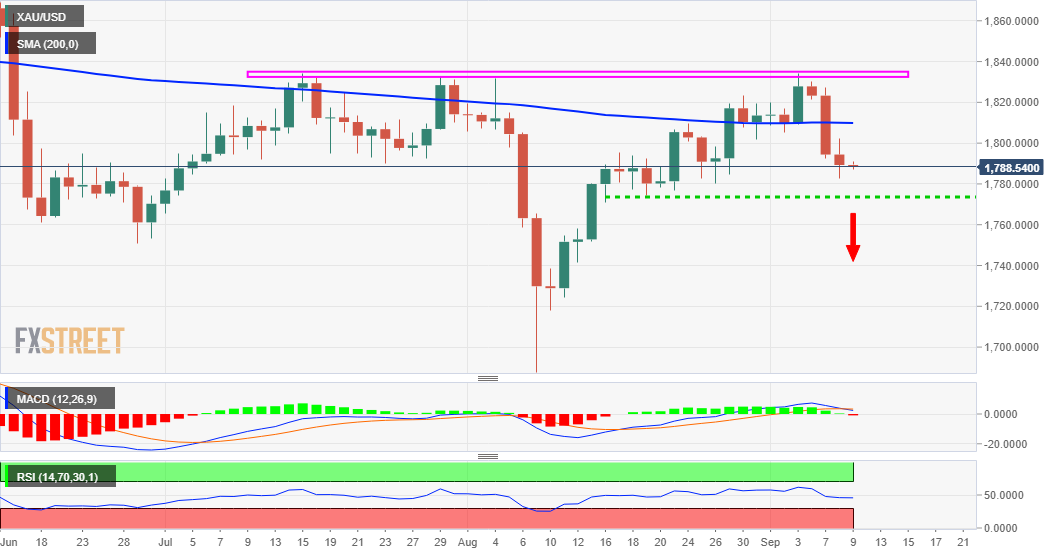
From a technical perspective, the latest rejection slide from the $1,832-34 supply zone constitutes the formation of multiple tops on the daily chart. A subsequent fall and acceptance below the $1,800 mark might have already set the stage for additional losses. Hence, some follow-through weakness towards the next relevant support, around the $1,775-74 region, remains a distinct possibility.
The latter coincides with the 38.2% Fibonacci level of the recent strong rebound from the $$1,687-86 region and should now act as a key pivotal point for short-term traders. A convincing break below will set the stage for a deeper retracement towards the $1,750 support zone.
On the flip side, bulls might now wait for a sustained strength back above the $1,800 round-figure mark before placing fresh bets. The XAU/USD might then climb back to the $1,821-22 resistance zone, above which a fresh bout of a short-covering move should pave the way for a move back towards challenging the $1,832-34 hurdle. Some follow-through buying will negate any near-term negative bias. The XAU/USD might then accelerate the momentum towards the $1,853 intermediate resistance en-route the $1.868-70 region.
Author

Haresh Menghani
FXStreet
Haresh Menghani is a detail-oriented professional with 10+ years of extensive experience in analysing the global financial markets.
















