Gold Price Forecast: XAU/USD gathers pace to retest all-time high at $2,450
- Gold price consolidates before the next push higher on Tuesday, as US Retail Sales data loom.
- The US Dollar tracks the USD/JPY rebound amid a cautious mood, US Treasury bond yields nurse losses.
- Gold price could retake $2,450 due to favorable technicals and increased September Fed rate cut bets.

Gold price is looking to extend previous gains early Tuesday, having clinched a new two-month high at $2,440 a day ago. Growing expectations that a US Federal Reserve (Fed) interest-rate cut in September is a done deal continue to underpin the non-interest-bearing Gold price.
Gold price capitalizes on Fed rate cut bets
Fed Chairman Jerome Powell’s comments affirmed bets for a rate reduction in September after he said Monday that the central bank will not wait until inflation hits 2% to lower interest rates. The Fed is looking for “greater confidence” that inflation will return to the 2% level, Powell added.
Those remarks by the Fed Chief fuelled a fresh leg down in the US Dollar (USD) alongside the US Treasury bond yields, driving Gold price back toward an all-time high of $2,450.
Earlier in the day, Gold price witnessed some corrective moves, as the Greenback took advantage of risk-aversion induced by the weekend’s assassination attempt on ex-US President Donald Trump during his Pennsylvania rally. Investors digested the fateful Trump attack and ramped up the odds of his win in the US Presidential race.
Further, investors flocked to safety in the USD following China’s second-quarter GDP miss in Asian hours on Monday. Data released by the National Bureau of Statistics (NBS) showed Monday that the world's second-largest economy grew 4.7% year-on-year in April-June, slowing from 5.3% in the previous three months while recording the weakest growth since the third quarter of 2023.
In Tuesday’s trading so far, Gold price is gathering strength for the next push higher even as the US Dollar stages a modest comeback. The rebound in the USD/JPY pair could be attributed to the USD uptick. However, weak US Treasury bond yields continue to support the non-yielding Gold price.
The bright metal also cheers the dovish comments from San Francisco Fed President Mary Daly. In her speech overnight, Daly said that she has confidence that inflation is heading lower.
Later in the day, the US Retail Sales report and Fedspeak will grab the eyeballs, as traders look to seal in a September Fed rate cut. Weaker-than-expected US Retail Sales data could reinforce the USD selling, lifting the Gold price northward.
Meanwhile, speculations that China could roll out stimulus measures to boost economic performance could also render Gold positive in the near term.
Gold price technical analysis: Daily chart
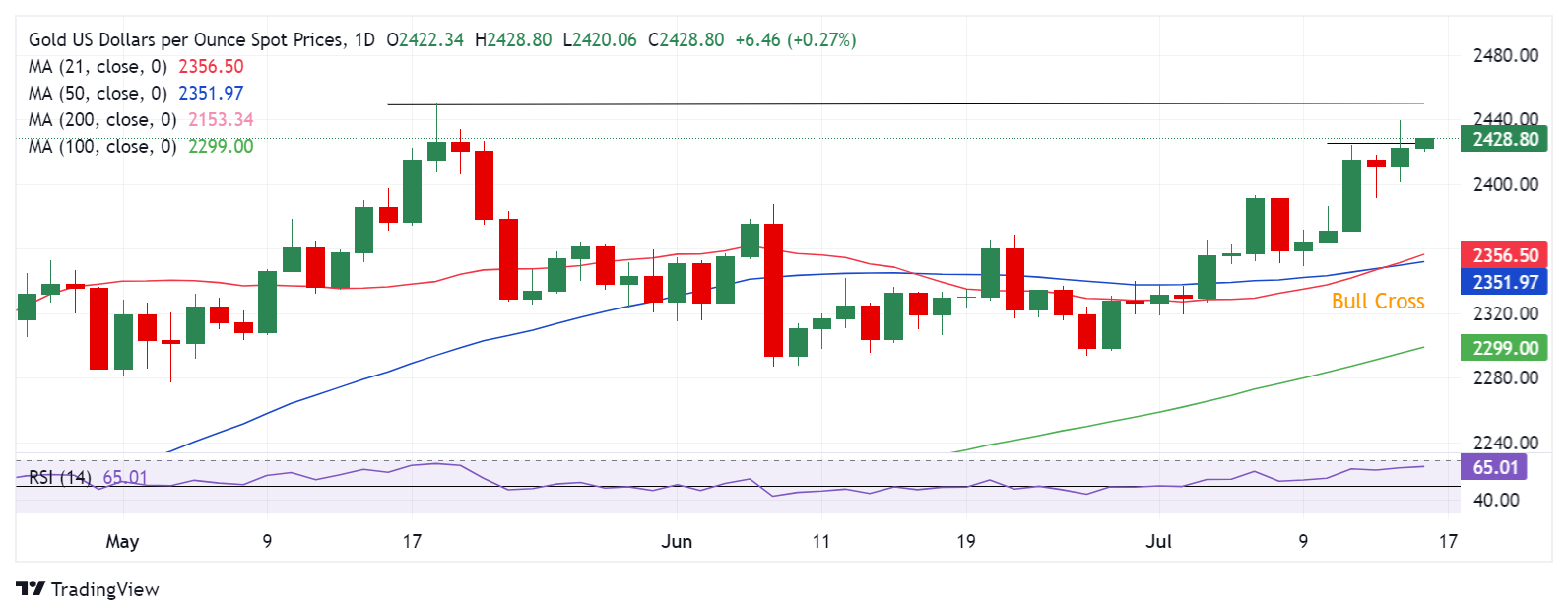
Gold price keeps sight on the all-time high at $2,450, as the 14-day Relative Strength Index (RSI) looks north near 65, at the press time.
The Bull Cross, represented by the 21-day Simple Moving Average (SMA) settling above the 50-day SMA on Friday, adds credence to the bullish potential.
Gold buyers, however, need to yield a daily closing above the previous two-month high of $2,425 to challenge the record highs of $2,450.
Ahead of that, the new two-month high of $2,440 could challenge the bearish commitments.
Alternatively, any pullback in Gold price could warrant a test of the $2,400 round level, below which Friday’s low of $2,391 could be tested.
The next relevant support levels are seen at the July 11 low of $2,371 and the $2,350 psychological levels.
Gold FAQs
Gold has played a key role in human’s history as it has been widely used as a store of value and medium of exchange. Currently, apart from its shine and usage for jewelry, the precious metal is widely seen as a safe-haven asset, meaning that it is considered a good investment during turbulent times. Gold is also widely seen as a hedge against inflation and against depreciating currencies as it doesn’t rely on any specific issuer or government.
Central banks are the biggest Gold holders. In their aim to support their currencies in turbulent times, central banks tend to diversify their reserves and buy Gold to improve the perceived strength of the economy and the currency. High Gold reserves can be a source of trust for a country’s solvency. Central banks added 1,136 tonnes of Gold worth around $70 billion to their reserves in 2022, according to data from the World Gold Council. This is the highest yearly purchase since records began. Central banks from emerging economies such as China, India and Turkey are quickly increasing their Gold reserves.
Gold has an inverse correlation with the US Dollar and US Treasuries, which are both major reserve and safe-haven assets. When the Dollar depreciates, Gold tends to rise, enabling investors and central banks to diversify their assets in turbulent times. Gold is also inversely correlated with risk assets. A rally in the stock market tends to weaken Gold price, while sell-offs in riskier markets tend to favor the precious metal.
The price can move due to a wide range of factors. Geopolitical instability or fears of a deep recession can quickly make Gold price escalate due to its safe-haven status. As a yield-less asset, Gold tends to rise with lower interest rates, while higher cost of money usually weighs down on the yellow metal. Still, most moves depend on how the US Dollar (USD) behaves as the asset is priced in dollars (XAU/USD). A strong Dollar tends to keep the price of Gold controlled, whereas a weaker Dollar is likely to push Gold prices up.
Author

Dhwani Mehta
FXStreet
Residing in Mumbai (India), Dhwani is a Senior Analyst and Manager of the Asian session at FXStreet. She has over 10 years of experience in analyzing and covering the global financial markets, with specialization in Forex and commodities markets.