Gold Price Forecast: XAU/USD down but not out amid BRICS Summit, Trump-win optimism
- Gold price corrects from near record highs of $2,749 on cautious optimism.
- The US Dollar stays firm with Treasury bond yields on potential Trump win and less aggressive Fed easing.
- BRICS Summit could cap Gold price downside, as extremely overbought RSI conditions ease.

Gold price is seeing a minor correction early Wednesday, having hit a fresh record high of $2,749 in the US last session. The sustained strength in the US Dollar (USD) and the US Treasury bond yields weigh on the Gold price.
Gold price suffers from Trump win expectations
The ongoing advance in the US Treasury bond yields and hence, the Greenback could be attributed to two fundamental factors, affecting the yieldless Gold price. With the US presidential election approaching, the market’s expectations for a Trump win are rising, Trump’s potential trade and fiscal policies are seen as inflationary, suggesting higher interest rates. These expectations have triggered a big sell-off in the US government bonds, spiking up US Treasury bond yields across the curve.
Additionally, increased odds that the US Federal Reserve (Fed) will be on a gradual interest-rate reduction path also act as a tailwind to the US yields, boosting the USD at the expense of the Gold price. Markets wager a 91% chance of a 25-basis points (bps) cut in November, the CME Group’s FedWatch tool showed.
The latest comments from San Francisco Fed President Mary Daly backed the expectations of a gradual policy easing by the Fed. Daly said late Tuesday that the economy is clearly in a better place, inflation has fallen substantially and the labor market has returned to a more sustainable path.
Despite, the persistent strength in the US Treasury bond yields and the Greenback on Tuesday, Gold price defied the bearish odds and recorded a new all-time high at $2,749. Escalating geopolitical tensions between Iran and Israel and the revival of the de-dollarization talks underpinned the sentiment around the bright metal.
With a three-day BRICS Summit underway, speculations resurfaced of a gold-backed currency to rival the US Dollar, as central banks from BRICS nations aim to shift to de-dollarization. BRICS countries account for about 20% of global Gold reserves.
That said, any further decline in Gold price could find some support, as day 2 of the BRICS Summit kicks off. Gold traders will also focus on the mid-tier US housing data and Fedspeak for fresh trading impetus.
In the meantime, risk trends and dynamics of the US Treasury bond yields will continue to drive the Gold price action.
Gold price technical analysis: Daily chart
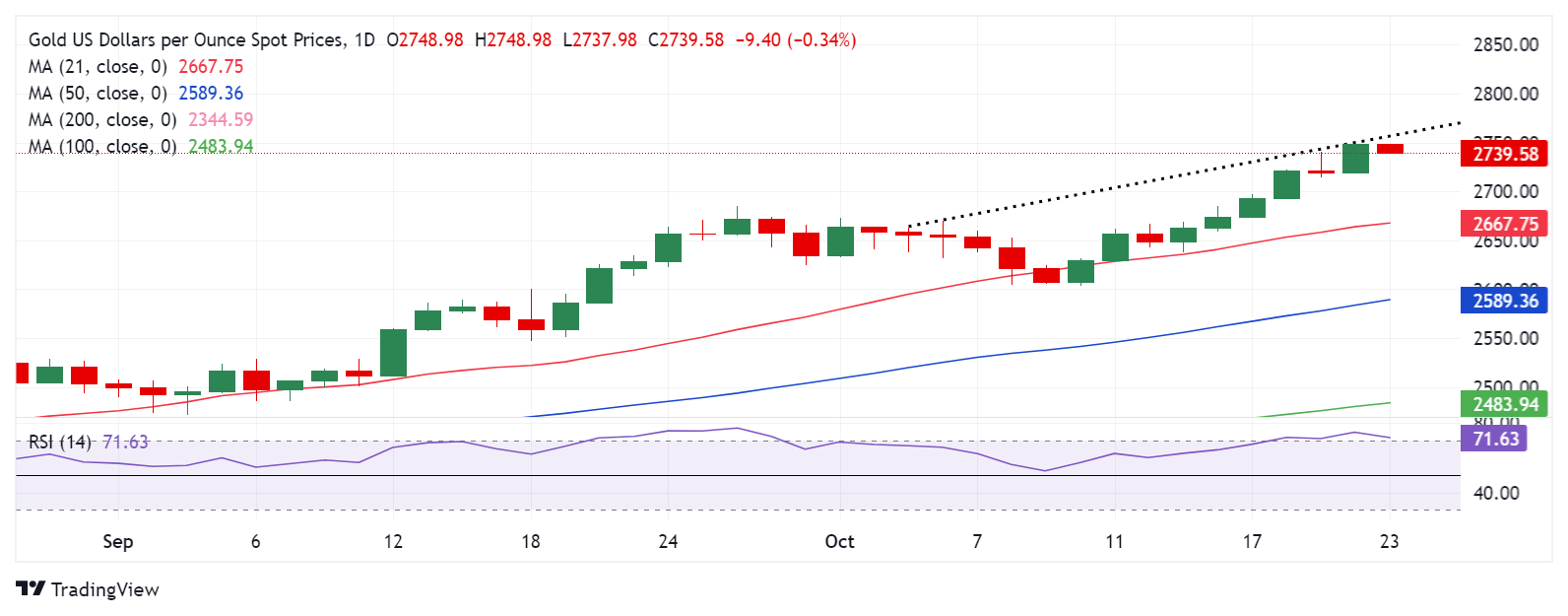
Gold price looks to test the $2,730 round level on its retracement from the record high of $2,749.
A sustained move below the latter could threaten the previous day’s low of $2,719.
The last line of defense for Gold buyers is seen at the $2,700 threshold.
The 14-day Relative Strength Index (RSI) has turned south, easing from the extreme overbought conditions, currently trade near 72.00. The leading indicator backs the latest downside in Gold price but keeps buyers hopeful.
In case of a rebound, Gold price need to take out the lifetime high at $2,749 to ensure a fresh advance toward the $2,800 psychoogical mark.
Ahead of that the rising trendline resistance at $2,756 could act as a stiff resistance.
BRICS FAQs
The BRICS is the acronym denoting the grouping of Brazil, Russia, India, China and South Africa. The name was created by Goldman Sachs’ economist Jim O’Neill in 2001, years before the alliance between these countries was formally established, to refer to a group of developing economies that were predicted back then to lead the global economy by 2050. The bloc is seen as a counterweight to the G7, the group of developed economies formed by Canada, France, Germany, Italy, Japan, the United Kingdom and the United States.
The BRICS is a bloc which intends to give voice to the so-called “Global South”. The alliance tends to have similar views on geopolitical and diplomatic issues, but still lacks a clear economic integration as the governing systems and cultural divergence between its members is significant. Still, it holds yearly summits at the highest level, coordinates multilateral policies and has implemented initiatives such as the creation of a joint development bank. Egypt, Ethiopia, Iran and the United Arab Emirates joined the group in January 2024.
The five founding members of the BRICS alliance account for 32% of the global economy measured at purchasing power parity as of April 2023, according to data from the International Monetary Fund. This compares with the 30% of the G7 group.
There has been increasing speculation about the BRICS alliance creating a currency backed by some sort of commodity like Gold. The proposal is meant to reduce the use of the dominant US Dollar in cross-border economic exchanges. In the BRICS’ 2023 summit, the group stressed the importance of encouraging the use of local currencies in international trade and financial transactions between the members of the bloc as well as their trading partners. The group also tasked finance ministers and central bank governors “to consider the issue of local currencies, payment instruments and platforms” for this purpose. Even if the bloc’s de-dollarization strategy looks clear, the creation and implementation of a new currency seems to have a long way to go.
Author

Dhwani Mehta
FXStreet
Residing in Mumbai (India), Dhwani is a Senior Analyst and Manager of the Asian session at FXStreet. She has over 10 years of experience in analyzing and covering the global financial markets, with specialization in Forex and commodities markets.