Gold Price Forecast: XAU/USD buyers stay hopeful whilst above $2,400
- Gold price extends correction from all-time highs of $2,484, paring weekly gains early Friday.
- The US Dollar rebounds firmly with US Treasury bond yields amid risk-aversion and Fed uncertainty.
- Gold buyers stay hopedul as the daily RSI still holds above 50, ‘buy the dips’?

Gold price is on a three-day corrective decline from record highs of $2,484 on Friday, paring back weekly gains amid a solid rebound staged by the US Dollar (USD) alongside the US Treasury bond yields.
Gold price consolidates weekly gains ahead of more Fedspeak
The Greenback witnessed a dramatic comeback in the second half of Thursday’s trading after risk-aversion gripped markets, as Wall Street traders remained wary, rotating away from high-priced megacap growth stocks amid second-quarter earnings season.
Escalating trade tensions between the US and China combined with uncertainty on whether the US Federal Reserve (Fed) will go for another interest-rate cut after lowering rates in September weighed on the market sentiment, lifting the US Treasury bond yields across the curve. This, in turn, propelled the US Dollar from four-month troughs against its major currency rivals.
Markets are fully pricing in the September Fed rate cut while another cut in December is also likely, according to the CME Group’s FedWAtch Tool.
San Francisco Fed President Mary Daly participated in a 'fireside chat' at a conference late Thursday, noting that she is looking for more confidence that inflation is moving back to the Fed's 2% target before calling for an interest rate cut.
Meanwhile, data on Thursday showed that US jobless claims rose to the highest level in nearly a year to a seasonally adjusted 243,000 for the week ended July 13. On the other hand, The Philly Fed Manufacturing Index jumped from 1.3 in June to an impressive 13.9 in July, reaching its highest point since April and smashing the 2.9 forecast. Mixed US economic data combined with prudent Fed commentary raised concerns on the scope of the Fed rate cuts this year.
Looking ahead, all eyes will remain on the speeches from the Fed officials, as the US central bank enters its ‘blackout period’ on Saturday before July 30-31 policy meeting. Fed policymakers John Williams and Raphael Bostic are due to speak later in the American session on Friday.
Also, Gold traders will stay cautious, as the end-of-the-week flows will remain in play and position readjustments ahead of next week’s advance US Gross Domestic Product (GDP) data for the second quarter.
Gold price technical analysis: Daily chart
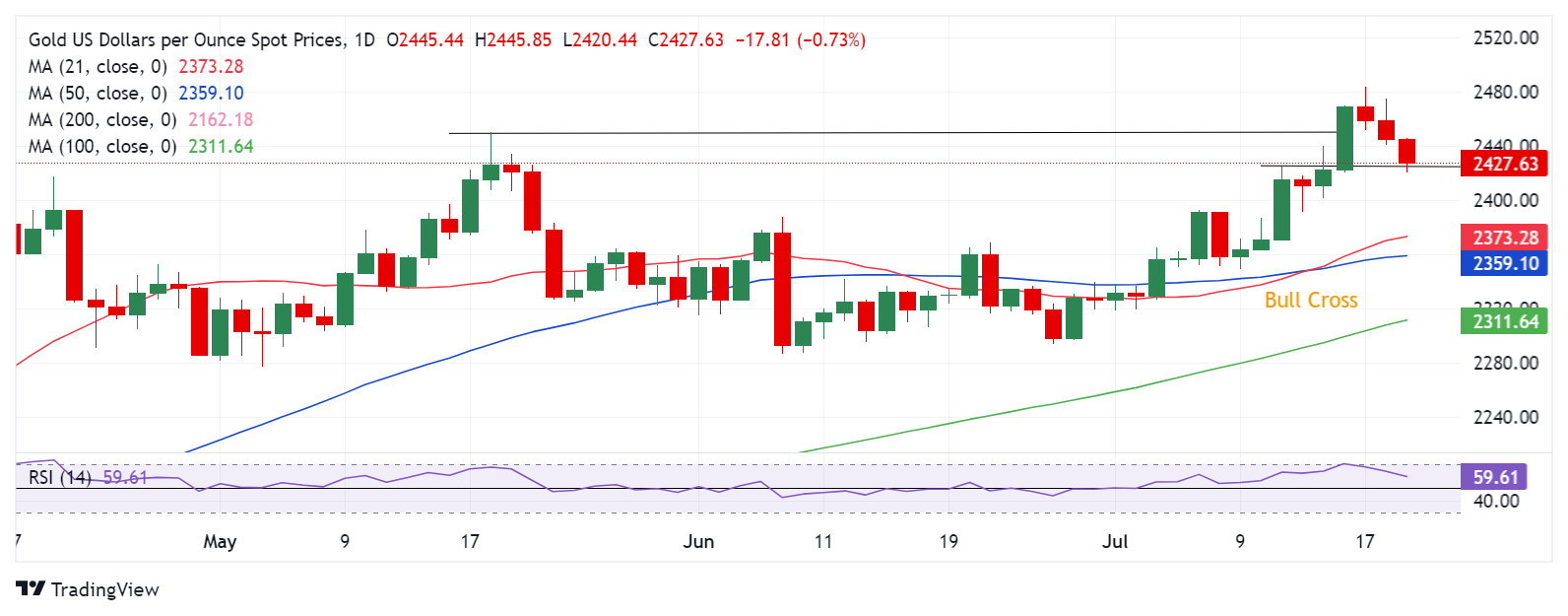
Despite the recent retracement, the bullish bias for Gold price remains intact so long as the 14-day Relative Strength Index (RSI) remains above the 50 level. The indicator is currently at 60.
The previous week’s 21-day and 50-day Simple Moving Averages (SMA) Bull Cross also continues to lean in favor of Gold buyers.
The immediate support for Gold price is seen at the previous week’s high of $2,425. A sustained move below that level could accentuate the downside toward the 21-day SMA at $2,373.
Ahead of that, the $2,400 mark could come into play.
On the flip side, if Gold price resumes its uptrend, the previous lifetime high at $2,450 will be put to the test, above which the new all-time high of $2,484 will be challenged en route the $2,500 barrier.
Gold FAQs
Gold has played a key role in human’s history as it has been widely used as a store of value and medium of exchange. Currently, apart from its shine and usage for jewelry, the precious metal is widely seen as a safe-haven asset, meaning that it is considered a good investment during turbulent times. Gold is also widely seen as a hedge against inflation and against depreciating currencies as it doesn’t rely on any specific issuer or government.
Central banks are the biggest Gold holders. In their aim to support their currencies in turbulent times, central banks tend to diversify their reserves and buy Gold to improve the perceived strength of the economy and the currency. High Gold reserves can be a source of trust for a country’s solvency. Central banks added 1,136 tonnes of Gold worth around $70 billion to their reserves in 2022, according to data from the World Gold Council. This is the highest yearly purchase since records began. Central banks from emerging economies such as China, India and Turkey are quickly increasing their Gold reserves.
Gold has an inverse correlation with the US Dollar and US Treasuries, which are both major reserve and safe-haven assets. When the Dollar depreciates, Gold tends to rise, enabling investors and central banks to diversify their assets in turbulent times. Gold is also inversely correlated with risk assets. A rally in the stock market tends to weaken Gold price, while sell-offs in riskier markets tend to favor the precious metal.
The price can move due to a wide range of factors. Geopolitical instability or fears of a deep recession can quickly make Gold price escalate due to its safe-haven status. As a yield-less asset, Gold tends to rise with lower interest rates, while higher cost of money usually weighs down on the yellow metal. Still, most moves depend on how the US Dollar (USD) behaves as the asset is priced in dollars (XAU/USD). A strong Dollar tends to keep the price of Gold controlled, whereas a weaker Dollar is likely to push Gold prices up.
Author

Dhwani Mehta
FXStreet
Residing in Mumbai (India), Dhwani is a Senior Analyst and Manager of the Asian session at FXStreet. She has over 10 years of experience in analyzing and covering the global financial markets, with specialization in Forex and commodities markets.