Gold Price Forecast: XAU/USD approaches $2,300 amid broad USD weakness

XAU/USD Current price: $2,290.28
- The US ISM Services PMI resulted at 51.4 in March, easing from 52.6 in the previous month.
- The ADP survey showed the private sector added 184K new positions in March.
- XAU/USD keeps posting record highs, extreme overbought conditions hint at a bearish correction.
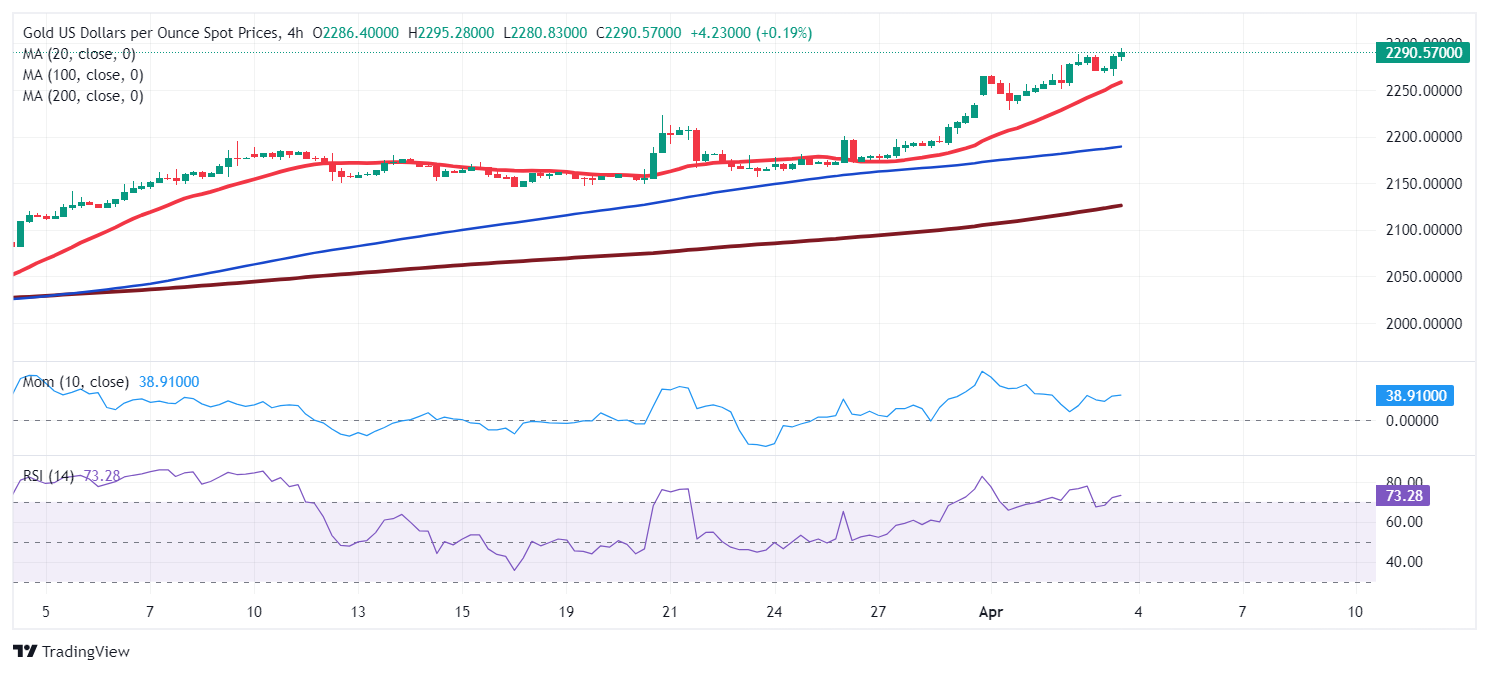
Gold's unstoppable rally continues on Wednesday, with the bright metal reaching a fresh record high just ahead of $2,300 a troy ounce. The US Dollar came under strong selling pressure following the release of the United States (US) ISM Services Purchasing Managers Index (PMI), which showed economic activity in the sector expanded in March for the 15th consecutive month, although at a slower-than-anticipated pace. The index printed 51.4, declining from 52.6 in February. The official report attributes the decrease in the rate of growth to "slower new orders growth, faster supplier deliveries and a contraction in employment."
Furthermore, Federal Reserve (Fed) Chairman Jerome Powell spoke at the Stanford Graduate School of Business and repeated that the central bank is not in a rush to cut interest rates. His comments had a limited impact on the USD but maintained it on the losing side. Earlier in the day, the country published the ADP survey on private job creation, showing the economy added 184K new positions in March, surpassing expectations of 148K. Additionally, February's reading was upwardly revised from 140K to 155K. As a result, Wall Street trades with a better tone weighing on USD demand.
XAU/USD short-term technical outlook
XAU/USD traded as high as $2,295.10 and maintains a firmly bullish tone despite being extremely overbought. The pair is up for a seventh consecutive day, and technical readings in the daily chart give little signs of upward exhaustion. Technical indicators are losing their upward strength, although the Relative Strength Index (RSI) indicator stands at 82. The Momentum indicator, however, has lost its bullish strength and consolidates well above its 100 level. Finally, moving averages maintain their firmly bullish slopes far below the current level, with the 20 Simple Moving Average (SMA) currently at around $2,188.50.
The 4-hour chart maintains the risk skewed to the upside. XAU/USD develops above a firmly bullish 20 SMA, providing support at around $2,261.30 while advancing beyond the longer ones. At the same time, technical indicators remain well above their midlines, barely losing their upward strength.
Support levels: 2,277.60 2,261.30 2,250.70
Resistance levels: 2,295.10 2,320.00 2,335.00
Author

Valeria Bednarik
FXStreet
Valeria Bednarik was born and lives in Buenos Aires, Argentina. Her passion for math and numbers pushed her into studying economics in her younger years.
















