Gold Price Forecast: Downside appears more compelling for XAU/USD
- Gold price hits a fresh weekly low near $2,310 early Wednesday, extending previous losses.
- The US Dollar holds gains amid firmer Treasury bond yields, hawkish Fed commentary and a risk-off mood.
- The downside appears more compelling for Gold price on triangle failure and bearish daily RSI.

Gold price is building on Tuesday’s decline, hitting a fresh weekly low near $2,310 in Asian trading on Wednesday. The sustained US Dollar (USD) strength alongside firmer US Treasury bond yields fuels additional downside in Gold price, as traders brace for a data-light US economic calendar later on Wednesday.
Gold price falls further, as US Dollar regains poise
The Greenback followed the US Treasury bond yields higher in the second half of Tuesday’s trading, in the face of US Federal Reserve (Fed) Governor Michelle Bowman’s hawkish comments.
In prepared remarks for a speech in London on Tuesday, Bowman said that “Should the incoming data indicate that inflation is moving sustainably toward our 2 percent goal, it will eventually become appropriate to gradually lower the federal funds rate to prevent monetary policy from becoming overly restrictive.” “However, we are still not yet at the point where it is appropriate to lower the policy rate," she was quick to add.
Meanwhile, Governor Lisa Cook argued that the timing of the rate cut is unclear even though “Inflation has slowed, and the labor market tightness has eased.”
The hawkish Fed commentary weighed negatively on the non-interest-bearing Gold price. Markets continued pricing in about a 68% chance of a Fed rate cut in September, according to CME FedWatch Tool.
In Wednesday’s session so far, Gold price is consolidating in weekly troughs, awaiting a fresh batch of top-tier US economic data on Thursday, including the final Gross Domestic Product (GDP) and Durable Goods Order ahead of Friday’s all-important PCE inflation data.
In the meantime, Gold traders will take cues from the mid-tier US housing data due this Wednesday, as sentiment around the Fed rate-cut expectations will continue to drive the Gold price action. Additionally, the half-year-end flows could remain in play, significantly affecting the value of the US Dollar and the Gold price.
Investors’ anxiety ahead of Sunday’s French election and next week’s UK general election could also keep the haven demand for the US Dollar underpinned, leaving Gold price vulnerable.
Gold price technical analysis: Daily chart
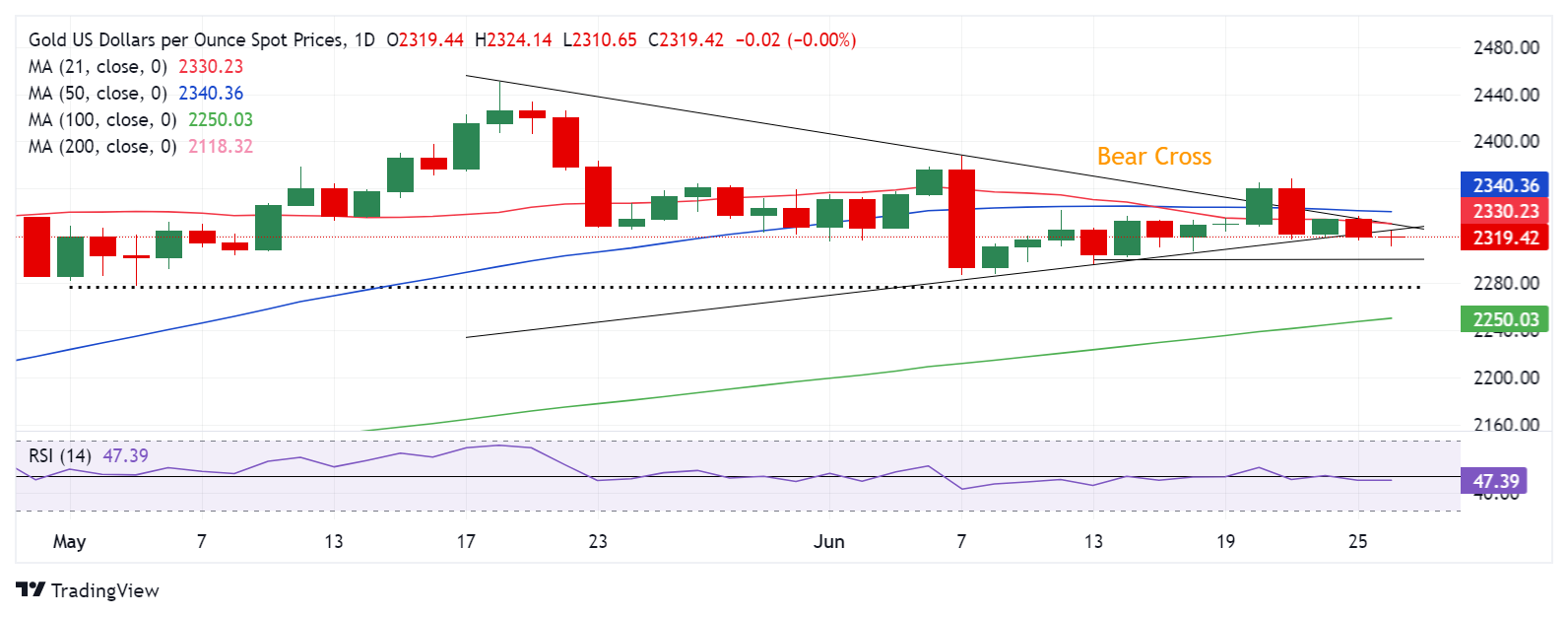
Gold price witnessed the symmetrical triangle pattern failure on Tuesday after it closed below the triangle support, then at $2,320.
The 14-day Relative Strength Index (RSI) maintains its position below the 50 level, justifying the bearish momentum in Gold price.
Also, the 21-day Simple Moving Average (SMA) and the 50-day SMA bearish crossover continues to act as a headwind.
If sellers gather strength, the initial demand area is seen at the $2,300 threshold.
Acceptance below the latter will put the May 3 low at $2,277 back in the spotlight.
On the other hand, Gold price needs to recapture the 21-day SMA at $2,320 on a daily closing basis to revive the recovery from the monthly low of $2,287.
Further up, the two-week high of $2,366 will be challenged, as buyers aim for the June 7 high of $2,388.
Gold FAQs
Gold has played a key role in human’s history as it has been widely used as a store of value and medium of exchange. Currently, apart from its shine and usage for jewelry, the precious metal is widely seen as a safe-haven asset, meaning that it is considered a good investment during turbulent times. Gold is also widely seen as a hedge against inflation and against depreciating currencies as it doesn’t rely on any specific issuer or government.
Central banks are the biggest Gold holders. In their aim to support their currencies in turbulent times, central banks tend to diversify their reserves and buy Gold to improve the perceived strength of the economy and the currency. High Gold reserves can be a source of trust for a country’s solvency. Central banks added 1,136 tonnes of Gold worth around $70 billion to their reserves in 2022, according to data from the World Gold Council. This is the highest yearly purchase since records began. Central banks from emerging economies such as China, India and Turkey are quickly increasing their Gold reserves.
Gold has an inverse correlation with the US Dollar and US Treasuries, which are both major reserve and safe-haven assets. When the Dollar depreciates, Gold tends to rise, enabling investors and central banks to diversify their assets in turbulent times. Gold is also inversely correlated with risk assets. A rally in the stock market tends to weaken Gold price, while sell-offs in riskier markets tend to favor the precious metal.
The price can move due to a wide range of factors. Geopolitical instability or fears of a deep recession can quickly make Gold price escalate due to its safe-haven status. As a yield-less asset, Gold tends to rise with lower interest rates, while higher cost of money usually weighs down on the yellow metal. Still, most moves depend on how the US Dollar (USD) behaves as the asset is priced in dollars (XAU/USD). A strong Dollar tends to keep the price of Gold controlled, whereas a weaker Dollar is likely to push Gold prices up.
Premium
You have reached your limit of 3 free articles for this month.
Start your subscription and get access to all our original articles.
Author
Dhwani Mehta
FXStreet
Residing in Mumbai (India), Dhwani is a Senior Analyst and Manager of the Asian session at FXStreet. She has over 10 years of experience in analyzing and covering the global financial markets, with specialization in Forex and commodities markets.