Gold Price Forecast: Bulls have the upper hand above $1,750 level
- Gold gained strong positive traction on Wednesday following the release of the US CPI report.
- Signs that inflation has peaked eased fears about an early Fed taper and extended support.
- A sustained move beyond the $1,760 is needed to support prospects for additional gains.

Gold recorded its biggest one-day percentage gain since May 6 on Wednesday and moved further away from the early week flash crash to the lowest level since March. Worries about the economic fallout from the fast-spreading Delta variant of the coronavirus extended some support to the safe-haven precious metal through the first half of the trading action. The intraday buying picked up pace following the release of US consumer inflation figures, which moderated a bit in July and eased fears about an early withdrawal of the stimulus by the Fed.
The headline CPI climbed 0.5% in July and the yeat rate remained at a 20-year high level of 5.4% for the second straight month. However, the closely watched measure of inflation that excludes volatile food and energy price – core CPI – fell short of market expectations and rose 0.3%. As a result, the yearly rate decelerated to 4.3% from 4.5%, which was a 29-year high. The US dollar and the US Treasury bond yields both retreated after the underwhelming US inflation data, which, in turn, pushed the dollar-denominated commodity back above the $1,750 level.
That said, comments by Kansas City Fed President Esther George, saying that the time had come to end the central bank’s bond-buying program, helped limit the USD profit-taking slide. George noted that the standard for reducing the bond-buying program may have already been met by the current spike in inflation, recent labour market improvements and the expectation for continued strong demand. Adding to this, Dallas Fed President Rob Kaplan said that he will press his colleagues to announce a plan to taper bond purchases at the next meeting in late September.
This, to a larger extent, helped offset Richmond Fed President Thomas Barkin's earlier remarks, saying that it may take a few months more for the US job market to recover enough for the Fed to reduce its crisis-era support for the economy. Nevertheless, the XAU/USD finally settled near the top end of its daily trading range and held steady through the Asian session on Thursday. As investors continue to assess the likely timing for policy tightening by the Fed, the commodity might wait for a fresh catalyst before the next leg of a directional move.
In the meantime, traders might take cues from the US economic docket – featuring the release of Producer Price Index (PPI) and the usual Initial Weekly Jobless Claims. Apart from this, the US bond yields might influence the USD price dynamics and provide some impetus to the non-yielding yellow metal. This, along with the broader market risk sentiment, will also be looked upon for some meaningful trading opportunities.
Short-term technical outlook
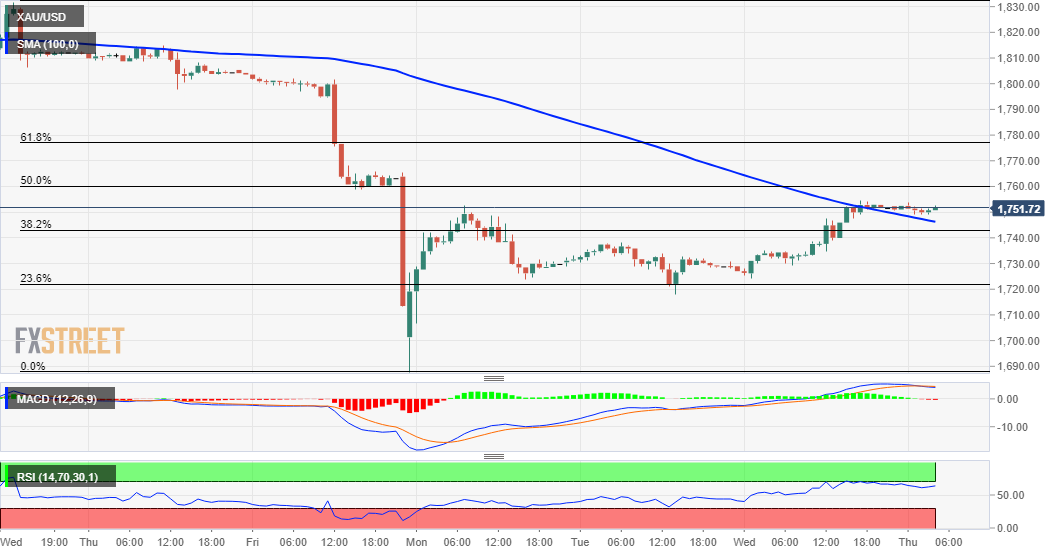
From a technical perspective, the overnight move back above 100-hour SMA might have set the stage for additional gains. However, any subsequent positive move is likely to confront stiff resistance near the $1,760 region, marking the 50% Fibonacci level of the $1,832-$1,688 downfall. Some follow-through buying beyond the $1,765 area will be seen as a fresh trigger for bullish traders and lift the commodity further towards the 61.8% Fibo. level, around the $1,777 area. A sustained move beyond should allow bulls to aim back to reclaim the $1,800 round-figure mark.
On the flip side, the $1,745-43 confluence region – comprising of 100-hour SMA and 38.2% Fibo. level – now seems to protect the immediate downside. Failure to defend the mentioned support might prompt some technical selling and drag the metal further towards the $1,725 zone en-route the 23.6% Fibo. level, around the $1,720 level. A convincing break below will negate any near-term positive bias and turn the XAU/USD vulnerable to slide back below the $1,700 mark, towards retesting multi-month lows support, around the $1,688 region.
Author

Haresh Menghani
FXStreet
Haresh Menghani is a detail-oriented professional with 10+ years of extensive experience in analysing the global financial markets.