Nio Stock Forecast: NIO rises to second day of gains on delivery data, positive China vibes
- Nio stock rose 6.1% on Thursday following Wednesday's double-digit rally.
- Chinese EV maker sees 135% gain in YoY April deliveries.
- BYD, other Chinese EV stocks also make gains.
- Nio is delivering its 2024 ET7 this week to buyers.


Nio (NIO) stock traded up 6.1% into the close on Thursday in its second straight day of gains. The Chinese electric vehicle (EV) manufacturer is still benefiting from better than expected delivery figures posted on Wednesday and overall improving sentiment toward China.
Unrelated to the EV sector, Alibaba (BABA) stock gained 7% on Thursday, while US indices like the S&P 500 and NASDAQ gained 0.9% and 1.5%, respectively.
Nio stock news
Nio posted April delivery figures on Wednesday that amounted to a 135% jump from a year ago. The 15,620 vehicles delivered by the Shanghai-based company were made up of 8,817 electric SUVs and 6,803 electric sedans.
Those figures led to Nio stock’s 11.7% surge on Wednesday, but Thursday also sees plenty of bulls stepping in. Nio has delivered 45,673 vehicles year-to-date, which is a 21.2% gain YoY, so the good results cannot be confined to April.
Nio began delivering the 2024 ET7 premium sedan on Tuesday, so maybe growth seen at the start of the year continues for the company. The Shanghai firm has also signed a new deal with Lotus Technology that involves advanced battery technology.
The Chinese EV sector is benefitting broadly from the new delivery figures. BYD (BYDDY), the long-time investment of Berkshire Hathaway, saw deliveries rise YoY. That is significant since BYD is currently the leading seller of hybrid electric vehicles. Fully electric XPeng (XPEV) and Li Auto (LI) saw stock rallies of their own.
Xiaomi’s major foray into EVs is also apparently bearing fruit as its upstart EV unit now has 88,000 non-refundable orders.
Tesla (TSLA) seems to have gotten the party started this week by receiving approval for its Full Self-Driving software in China following Elon Musk's visit with a major political official. Additionally, Tesla signed a partnership with Baidu (BIDU) concerning data collection in the country.
EV stocks FAQs
Electric vehicles or EVs are automobiles that use rechargable batteries and electric motors to accelerate rather than internal combustion engines (ICEs). They have been around for more that 100 years, but battery technology research & development was meager for much of the 20th century. Lithium-ion battery technology became advanced enough to produce EVs at scale in the late 1990s and 2000s, and sales have been steadily increasing since then Tesla’s Roadster was unveiled in 2008. EVs are viewed as a means of reducing carbon emissions since battery electric vehicles (BEVs) themselves produce zero emissions. Other vehicles called plug-in hybrid electric vehicles (PHEVs) utilize both battery electric power and ICEs as a backup.
EVs are growing from a small base, but they rose from 9% of global new auto sales in 2021 to 14% of the total in 2022. This was a 65% YoY growth rate, and the industry delivered 10.2 million EVs worldwide in 2022. Projections show this number climbing above 16 million in 2023. Across the world, market shares differ greatly among nations. Nearly 88% of Norwegian new car sales in 2022 were EVs. On the other hand, the United States, where much of the modern innovation in EVs was forged, had less than 8% of new vehicle sales go to EVs in 2022. The largest EV market in the world, China, saw 30% of the market go to EVs that year.
We know you’re thinking Elon Musk, but he’s probably more like the father of the mass-market, contemporary EV. All the way back in 1827, a Hungarian priest named Anyos Jedlik invented the electric motor and used it the following year to power a vehicle of sorts. French scientist Gaston Planté invented the lead-acid battery in 1859, and German engineer Andreas Flocken built the first true electric car for the public in 1888. EVs made up about 38% of all vehicles sold in the US around 1900. They began losing market share rapidly after 1910 when gasoline-powered vehicles grew much more affordable. They largely died off until new research programs in the 1990s led to gradual private sector investment in the 2000s.
China’s BYD is by far the largest manufacturer of EVs in the world. In 2022 it sold 1.8 million EVs and in the second half of the year made up 20% of the global market. The asterisk given to BYD is that the vast majority of these vehicles are hybrids. Tesla’s 12% market share is often treated as more significant than BYD, because it only sells BEVs and is the most famous EV brand in the world. Volkswagen, BMW and Wuling then round out the top five. As a new sector with heavy investment though, many startups have flooded the market. These include China’s Nio, Li Auto and Xpeng; a Swedish-Chinese manufacturer called Polestar; and Lucid and Rivian from the US.
Nio stock forecast
Nio stock is showing encouraging signs of a rally in motion. Thursday's gain closed near the intraday high of $5.67. Likewise, the 9-day Exponential Moving Average (EMA) has overpowered its 21-day counterpart, and the 9-day looks poised to do the same to the 50-day EMA in short order. These kind of bullish crossovers are normally key for longer rallies to gain legs.
NIO stock needs to remain above the support level of $5.30 that draws its significance from February and March of this year. The next bet is a retest of the $7.00 to $7.30 range that held support in October through December of last year and that bulls will endeavor to turn back into support.
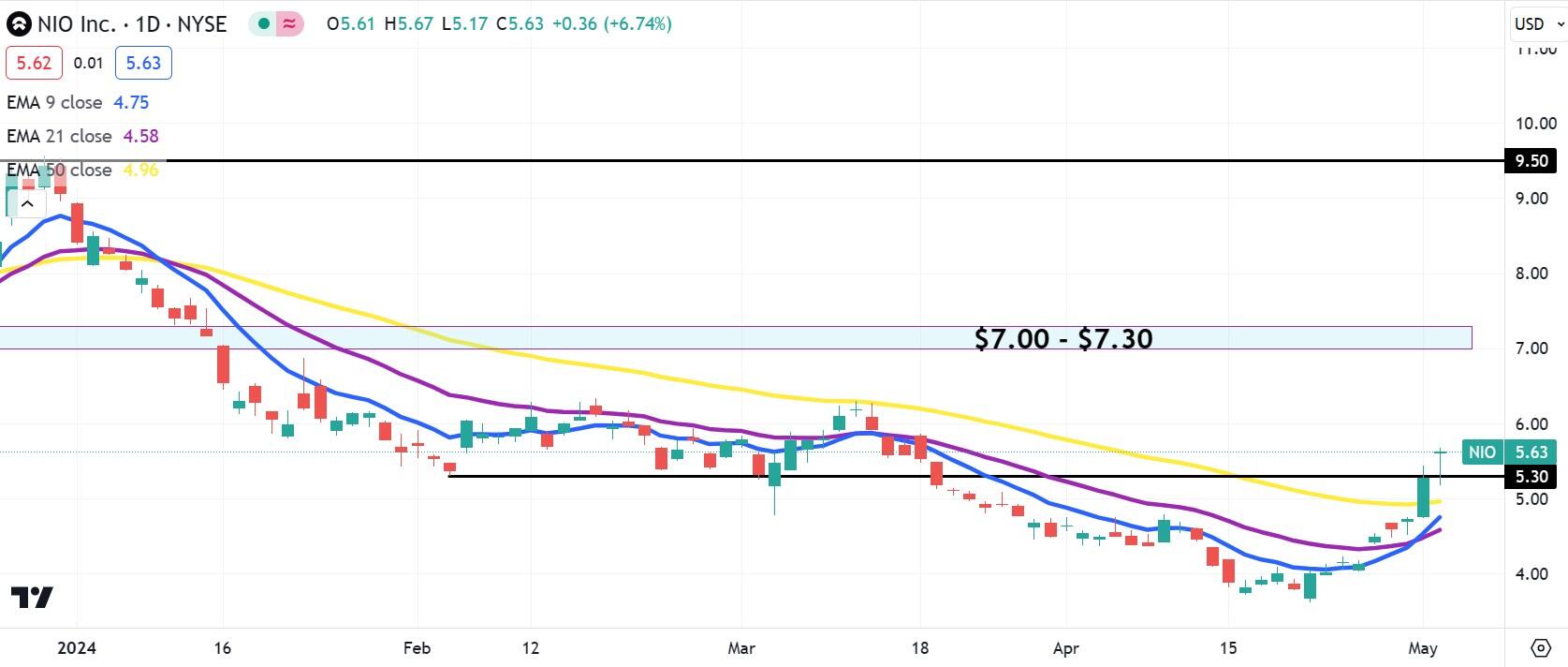
NIO daily stock chart
Premium
You have reached your limit of 3 free articles for this month.
Start your subscription and get access to all our original articles.
Author
Clay Webster
FXStreet
Clay Webster grew up in the US outside Buffalo, New York and Lancaster, Pennsylvania. He began investing after college following the 2008 financial crisis.