GBP/USD Price Forecast: Bears likely to target 1.2350 area; focus remains on FOMC Minutes
- GBP/USD drifts lower for the second straight day amid some follow-through USD buying.
- The Fed’s hawkish stance and elevated US bond yields continue to underpin the Greenback.
- The cautious market mood also benefits the safe-haven buck ahead of the FOMC Minutes.

The GBP/USD pair attracted some sellers for the second successive day on Wednesday and moved away from a one-week high, around the 1.2575 area touched the previous day. The downtick is sponsored by the emergence of some follow-through US Dollar (USD) buying, which now seems to have reversed a major part of its weekly losses registered on Monday amid the Federal Reserve's (Fed) hawkish shift.
In fact, the US central bank projected only two quarter-point rate cuts in 2025 amid still elevated inflation in the world's largest economy. Furthermore, US President-elect Donald Trump's policies are expected to stoke further inflation and force the Fed to slow the pace of rate cuts this year. The outlook was reinforced by Tuesday's upbeat US macro data, which pointed to a still resilient US economy. The Institute for Supply Management reported that its Non-Manufacturing Purchasing Managers' Index (PMI) rose to 54.1 in December and the Prices Paid component rose to a nearly two-year high. Separately, the Job Openings and Labor Turnover Survey, or JOLTS report, showed that job openings unexpectedly increased to 8.098 million by the last day of November from the 7.839 million previous.
The data prompted investors to bet the Federal Reserve will lower interest rates just once this year, which lifts the yield on the benchmark 10-year US government bond to its highest level since April 2024. Apart from this, persistent geopolitical risks stemming from the protracted Russia-Ukraine war and tension in the Middle East, along with trade war fears, lend additional support to the safe-haven Greenback. Furthermore, the sentiment surrounding the British Pound (GBP) remains weak amid a recent series of weak UK macro data and doubts about the newly elected Labour government’s fiscal strategy. Adding to this, the Bank of England's (BoE) relatively dovish stance and a split vote decision to leave interest rates unchanged in December weighs on the GBP and the GBP/USD pair.
The USD bulls, however, seem reluctant and opt to move to the sidelines ahead of the FOMC meeting Minutes, due for release later during the US session, which, in turn, could limit the downside for the currency pair. In the meantime, Wednesday's US economic docket – featuring the US ADP report on private-sector employment and the usual Weekly Initial Jobless Claims data – will be looked upon for short-term trading opportunities around the GBP/USD pair.
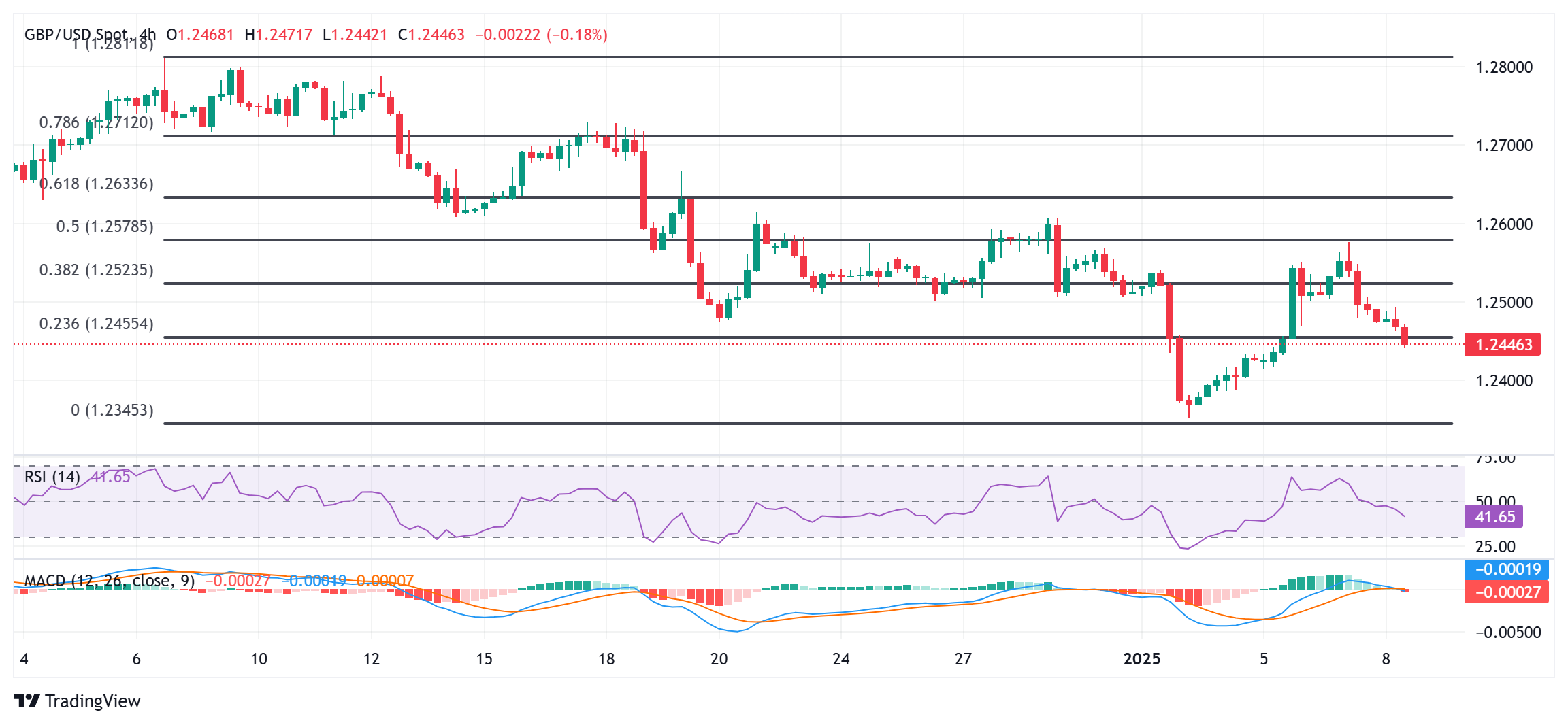
GBP/USD 4-hour chart
Technical Outlook
From a technical perspective, the emergence of fresh selling near the 50% Fibonacci retracement level of the December-January fall and the subsequent slide favors bearish traders. Moreover, oscillators on the daily chart – though they have been recovering – are still holding in negative territory, suggesting that the path of least resistance for the GBP/USD pair is to the downside. Hence, some follow-through weakness towards the 1.2400 mark, en route to the December swing low, around the 1.2350 area, looks like a distinct possibility.
On the flip side, the 1.2500 psychological mark, closely followed by the 1.2520-1.2525 region (38.2% Fibo. level) could act as immediate hurdles ahead of the 1.2575 area, or the weekly top, and the 1.2600 round figure. A sustained strength beyond the latter might shift the near-term bias in favor of bullish traders and lift the GBP/USD pair further towards the 1.2660 intermediate resistance en route to the 1.2700 mark.
Author

Haresh Menghani
FXStreet
Haresh Menghani is a detail-oriented professional with 10+ years of extensive experience in analysing the global financial markets.