GBP/USD Forecast: Sterling set to fall off the blue wave as covid ravages Britain
- GBP/USD has advanced as the US Democratic lead weighs on the dollar.
- Surging UK coronavirus cases and a slow vaccination campaign may send sterling down.
- Wednesday's four-hour chart is pointing to losses.

Georgia is on markets' minds – but the blue wave may wash away for sterling. The safe-haven dollar US dollar is on the back foot as investors cheer the prospects of Democrats controlling the US Senate.
Dem candidate Raphael Warnock won his race against GOP incumbent Kelly Loeffler. Her fellow Republican Senator is trailing Jon Ossof by around 0.3%, but the remaining votes are from Democratic-leaning counties. That would lead to a 50-50 tie in the Senate, which Vice-President-elect Kamala Harris would break. The prospects of a multi-trillion stimulus package mean the money would flow to the US and global economies and there is less need for safety – the US dollar.
See Georgia Elections Analysis: Markets to surf higher on imminent blue wave, USD to chop around
On the other hand, the situation in Britain is dire. COVID-19 hospitalizations have topped the peak seen in the spring and one out of every 50 people in England has had coronavirus recently. The worrying statistics come as the UK entered a severe lockdown – and markets find the recent injection by the Treasury as insufficient.
Moreover, vaccine distribution is advancing at a snail's pace. While Britain is ahead of European countries, it vaccinated only around 1.5% of its population and is unlikely to ramp up distribution in the next two weeks.
Estimates of an ongoing slow pace come despite the deployment of the University of Oxford/AstraZeneca jab – which benefits from mass production in Britain and requires only normal storage temperatures. The government aims to vaccinate 13 million people by mid-February and at the time of writing, only 1.3 million have received the first jab.
Unless covid cases fall and vaccinations accelerate, sterling may struggle to hold onto gains.
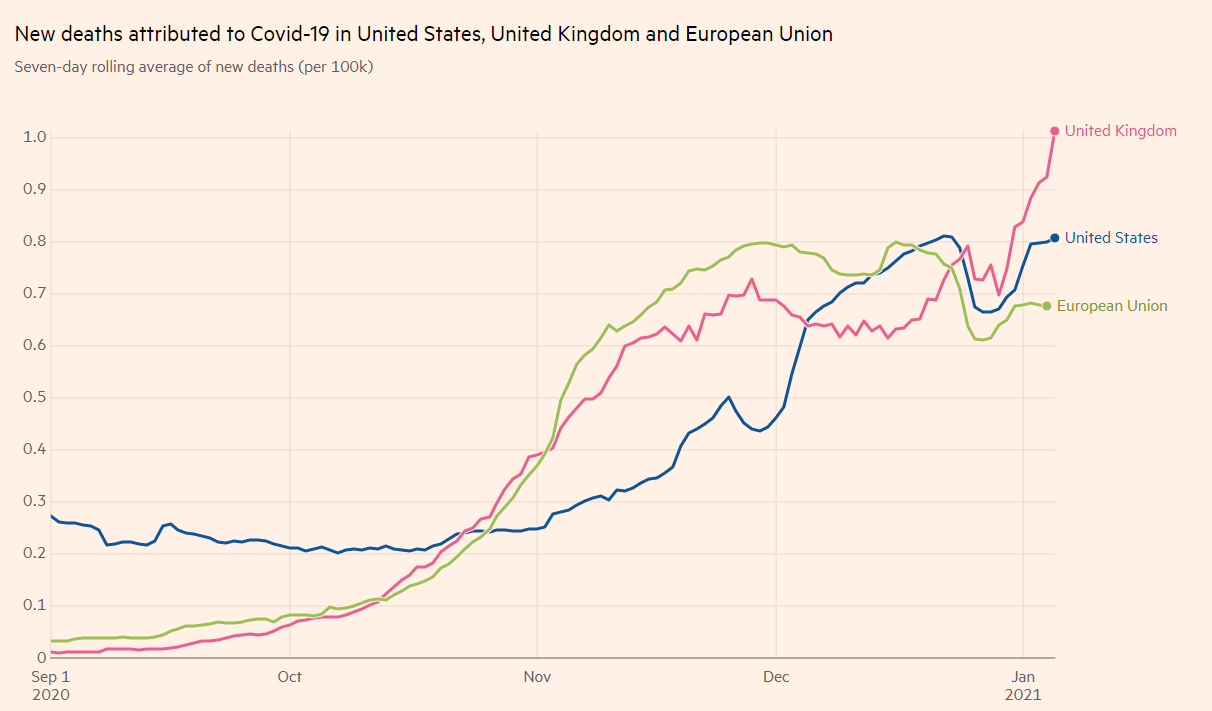
Source: FT
Another worrying development is that government officials cast doubt that the vaccines can beat the South African strain of the virus. Contrary to the British variant which probably succumbs to vaccines, the newer version is more complex. If these worries prove correct, it would be worrying for the entire world, potentially boosting the safe-haven dollar. Further data is awaited.
Apart from virus US political developments, the Federal Reserve's meeting minutes from December are awaited. The document may provide clues to future policy, especially additional bond-buying. The Fed could expand its scheme if the government introduces further stimulus.
ADP's employment report for December serves as a hint toward Friday's official Nonfarm Payrolls publication. While these reports have diverged in recent months, any print – and especially a negative one – could move markets.
All in all, cable's rise may hit roadblocks.
GBP/USD Technical Analysis
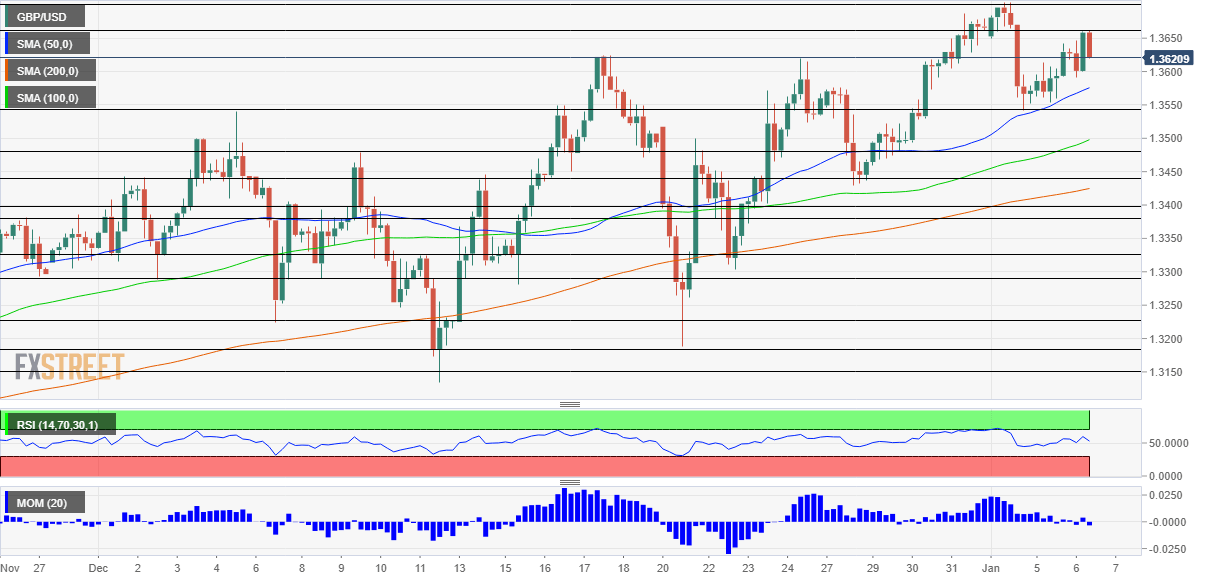
Momentum on the four-hour chart has flipped back to the downside, taking some of the air out the bullish picture. Pound/dollar continues trading above the 50, 100 and 200 Simple Moving Averages and the Relative Strength Index is balanced.
Some resistance awaits at 1.3660, the daily high, followed by 1.3705, the 2021 peak. The next levels to watch are 1.3730 and 1.3810.
Support is at 1.3545, the 2021 low. It is followed by 1.3480 and 1.3445.
More GBP/USD Price Forecast 2021: Cable braces for calendar comeback amid three exits
Author

Yohay Elam
FXStreet
Yohay is in Forex since 2008 when he founded Forex Crunch, a blog crafted in his free time that turned into a fully-fledged currency website later sold to Finixio.
















