GBP/USD Forecast: Pound Sterling recovery on the line, markets await BoE and Fed
- GBP/USD trades in positive territory above 1.2900 following Wednesday's sharp decline.
- The BoE and the Fed will announce policy decisions on Thursday.
- The pair trades in between key technical levels.

GBP/USD lost over 1% on Wednesday and registered its lowest daily-close since mid-August. The pair corrects higher toward 1.2950 in the European morning on Thursday as investors prepare for the Bank of England's (BoE) and the Federal Reserve's (Fed) monetary policy decisions.
British Pound PRICE This week
The table below shows the percentage change of British Pound (GBP) against listed major currencies this week. British Pound was the weakest against the Australian Dollar.
| USD | EUR | GBP | JPY | CAD | AUD | NZD | CHF | |
|---|---|---|---|---|---|---|---|---|
| USD | 0.63% | -0.03% | 1.25% | -0.33% | -1.14% | -0.25% | 1.03% | |
| EUR | -0.63% | -0.71% | 0.18% | -1.36% | -1.46% | -1.28% | -0.01% | |
| GBP | 0.03% | 0.71% | 0.64% | -0.66% | -0.76% | -0.57% | 0.68% | |
| JPY | -1.25% | -0.18% | -0.64% | -1.56% | -1.81% | -1.27% | 0.07% | |
| CAD | 0.33% | 1.36% | 0.66% | 1.56% | -0.60% | 0.07% | 1.34% | |
| AUD | 1.14% | 1.46% | 0.76% | 1.81% | 0.60% | 0.19% | 1.45% | |
| NZD | 0.25% | 1.28% | 0.57% | 1.27% | -0.07% | -0.19% | 1.26% | |
| CHF | -1.03% | 0.00% | -0.68% | -0.07% | -1.34% | -1.45% | -1.26% |
The heat map shows percentage changes of major currencies against each other. The base currency is picked from the left column, while the quote currency is picked from the top row. For example, if you pick the British Pound from the left column and move along the horizontal line to the US Dollar, the percentage change displayed in the box will represent GBP (base)/USD (quote).
The unabated US Dollar (USD) strength weighed heavily on GBP/USD on Wednesday as markets reacted to Donald Trump's victory in the US presidential election. The benchmark 10-year US Treasury bond yield rose nearly 4% and the USD Index, which gauges the USD's valuation against a basket of six major currencies, registered its largest one-day gain, rising over 1.5%.
The BoE is forecast to cut the bank rate by 25 basis points (bps) to 4.75%. Markets expect two policymakers to vote for a no-change. In case more policymakers vote in favor of keeping the policy rate steady, the immediate reaction could boost the Pound Sterling and help GBP/USD extend its recovery. On the flip side, a rate cut decision with a unanimous vote could cause GBP/USD to turn south.
Following Trump's victory, Ahmet Kaya, principal economist at the UK's National Institute of Economic and Social Research (NIESR), voiced his concerns over the proposed tariff policies. "Relative stability is under serious threat by the potential raising of import tariffs in the United States," Kaya said during a presentation of NIESR's latest forecasts. If BoE Governor Andrew Bailey comments on threats to the UK growth outlook, markets could see that as a dovish tone and make it difficult for Pound Sterling to stay resilient against its rivals.
Later in the day, the Fed is seen lowering the policy rate by 25 basis points (bps) to the range of 4.5%-4.75%. Fed Chairman Jerome Powell will surely be asked about how Trump's policies, especially in regard to tax cuts and increased tariffs, could influence monetary policy in the near future. Powell is unlikely to respond to these questions and repeat that they will stick to a data-dependent approach to policymaking.
According to the CME Group FedWatch Tool, markets are currently pricing in a nearly 70% chance of the Fed lowering the policy rate by another 25 bps in December. If Powell reaffirms that they are likely to lower the policy rate again at the last policy meeting of the year, the market positioning suggests that the USD has more room on the downside. On the other hand, the USD could regather its strength and force GBP/USD to stay on the back foot, if Powell leaves the door open for a policy hold next month.
GBP/USD Technical Analysis
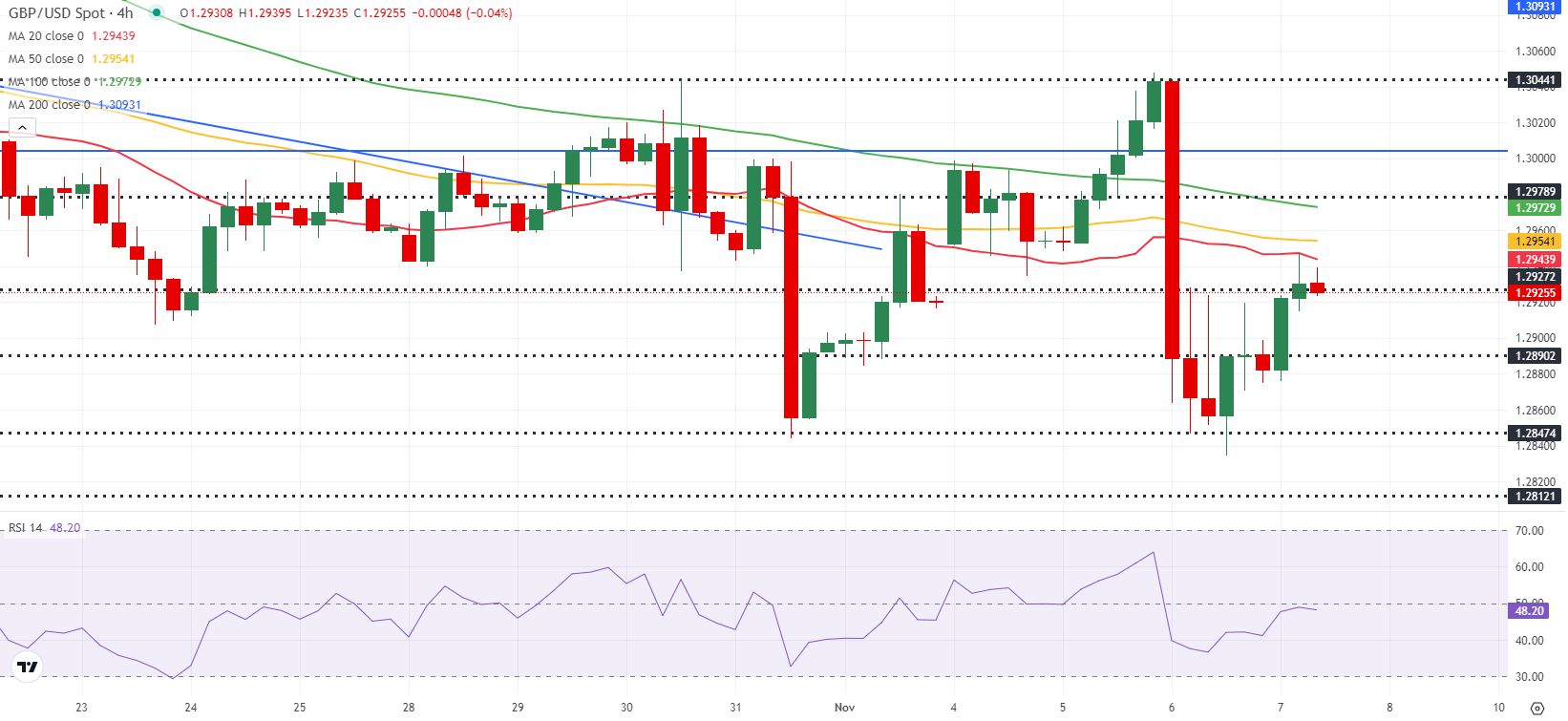
The Relative Strength Index (RSI) indicator on the 4-hour chart stays near 50, pointing to a loss of bearish momentum. Meanwhile, GBP/USD trades between the 100-day and the 200-day Simple Moving Averages (SMA), currently located at 1.3000 and 1.2820, respectively.
If GBP/USD rises above 1.3000 (100-day SMA) and starts using this level as support, it could face the next resistance at 1.3050 (static level) before 1.3100 (50-day SMA). On the downside, interim support is located at 1.2870 before 1.2820 (200-day SMA). A daily close below 1.2820 could attract technical sellers and open the door for another leg lower toward 1.2760 (static level).
BoE FAQs
The Bank of England (BoE) decides monetary policy for the United Kingdom. Its primary goal is to achieve ‘price stability’, or a steady inflation rate of 2%. Its tool for achieving this is via the adjustment of base lending rates. The BoE sets the rate at which it lends to commercial banks and banks lend to each other, determining the level of interest rates in the economy overall. This also impacts the value of the Pound Sterling (GBP).
When inflation is above the Bank of England’s target it responds by raising interest rates, making it more expensive for people and businesses to access credit. This is positive for the Pound Sterling because higher interest rates make the UK a more attractive place for global investors to park their money. When inflation falls below target, it is a sign economic growth is slowing, and the BoE will consider lowering interest rates to cheapen credit in the hope businesses will borrow to invest in growth-generating projects – a negative for the Pound Sterling.
In extreme situations, the Bank of England can enact a policy called Quantitative Easing (QE). QE is the process by which the BoE substantially increases the flow of credit in a stuck financial system. QE is a last resort policy when lowering interest rates will not achieve the necessary result. The process of QE involves the BoE printing money to buy assets – usually government or AAA-rated corporate bonds – from banks and other financial institutions. QE usually results in a weaker Pound Sterling.
Quantitative tightening (QT) is the reverse of QE, enacted when the economy is strengthening and inflation starts rising. Whilst in QE the Bank of England (BoE) purchases government and corporate bonds from financial institutions to encourage them to lend; in QT, the BoE stops buying more bonds, and stops reinvesting the principal maturing on the bonds it already holds. It is usually positive for the Pound Sterling.
Premium
You have reached your limit of 3 free articles for this month.
Start your subscription and get access to all our original articles.
Author

Eren Sengezer
FXStreet
As an economist at heart, Eren Sengezer specializes in the assessment of the short-term and long-term impacts of macroeconomic data, central bank policies and political developments on financial assets.