GBP/USD Forecast: Pound Sterling needs to clear 1.2300 to keep buyers interested
- GBP/USD edged lower after testing 1.2300 on Wednesday.
- The cautious market stance could limit the pair's upside in the near term.
- Comments from Fed officials could impact the USD's valuation in the American session.

GBP/USD rose above 1.2300 for the first time since September 22 on Wednesday but struggled to gather further bullish momentum. The negative shift seen in risk sentiment could limit the pair's upside in the near term but the US Dollar (USD) could have a hard time preserving its strength in case policymakers deliver dovish remarks.
San Francisco Federal Reserve President Mary Daly and Atlanta Federal Reserve President Raphael Bostic both argued on Tuesday that the policy was restrictive enough to bring inflation back to the 2% target. Bostic said that there was no need for one more rate hike and Daly noted that the recent increase in US yield could be seen as the equivalent of another rate increase.
Pound Sterling price this week
The table below shows the percentage change of Pound Sterling (GBP) against listed major currencies this week. Pound Sterling was the strongest against the US Dollar.
| USD | EUR | GBP | CAD | AUD | JPY | NZD | CHF | |
| USD | -0.51% | -0.64% | -0.58% | -0.94% | -0.30% | -1.05% | -0.61% | |
| EUR | 0.49% | -0.13% | -0.07% | -0.50% | 0.21% | -0.47% | -0.10% | |
| GBP | 0.60% | 0.09% | 0.03% | -0.38% | 0.30% | -0.40% | -0.01% | |
| CAD | 0.56% | 0.06% | -0.03% | -0.37% | 0.26% | -0.45% | -0.04% | |
| AUD | 0.93% | 0.47% | 0.34% | 0.40% | 0.64% | -0.06% | 0.42% | |
| JPY | 0.30% | -0.20% | -0.27% | -0.26% | -0.69% | -0.72% | -0.30% | |
| NZD | 1.03% | 0.53% | 0.40% | 0.46% | 0.06% | 0.71% | 0.40% | |
| CHF | 0.62% | 0.11% | 0.01% | 0.04% | -0.37% | 0.29% | -0.36% |
The heat map shows percentage changes of major currencies against each other. The base currency is picked from the left column, while the quote currency is picked from the top row. For example, if you pick the Euro from the left column and move along the horizontal line to the Japanese Yen, the percentage change displayed in the box will represent EUR (base)/JPY (quote).
On a hawkish note, Fed Governor Michelle Bowman said that the policy rate may need to rise further and stay restrictive for some time to return inflation to the Fed's target, citing healthy spending activity and tight labor market conditions. This last comment seems to be helping the USD hold its ground.
Meanwhile, US stock index futures were last seen trading virtually unchanged on the day, suggesting that investors remain reluctant to bet on an extended risk rally.
In the second half of the day, Atlanta Fed's Bostic and Fed Governor Christopher Waller will be delivering speeches. Bostic has made it clear that he wants the Fed to keep the policy rate steady. Hence, his remarks are unlikely to trigger a noticeable market reaction. The last time Waller spoke, he said that he needed to see more data to say that the Fed was done raising rates. In case Waller notes that there is no need for additional tightening, the USD could continue to weaken against its rivals.
The US economic docket will also feature the Producer Price Index (PPI) data for September.
GBP/USD Technical Analysis
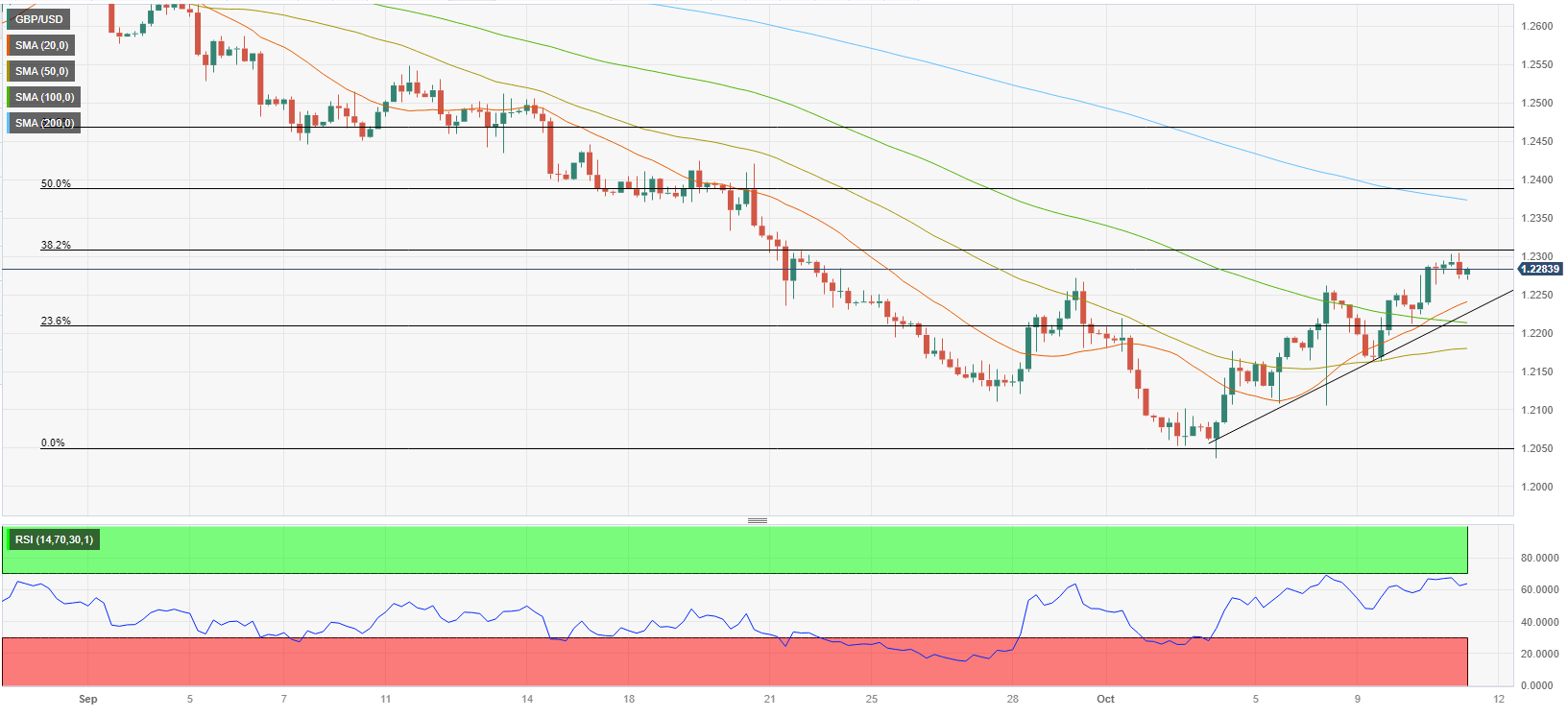
GBP/USD holds above the ascending trend line and the Relative Strength Index (RSI) indicator on the 4-hour chart stays near 60, reflecting the bullish bias. On the upside, 1.2300 (psychological level, Fibonacci 38.2% retracement of the latest downtrend) aligns as key support. If the pair manages to rise above that level and stabilize there, it could target 1.2350 (static level) and 1.2380, where the 200-period Simple Moving Average (SMA) is located.
On the downside, interim support is located at 1.2250 (20-period SMA, ascending trend line) before 1.2200 (Fibonacci 23.6% retracement, 100-period SMA) and 1.2175 (50-period SMA).
Author

Eren Sengezer
FXStreet
As an economist at heart, Eren Sengezer specializes in the assessment of the short-term and long-term impacts of macroeconomic data, central bank policies and political developments on financial assets.