GBP/USD Forecast: Deeply depressed by Brexit and Trump, but has it gone too far?
- GBP/USD has extended its downfall, amid growing uncertainty about Brexit and global trade tensions.
- Further political developments, as well as UK PMIs, will shape the pound's trading.
- The daily chart for early June shows oversold conditions on GBP/USD, implying a bounce.
- Experts are bearish in the short term but foresee considerable bounces later on.

What just happened: Political uncertainty and trade dominate
The week began with a humiliating defeat to Britain's mainstream parties which ground to those that had a clear message on the UK's exit from the EU. Nigel Farage's Brexit Party won the election, sending the ruling Conservatives to the fifth place. The pro-Remain Liberal-Democrats came in second, pushing Labour to third place.
The fragmentation of British politics has been overshadowed only by the polarization in the public that implies no compromise – it is either a hard Brexit or no Brexit at all – and the pound suffered.
Theresa May is still Prime Minister and the official leadership contest begins only on June 10th, but the contest is in full swing. Former foreign secretary Boris Johnson is still the bookies' favorite to win the race, but a fierce "anti-Boris" camp has emerged and Johnson's entry to Downing Street is not guaranteed. Former Brexit secretary Dominic Raab – a pro-Brexit member like Johnson – has launched a "clean campaign" pledge that excluded his competitor.
Members that support a softer version of Brexit have also stepped up their game. Jeremy Hunt – who replaced Johnson at the foreign office – is one of the top candidates calling for a renegotiation of the Irish backstop. However, Chief EU Negotiator Michel Barnier reiterated the bloc's fierce opposition to reopening the accord.
In the US, GDP growth met expectations but the weak inflation component triggered concerns about future growth and sent bond yields down. Treasuries were also in demand on the intensifying trade wars. China is preparing to limit exports of rare earth as the US is growing skeptical of striking a deal. President Donald Trump reopened the North American front by threatening to slap tariffs on Mexico as a punishment for allowing migrants to flow past the border – weighing on the global mood as well.
UK events: Heated Conservative Contest and PMIs eyed
The Tory leadership contest remains in the spotlight. More MPs are likely to announce they are running while others are set to offer their endorsements. If the odds of a pro-Remain member to win rise, the pound could follow with gains. Yet if a hard-Brexiteer such as Raab is seen as having higher chances, the pound may fall.
A victory for Johnson is priced in – and he may not necessarily be so hard on Brexit.
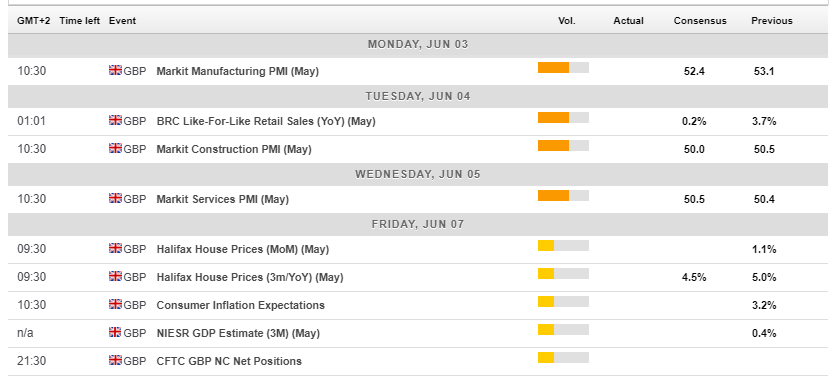
The economic calendar features the all-important purchasing managers' indexes. It will be interesting to see if growing political uncertainty has hurt confidence. Manufacturing PMI kicks off the week with an expected drop. While the sector benefits from a weaker pound, fears of a no-deal exit may weigh.
The construction sector is eyed on Tuesday with the score expected to hit 50 – the threshold separating expansion from contraction.
Services PMI is due on Thursday and it is the most significant release. The UK's largest sector is also struggling with the unknown nature of Brexit but is expected to remain above 50 points in May.
Here are the events lined up in the UK on the forex calendar:
US events: Trade tensions a buildup to the NFP
Trade will likely remain center stage in the upcoming week. China's counter-measures against US tariffs kick in and the US may respond – perhaps via tweets from Trump. Relations between the US and Mexico will also be eyed after the latest dispute. The world is watching for clues and the US dollar is set to respond.
Nevertheless, the data will also have its say. The first week of the month features top-tier events culminating with Friday's jobs report.
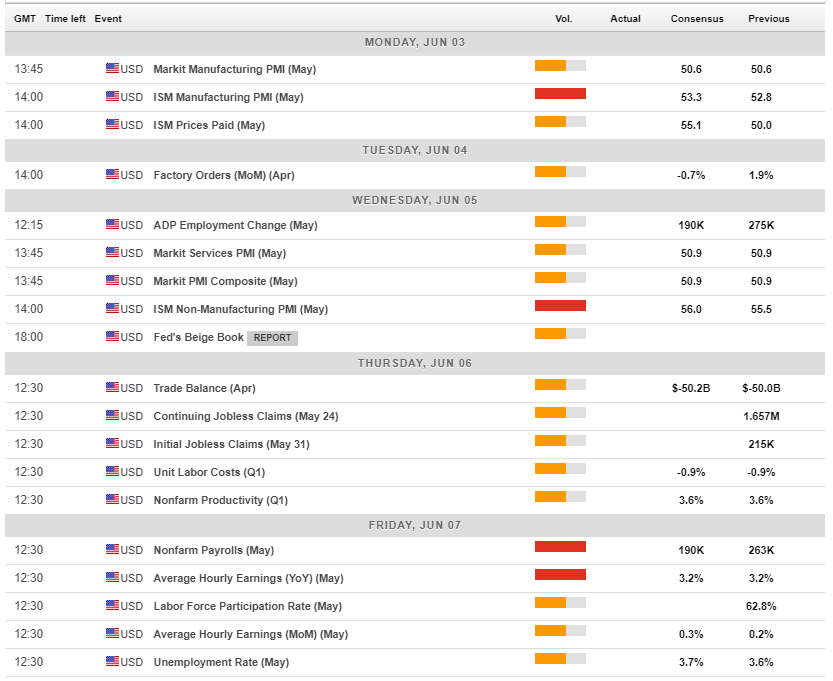
The ISM Manufacturing PMI for May kicks off the week. While economists' projections stand at a similar figure to April's number, the escalation in US-Sino tensions may have taken its toll.
Wednesday features two considerable hints for the NFP. The ADP Non-Farm Payrolls will provide an insight into private hiring. After a hefty increase of 275K positions in April, a return to the averages is due now. The ISM Non-Manufacturing PMI will provide an updated picture of the services sector which is projected to reflect healthy growth – but may fall on trade concerns.
And finally, Friday's Non-Farm Payrolls report for May is set to unleash volatility. The official government numbers carry the same expectations as ADP's: an increase of around 190K jobs. Wages are forecast to rise by 0.3% on a monthly basis, faster than in April, but are predicted to remain stable at 3.2% on a yearly basis.
Here are the scheduled events in the US:
GBP/USD Technical Analysis
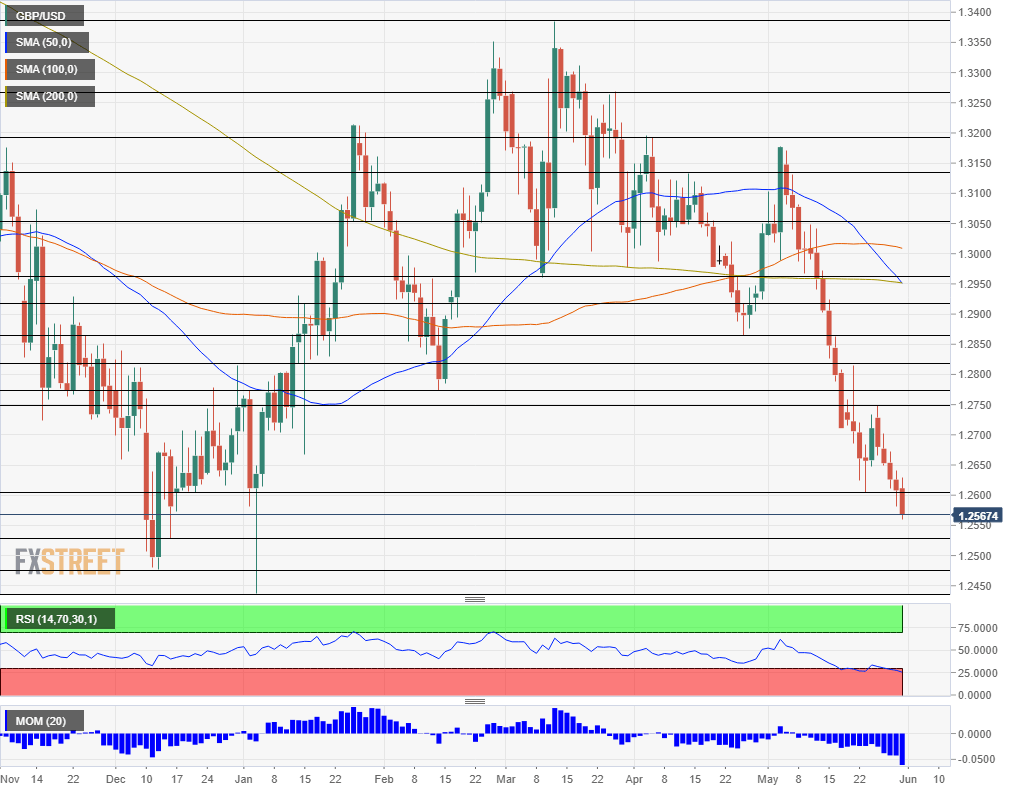
Pound/dollar is oversold according to the Relative Strength Index on the daily chart. An RSI level below 30 implies an imminent bounce. However, downside momentum is robust and the 50-day Simple Moving Average crossed the 200-SMA – the "death cross" pattern.
Initial support awaits at 1.2530 which was a swing low close to Christmas 2018. Further support also dates back to December last year: 1.2475. Next, we find 1.2445 which is the flash crash low seen in January and the trough for 2019. The next noteworthy level is 1.2375 which dates back to 2017.
Initial resistance awaits at 1.2605 which was the initial low in late May. The next line is further away. 1.2750 capped a recovery attempt around the same time. 1.2775 was the low point in February and it is followed by 1.2810 which was a swing high in mid-May.
GBP/USD Sentiment
GBP/USD went too far and too fast and has room to bounce – but probably only to fall again. Growing fears about a no-deal Brexit may be reflected in the PMIs and Trump's relentless trade wars indicate further drops down the line.
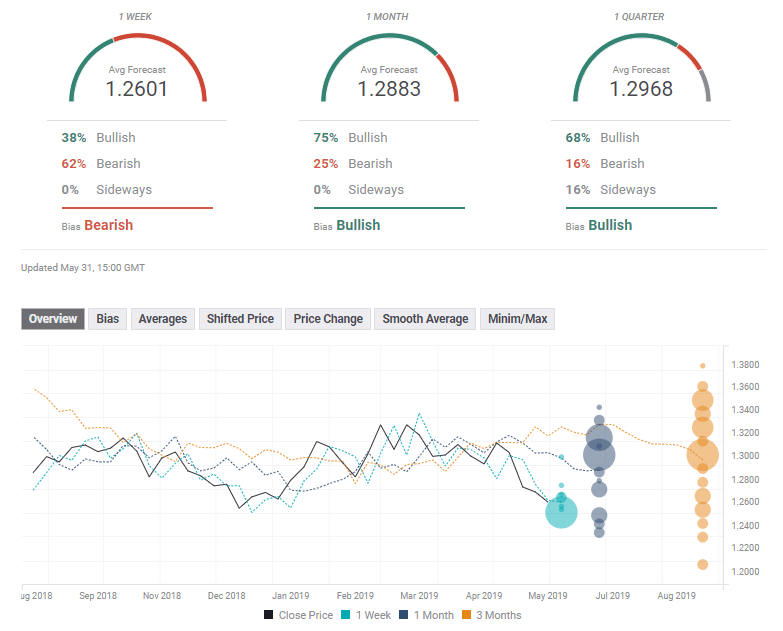
The FXStreet Poll shows a substantial downgrade in the short term, indicating experts have adapted to the recent fall. However, the average target in the medium term has not moved much and the long-term objective has been downgraded but remains bullish – close to 1.3000. Do they see a "Boris bounce"?
Related Forecast
- EUR/USD Forecast: WW III is here, and is a trade one
- USD/JPY Forecast: Multiple trade fronts take their toll, all eyes on the Non-Farm Payrolls
Author

Yohay Elam
FXStreet
Yohay is in Forex since 2008 when he founded Forex Crunch, a blog crafted in his free time that turned into a fully-fledged currency website later sold to Finixio.
















