EUR/USD Forecast: WW III is here, and is a trade one
- Trade war overshadowed it all, with fresh measures from Trump unwinding panic.
- EUR/USD set to continue falling toward 1.1000, a critical inflection point.

This past week was signaled by the absence of first-tier data and persistent fears driving currencies. In such scenario, the EUR/USD pair edged lower, approaching the multi-year low set earlier this May at 1.1106 and contained by sellers aligned around the 1.1200 figure. Still, it remained contained inside the previous week's range.
After being at a brink of sealing a trade deal, all of a sudden the trade relationship between China and the US collapsed, with leading officials from both economies reaching the wires with harsh words about their rivals. Tensions between the two countries fuel concerns about a global economic downturn, with the latest data released confirming that growth in most major economies, continues deteriorating in the second quarter of the year.
A shocker came late Thursday when US President Trump announced tariffs on all Mexican imports. "On June 10th, the United States will impose a 5% Tariff on all goods coming into our Country from Mexico, until such time as illegal migrants coming through Mexico, and into our Country, STOP." Those tariffs will gradually increase until the illegal immigration problem is solved, according to his words, becoming 10% starting July 1st.
On Friday, German's Merkel, speaking at Harvard, slammed her US counterpart over protectionism and trade conflicts, saying that protectionism jeopardizes the very foundations of prosperity. Trade-war in full fashion.
Fear turned into panic, resulting in US Treasury yields falling to fresh two-year lows and worldwide equities collapsing. The effect on the EUR/USD pair, however, was limited, although the high-yielding shared currency gained some ground by the end of the week, as the dollar sold-off vs. safe-havens' Gold and Yen.
In balance, data released these last few days played in favor of the greenback, as despite revised modestly lower, US Q1 GDP was estimated at a solid 3.1%, while core PCE inflation also came in-line with the market's expectations. Housing data was mixed, although employment figures showed signs of improvement. In Europe, on the other hand, the focus was on Germany, as all the numbers released by the country came below the market's expectations, with Retail Sales falling 2.0% in April and inflation in May shrank by more-than-anticipated.
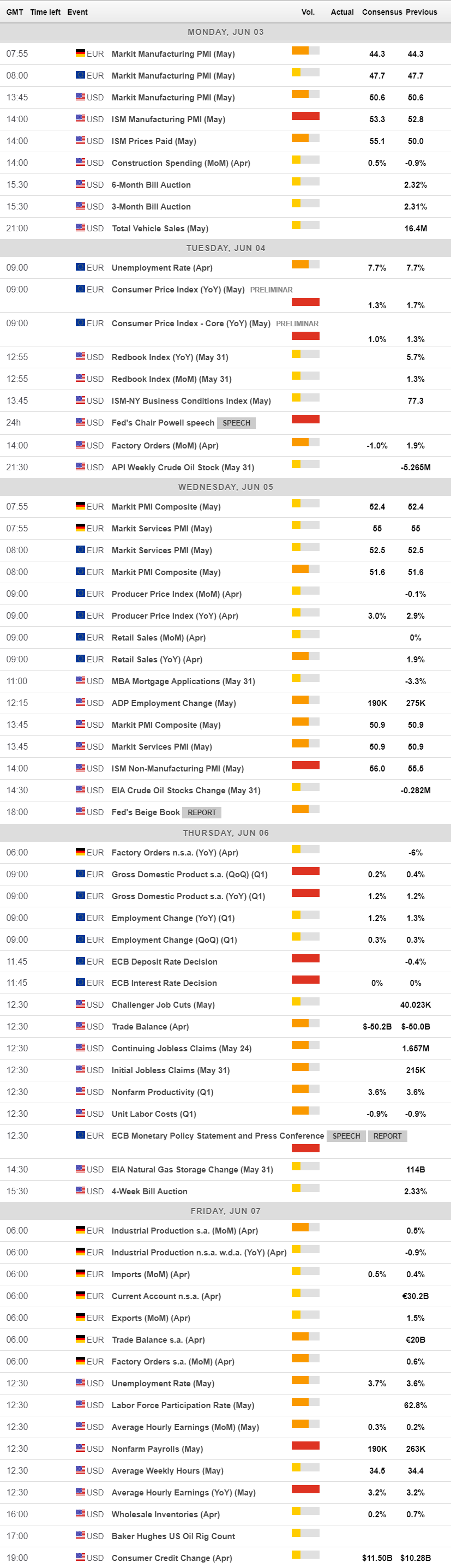
Next week, Markit will confirm the final versions of May PMI, while the US will release the official manufacturing and services indexes. The ECB will have its monetary policy meeting, while the US will release the monthly Nonfarm Payrolls report. Data is now relevant in terms of indicating the degree of economic growth's deterioration, with Trump's protectionism.
EUR/USD technical outlook
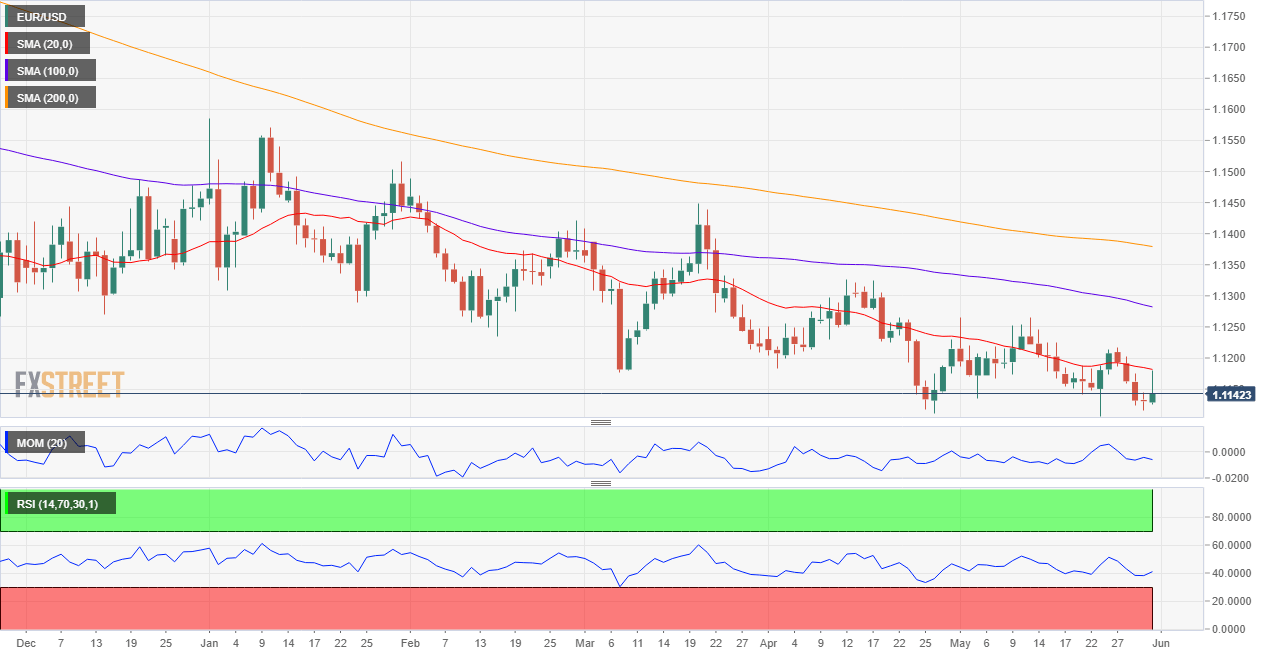
The EUR/USD pair is poised to close the week around 1.1140, with the long-term bearish trend intact. The weekly chart shows that the pair keeps developing below a daily descendant trend line coming from September 2018 high at 1.1622, which falls at 1.1285 for the upcoming week. The 20 SMA in the mentioned chart continues heading lower above the current level and below the larger ones, below the mentioned trend line. Technical indicators turned lower within negative levels, although lacking directional strength.
In the daily chart, the pair is also developing below its moving averages, which maintain their downward slopes, with the closest being the 20 SMA at 1.1180. Technical indicators in this last timeframe have bounced from near oversold levels, heading higher but within negative levels, rather reflecting the ongoing bounce than suggesting further gains ahead.
The pair could correct higher in between the dominant bearish trend, yet as long as it remains below the mentioned trend line, little chances are of a trend change. The 1.1100 figure is the immediate support, with a break below it favoring a slump toward the 1.1000/20 price zone. The 1.1000 figure should be a tough bone to break, yet if it happens, it could unwind a sell-off toward 1.0860. The most relevant resistances this week are 1.1200, and the mentioned 1.1280/90 price zone.
EUR/USD sentiment poll
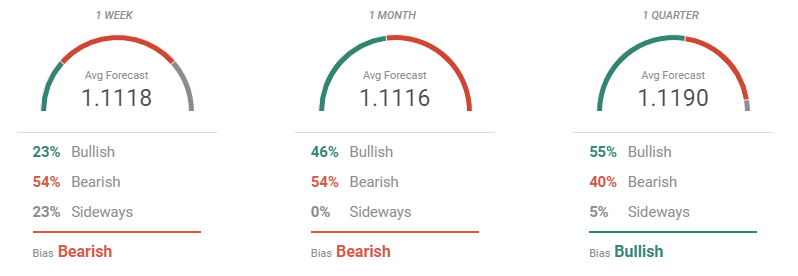
According to the FXStreet Forecast Poll, the pair is set to continue falling in the upcoming weeks, with bears being a majority in the weekly an monthly views. Bulls jump to 55% in the quarterly perspective, yet in the three timeframes under study, the pair is seen barely holding above the 1.1100 figure on average. Despite in the longer view, the pair is seen closer to 1.1200, the largest accumulation of targets comes around the 1.1000 figure.
The Overview chart shows that, when compared to the current price, the weekly and monthly moving averages, both with bearish slopes, have narrowed their distance, somehow warning that speculative interest has reached its previous targets. In the three-month view, the moving average resumed its decline after a period of consolidation, although little changed from the current level., still indicating the bearish mood around the pair.
Related Forecasts:
Author

Valeria Bednarik
FXStreet
Valeria Bednarik was born and lives in Buenos Aires, Argentina. Her passion for math and numbers pushed her into studying economics in her younger years.
















