European Central Bank Preview: Lagarde needs to repeat her hawkish message
- European Central Bank's monetary policy decision expected to add noise to financial markets.
- Encouraging Eurozone macroeconomic data released lately unlikely to twist ECB’s hand.
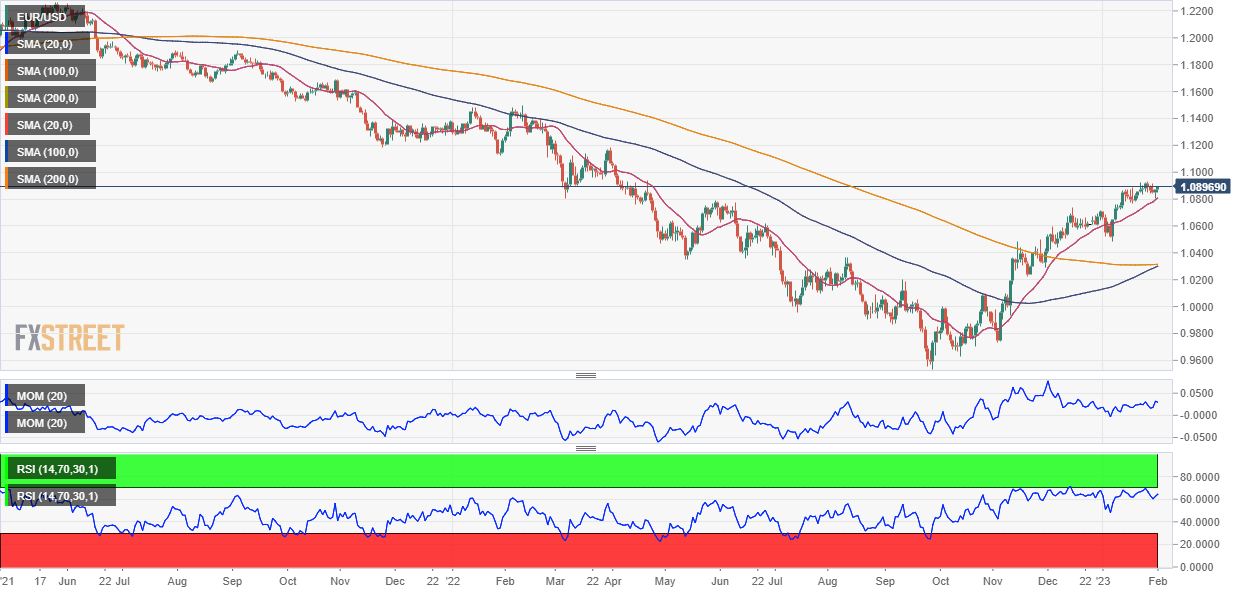
- EUR/USD is in a consolidative phase, maintaining the bullish stance ahead of the event.

The European Central Bank (ECB) is starting its two-day meeting that, at least according to what President Christine Lagarde hinted beforehand, will end up with the announcement of a 50 bps hike of all key interest rates. Financial markets have fully priced in the move, which means the focus will turn to whatever Lagarde and co have on the docket for future meetings.
Beyond the 50 bps hike, the ECB is expected to deliver detailed parameters for the reduction of the Assets Purchase Program (APP). The central bank anticipated a €15bn reduction per month starting in March 2023 in its December meeting. Still, and given the amount has been set, details of the plan will likely have no impact on the EUR.
Recent Euro Zone (EU) economic data and policymakers suggest this would not be the last 50 bps hike. The ECB Governing Council raised rates by 250 basis points throughout 2022 and indicated at least 100 bps more coming in the first quarter of the year.
In fact, President Lagarde warned after the December meeting that there was still more than one rate hike still to come as inflation remains too high and at risk of becoming entrenched. She also noted that the risk of a recession increased but that this alone would not bring down inflation. “We must not allow inflationary expectations to become de-anchored or wages to have an inflationary effect,” Lagarde noted. “We know wages are increasing, probably at a faster pace than expected, but we must be wary that they do not start fueling inflation.”
Inflation is the key, not growth
Encouraging figures posted these days are not enough to change the market’s perception of the upcoming ECB decision. Nevertheless, macroeconomic data has been quite encouraging. On the one hand, Eurostat reported the local economy grew at a faster-than-anticipated pace in the final quarter of 2022, with the annual Gross Domestic Product (GDP) up by 1.9%. Furthermore, the Harmonized Index of Consumer Prices (HICP) rose by 8.5% YoY in January, according to preliminary estimates, easing further from the multi-decade high of 10.6% reached in October 2022.
Cooling energy prices are partially responsible for the inflation and growth improvement at the end of the year, although the Russian invasion of Ukraine poses a risk to both. European countries are holding on by a thread and constantly struggling to maintain energy stocks and prices under control. And while the situation seems amenable, the risk of skyrocketing energy prices remains high, particularly if Moscow escalates the war.
At this point, it is worth remembering the ECB mandate is to reach price stability, not economic growth. As is the case with overseas counterparts, avoiding a recession is not part of the ECB’s mandate. That’s why we heard policymakers say that they believe a potential setback could be shallow and short-lived. The wording seems aimed at cooling down markets’ expectations rather than an honest view and how the economy will perform in the near future. At the end of the day, European policymakers are only focused on inflationary pressures and how to deal with them.
Also, further rate hikes or APP reductions will be data-dependant. With that in mind, the market’s reaction to the ECB monetary policy decision will mostly depend on the wording of the statement and whatever President Christine Lagarde says in the press conference.
EUR/USD possible reaction
The EUR/USD pair hovers around the 1.0900 level while heading into the event, although with one caveat: the US Federal Reserve (Fed) will make its own monetary policy announcement ahead of the ECB decision. The US central bank is widely anticipated to hike rates by 25 bps, but hawkish words from Chairman Jerome Powell have spurred speculation the American central bank is not as close to a pivot as the market thinks.
Technically, EUR/USD has been in a consolidative phase ever since reaching the current price zone in mid-January. The pair peaked at 1.0928 in the last week, its highest since April 2022. Buyers are defending the 1.0800 threshold, while a more relevant support level comes at 1.0745, the 61.8% Fibonacci retracement of the 2022 yearly slump. The pair maintains its positive stance, despite a generally sour mood, somehow suggesting speculative interest is not willing to buy the US Dollar.
A hawkish message from President Lagarde, following a more dovish one from US Federal Reserve Chair Powell, could lead to an advance towards the psychological 1.1000 figure and beyond. The opposite scenario may result in the pair losing the mentioned Fibonacci support, although bulls and bears could have quite a fight around it before one side stands victorious.
Author

Valeria Bednarik
FXStreet
Valeria Bednarik was born and lives in Buenos Aires, Argentina. Her passion for math and numbers pushed her into studying economics in her younger years.