EUR/USD Weekly Forecast: Battle around 1.0700 could soon come to an end
- A sour market mood and central banks’ imbalances kept EUR/USD under pressure.
- The FOMC meeting Minutes and US employment-related figures stand out next week.
- EUR/USD is at risk of retesting the year’s low at 1.0600 and even falling further.

The EUR/USD pair traded lifeless for most of the week around 1.0700, barely reacting on Friday following the release of the United States (US) Personal Consumption Expenditures (PCE) Price Index.
The Federal Reserve (Fed) favorite inflation gauge came largely in line with expectations, as the PCE Price Index rate edged lower to 2.6% YoY in May from 2.7% in April, while the monthly reading matched the 0.0% expected, according to the US Bureau of Economic Analysis (BEA). As forecasted, the core annual inflation printed at 2.6%, while the monthly core PCE Price Index rose 0.1%. The US Dollar shed some ground with the news, but losses were limited, and EUR/USD quickly returned to hover around the 1.0700 mark.
Sentiment leads the way
Generally speaking, financial markets stayed in a risk-off mood, although the absence of first-tier macroeconomic data kept major pairs within familiar levels. Speculative interest sought safety amid political turmoil in the Eurozone, particularly focused on France and the upcoming snap elections. Meanwhile, central banks’ imbalances continue to favor the US Dollar, as the Fed maintains a firmly hawkish stance against the dovish lean of its major counterparts. Monetary easing has begun in Europe and Canada, but the US central bank seems determined to delay an interest rate cut for as long as possible. Hawkish comments from Fed officials these last few days suggest the central bank will deliver just one 25 basis points (bps) interest rate cut this year.
Macroeconomic data further limited the Euro. Germany released the IFO Survey on Business Climate, which unexpectedly contracted to 88.6 in June from 89.3 previously. Expectations and the Current Assessment also missed expectations. The country’s GfK Consumer Confidence Survey also missed the forecast, down to -21.8 in July. Finally, the Eurozone Economic Sentiment Indicator posted 95.9 in June, easing from 96.0 in May.
Across the pond, the US confirmed that the Gross Domestic Product (GDP) rose at an annualized pace of 1.4% in the first quarter of the year, slightly better than the preliminary estimate of 1.3%. Also, Durable Goods Orders were up 0.1% in May.
Policymakers and US employment-related data in focus
The upcoming week will be quite a busy one in terms of macroeconomic data. On Monday, Germany will release the preliminary estimate of the June Harmonized Index of Consumer Prices (HICP), while the US will publish the June ISM Manufacturing PMI. The Eurozone will also publish the preliminary estimate for the June HICP and May Retail Sales.
Fed speakers will flood the news next week, while on Tuesday, European Central Bank (ECB) President Christine Lagarde and Fed Chairman Jerome Powell will speak at a panel at the ECB Forum on Central Banking and may comment on future monetary policy. More relevantly, the Federal Open Market Committee (FOMC) will release the Minutes of its latest meeting on Wednesday. The document will likely bring no big surprises but could provide some insights into policymakers’ views.
US employment-related figures will take centre stage, as the country will publish JOLTs Job Openings for May (Tuesday), the June ADP survey on private job creation (Wednesday), and, finally, on Friday, the Nonfarm Payrolls (NFP) report for the same month.

EUR/USD technical outlook
The EUR/USD pair ends June with losses and barely holds above its monthly low set at 1.0665. The weekly chart shows a directionless 100 Simple Moving Average (SMA) reinforces the support area, limiting the downside for a third consecutive week. At the same time, the 20 SMA grinds lower above the current level with limited downward strength. Finally, technical indicators consolidate within negative levels, failing to provide clear directional clues, albeit skewing the risk to the downside.
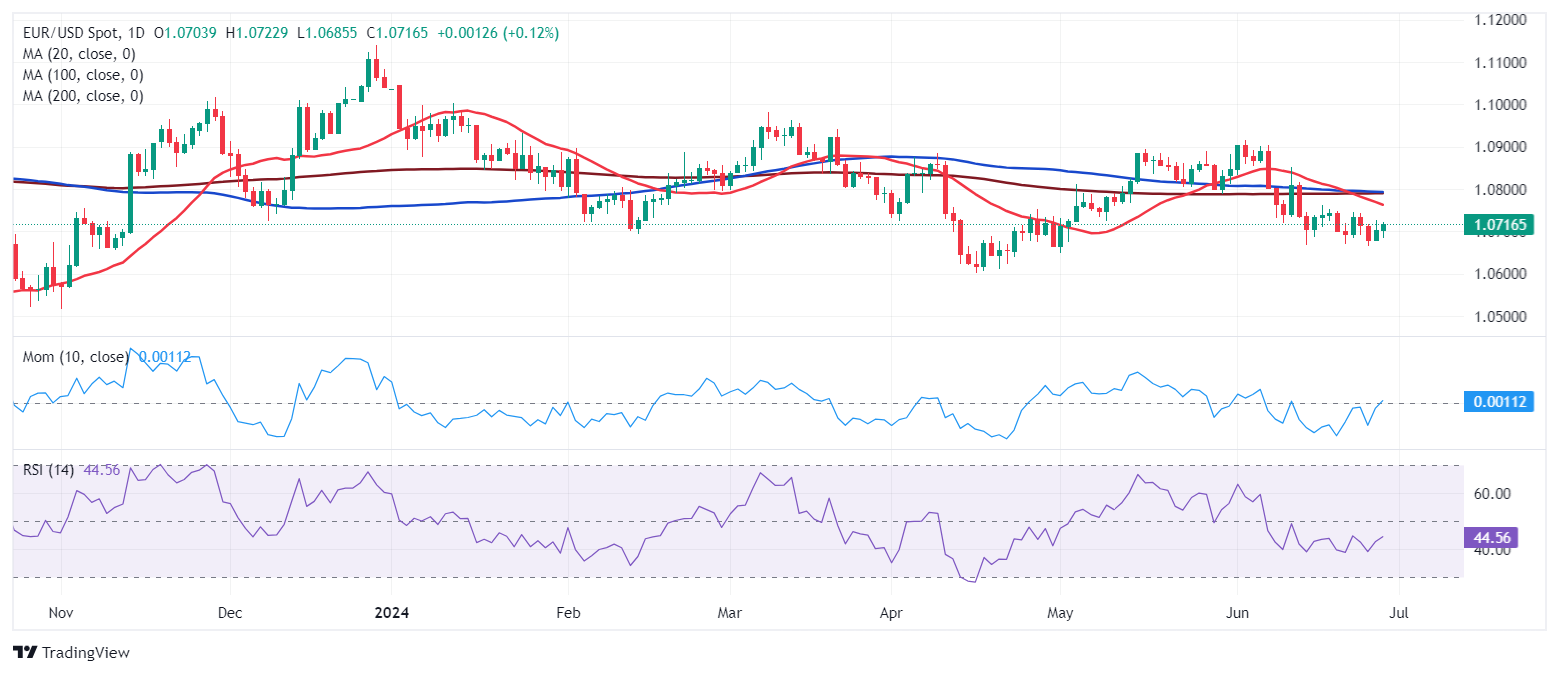
The case for a EUR/USD bearish extension is a bit clearer in the daily chart as the pair develops below all its moving averages. The 20 SMA has accelerated south and crossed below directionless 100 and 200 SMAs, maintaining its downward slope and providing dynamic resistance at around 1.0760. At the same time, the Momentum indicator aims modestly higher below its 100 line, while the Relative Strength Index (RSI) indicator turned marginally lower at around 41, anticipating a potential slide through the 1.0660 support area.
Once below it, the pair may extend its slump towards the year-low at 1.0600, while beyond the latter, the next relevant support level comes at 1.0520. Resistance beyond the 1.0760 area is seen at 1.0800, while stronger selling interest may surge if the pair nears the 1.0850 price zone.
Economic Indicator
FOMC Minutes
FOMC stands for The Federal Open Market Committee that organizes 8 meetings in a year and reviews economic and financial conditions, determines the appropriate stance of monetary policy and assesses the risks to its long-run goals of price stability and sustainable economic growth. FOMC Minutes are released by the Board of Governors of the Federal Reserve and are a clear guide to the future US interest rate policy.
Read more.Next release: Wed Jul 03, 2024 18:00
Frequency: Irregular
Consensus: -
Previous: -
Source: Federal Reserve
Minutes of the Federal Open Market Committee (FOMC) is usually published three weeks after the day of the policy decision. Investors look for clues regarding the policy outlook in this publication alongside the vote split. A bullish tone is likely to provide a boost to the greenback while a dovish stance is seen as USD-negative. It needs to be noted that the market reaction to FOMC Minutes could be delayed as news outlets don’t have access to the publication before the release, unlike the FOMC’s Policy Statement.
Author

Valeria Bednarik
FXStreet
Valeria Bednarik was born and lives in Buenos Aires, Argentina. Her passion for math and numbers pushed her into studying economics in her younger years.

















