EUR/USD Weekly Forecast: US Dollar buyers not ready to give up
- Encouraging US data ahead of the weekly close boosted demand for the US Dollar.
- The United States will release the Federal Reserve’s favorite inflation gauge next week.
- EUR/USD trades near its lowest level in June, bears aim to challenge the year-to-date low.

The US Dollar (USD) retained the ground gained in the previous days, and EUR/USD settled below the 1.0700 threshold for a second consecutive week. The pair moved mostly on sentiment, although tepid United States (US) data pushed EUR/USD up to 1.0760 on Tuesday. Nevertheless, the Greenback regained its strength ahead of the close, as geopolitical jitters backed safe-haven demand.
Beyond European woes after far-right parties dominated the European Parliament Election, the focus was on Russia. President Vladimir Putin said on Thursday that the country is considering introducing changes to its nuclear doctrine, including lowering the threshold for the use of such weapons in the West. Additionally, Putin said that Russia could provide other countries with its weapons as the West does to Ukraine.
United States data disappoints
US Retail Sales posted a modest 0.1% advance in May, while April's figure was downwardly revised to -0.2%. Furthermore, Initial Jobless Claims for the week ended June 14 were up by 238K, worse than the 235K expected. At the same time, Building Permits fell by 3.8% mont-over-month (MoM) in May, while Housing Starts declined by 5.5%. Finally, the Philadelphia Fed Manufacturing Survey printed at 1.3 in June, down from the previous 4.5 and worse than the 5 anticipated.
On a positive note, the country reported that Industrial Production rose 0.9% in May, while Capacity Utilization increased to 78.7% in the same period.
Meanwhile, Federal Reserve (Fed) speakers have affected the market’s mood. Officials have leaned to the hawkish side, expressing concerns about inflation and cooling down hopes for interest rate cuts.
Finally, S&P Global released the preliminary estimates of the June Manufacturing and Services Purchasing Managers Index (PMI) on Friday. The news gave an additional impulse to the USD as the figures beat expectations. The S&P Global Composite PMI surged to 54.6 from 54.5 in May, its highest in over two years, as the Manufacturing PMI surged to 51.7 while the Services index improved to 55.1.
Unexpected slowdown in European growth
Across the pond, the Eurozone confirmed that the Harmonized Index of Consumer Prices (HICP) rose 2.6% year-over-year (YoY) in May, as previously estimated, while the monthly reading also matched the flash estimate.
Also, the German ZEW survey showed that Economic Sentiment posted a modest improvement in June, up to 47.5 from 47.1, missing expectations of 50. The assessment of the current situation was much worse than anticipated, down to -73.8 from -72.3 in May. Finally, the Economic Sentiment in the EU improved to 51.3, beating the expected 47.8.
The Hamburg Commercial Bank (HCOB) preliminary June PMIs showed that economic activity in the Union still struggles to gain momentum. German figures showed a third consecutive monthly rise in business activity, although the Composite PMI resulted in 50.6, amid a sharp drop in services output and a drop in manufacturing activity.
The EU Composite PMI declined from 52.2 in May to 50.8 in June, indicating the region’s economic recovery suffered a setback at the end of the second quarter of the year. “The slowdown in growth of business activity seen in June was reflective of a softer expansion in the service sector and a more pronounced decrease in manufacturing production,” according to the HCOB report.
US inflation retakes centre stage
The US Personal Consumption Expenditures (PCE)—Price Index for May will be released on June 28, and it seems likely that market participants will await the figures before committing to a certain USD direction. The Fed’s favorite inflation gauge is expected to have risen 0.1% MoM and 2.6% YoY in May, while the core annual figure is foreseen at 2.7% following a 2.8% reading in April. Right afterward, the country will publish the final estimate of the June Michigan Consumer Sentiment Index.
Whether inflation keeps easing or not will deter USD destiny. Investors have been waiting for the Fed to abandon the tightening bias for a few months now, but the central bank refuses to ease interest rates amid concerns that inflation will pick up. Softer-than-anticipated PCE figures may signal a sooner rate cut, which should undermine demand for the American currency yet, at the same time, could boost optimism about economic developments. It’s hard to believe the USD would lose ground should local data begin to improve, even if that means the Fed trimming interest rates. Other than that, the country will release Durable Goods Orders for May, CB Consumer Confidence for June, and the final estimate of the Q1 Gross Domestic Product.
German will publish the June IFO Business Climate index, the July GfK Consumer Confidence Survey, and May Retail Sales throughout the week.

EUR/USD technical outlook
The weekly chart for the EUR/USD pair shows that it trades near 1.0667, the June monthly low. The risk skews to the downside, but the momentum is missing, given that technical indicators have lost their directional strength within negative levels. At the same time, the pair developed below a mildly bearish 20 Simple Moving Average (SMA), providing resistance at around 1.0790. A flat 100 SMA, in the meantime, acts as support around the aforementioned monthly low.
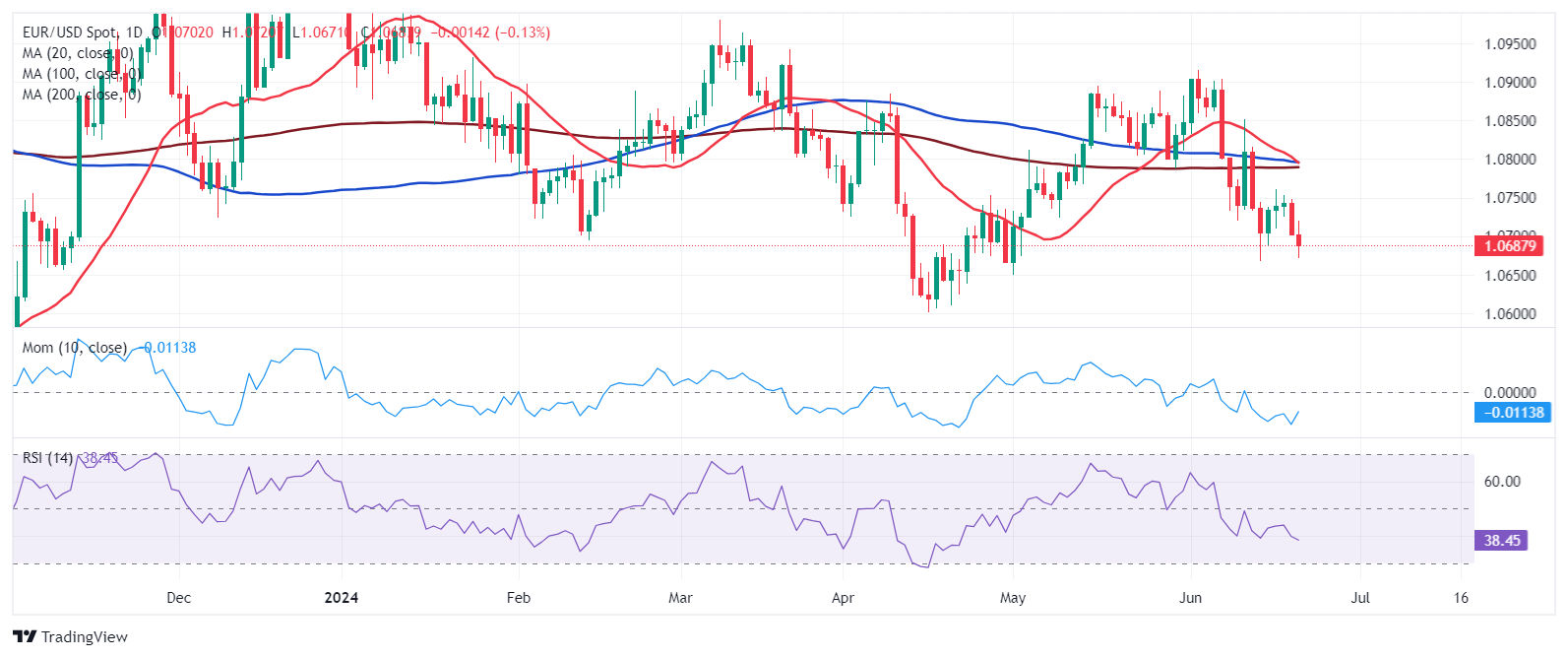
The bearish case is even clearer on a daily basis. Technical indicators head firmly south within negative levels, still far from suggesting downward exhaustion. At the same time, a bearish 20 SMA is about to cross below the 100 and 200 SMAs, converging in the 1.0780 area.
A slide through 1.0660 should expose the year’s low at 1.0600, while below the latter, the next relevant support level comes at 1.0520. On the contrary, sellers are aligned just ahead of the 1.0800 region, while an advance beyond the latter could extend toward the 1.0850 price zone.
Economic Indicator
Personal Consumption Expenditures - Price Index (YoY)
The Personal Consumption Expenditures (PCE), released by the US Bureau of Economic Analysis on a monthly basis, measures the changes in the prices of goods and services purchased by consumers in the United States (US). The YoY reading compares prices in the reference month to a year earlier. Price changes may cause consumers to switch from buying one good to another and the PCE Deflator can account for such substitutions. This makes it the preferred measure of inflation for the Federal Reserve. Generally, a high reading is bullish for the US Dollar (USD), while a low reading is bearish.
Read more.Next release: Fri Jun 28, 2024 12:30
Frequency: Monthly
Consensus: -
Previous: 2.7%
Source: US Bureau of Economic Analysis
Author

Valeria Bednarik
FXStreet
Valeria Bednarik was born and lives in Buenos Aires, Argentina. Her passion for math and numbers pushed her into studying economics in her younger years.

















