EUR/USD Weekly Forecast: Could the Nonfarm Payrolls report confirm the monetary policy shift?
- Easing inflation figures fueled speculation central banks will refrain from hiking rates further.
- The focus shifts to United States data next week, featuring the Nonfarm Payrolls report.
- EUR/USD turned bearish after meeting selling interest around a Fibonacci resistance level.

The EUR/USD pair started the week on a strong footing but lost momentum and is set to close the week in the red, well below the 1.0900 mark. Market participants mainly traded on sentiment, betting against the US Dollar amid optimism about a change in the monetary policies’ tightening cycles worldwide.
European Central Bank officers take down the tone
European Central Bank (ECB) President Christine Lagarde gave different speeches throughout the week, repeating her well-known message about the risks of higher inflation and the need to keep interest rates higher for longer. However, different ECB officials eased their tone and started skewing to the dovish side. ECB Governing Council member Yannis Stournaras warned about premature bets on rate cuts but added he would expect such a move in mid-2024, earlier than that could be a bit optimistic, according to Stournaras.
Also, ECB executive board member and Governor of the Bank of Italy Fabio Panetta said that the current interest rates level is consistent with bringing inflation down to target and warned about the “unnecessary damage” the ECB could cause through sustained high-interest rates.
Furthermore, the Euro dived on Thursday amid rumors suggesting the central bank could pause the Pandemic Emergency Purchase Programme (PEPP) reinvestments in the last days of 2023 on low liquidity.
At this point, financial markets are pricing a first ECB cut in April.
Dovish surprise from Federal Reserve officials
Across the pond, dovish comments from Federal Reserve (Fed) officials shocked investors. Fed Governor Christopher Waller said that the recent slowdown in economic activity is encouraging, as it may indicate that the monetary policy is tight enough to contain inflation. Waller added that if inflation continues to fall for several more months, the central bank could lower the policy rate.
Meanwhile, Chicago Fed President Austan Goolsbee said overall, there has been progress on inflation, noting that "it's been coming down, it's not yet down to target but 2023 we're on path to set the highest drop in the inflation rate in 71 years."
Macroeconomic data points to no more rate hikes
Inflation took centre stage these last few days, with figures fueling optimism as price pressures declined at both shores of the Atlantic. Germany’s Harmonized Index of Consumer Prices (HICP) inflation printed at 2.3% YoY in November, easing from 3% in the previous month. The Eurozone HICP in the same period was up 2.4%, down from 2.9% in October.
Finally, the United States (US) published the October Personal Consumption Expenditures (PCE) Price Index, the Fed’s favorite inflation gauge. According to the Bureau of Economic Analysis (BEA), the core annual PCE Price Index rose 3.5% YoY, as expected, yet below the 3.7% recorded in September.
Meanwhile, the US upwardly revised the Q3 Gross Domestic Product (GDP), which registered an annualized pace of growth of 5.2%. German Retail Sales came in better than anticipated, up 1.1% MoM in October.
Finally, the US published the ISM Manufacturing PMI, which resulted at 46.7 in November, matching October reading and missing expectations of 47.6.
Focus shifts to employment
Overall, data suggests that growth remains solid while inflation continues to recede. The labor market needs to loosen further for central banks to confirm a monetary policy shift. Speculative interest keeps increasing bets on soon-to-come rate cuts among major economies and prefers to ignore warnings from policymakers that rates will remain higher for longer.
The macroeconomic calendar has little interest figures next week. Multiple ECB officials will be on the wires on Monday, but silence will reign among US policymakers ahead of the December monetary policy meeting. The Eurozone will release a revision of the Q3 GDP. Still, the focus will be on US employment figures, as the country will publish the Nonfarm Payrolls report on Friday, preceded by the usual ADP survey, JOLTS Job Openings, quarterly Unit Labor Cost and Nonfarm Productivity reports.

EUR/USD technical outlook
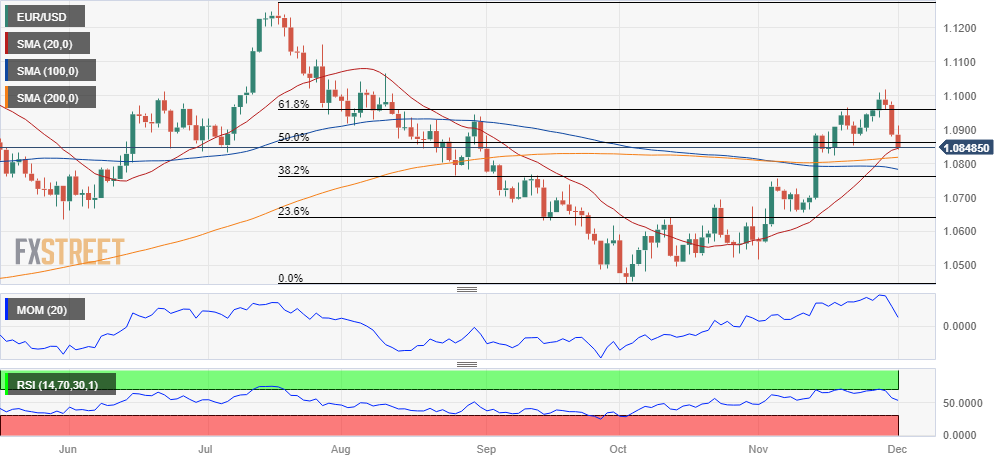
The EUR/USD pair briefly traded above the 61.8% Fibonacci retracement of the 1.1275/1.0447 slide at 1.0960, ending the week below the 50% retracement at 1.0861. The fact that such a critical resistance level held, is quite a sign for sellers, as it opens the door for another leg south.
The weekly chart for EUR/USD shows the positive momentum has receded. Technical indicators have lost their bullish strength and turned neutral-to-bearish within neutral levels. At the same time, the pair remains above its 20 and 100 Simple Moving Averages (SMAs), but they head marginally lower, suggesting declining buying interest.
Technical readings in the daily chart anticipate that EUR/USD can extend its slide. Technical indicators head firmly south, although they still develop within positive levels. At the same time, the 20 SMA is partially losing its bullish strength while holding above the longer ones, all of them below the current level.
The main resistance level is 1.0960, with a break above it exposing the recent multi-month high at 1.1016. Once above the latter, EUR/USD can extend its advance towards the 1.1060 price zone. On the flip side, if the pair remains below 1.0860, a test of 1.0790 comes into sight, while once below the latter, 1.0740 comes as the next support level en route to 1.0690.
Economic Indicator
United States Nonfarm Payrolls
The Nonfarm Payrolls release presents the number of new jobs created in the US during the previous month in all non-agricultural businesses; it is released by the US Bureau of Labor Statistics (BLS). The monthly changes in payrolls can be extremely volatile. The number is also subject to strong reviews, which can also trigger volatility in the Forex board. Generally speaking, a high reading is seen as bullish for the US Dollar (USD), while a low reading is seen as bearish, although previous months' reviews and the Unemployment Rate are as relevant as the headline figure. The market's reaction, therefore, depends on how the market assesses all the data contained in the BLS report as a whole.
Read more.Why it matters to traders
America’s monthly jobs report is considered the most important economic indicator for forex traders. Released on the first Friday following the reported month, the change in the number of positions is closely correlated with the overall performance of the economy and is monitored by policymakers. Full employment is one of the Federal Reserve’s mandates and it considers developments in the labor market when setting its policies, thus impacting currencies. Despite several leading indicators shaping estimates, Nonfarm Payrolls tend to surprise markets and trigger substantial volatility. Actual figures beating the consensus tend to be USD bullish.
Author

Valeria Bednarik
FXStreet
Valeria Bednarik was born and lives in Buenos Aires, Argentina. Her passion for math and numbers pushed her into studying economics in her younger years.