EUR/USD Weekly Forecast: Focus now shifts to 1.1275
- Rising bets for a rate cut by the Fed in September weighed on the US Dollar.
- Powell paved the way for an interest rate cut in September.
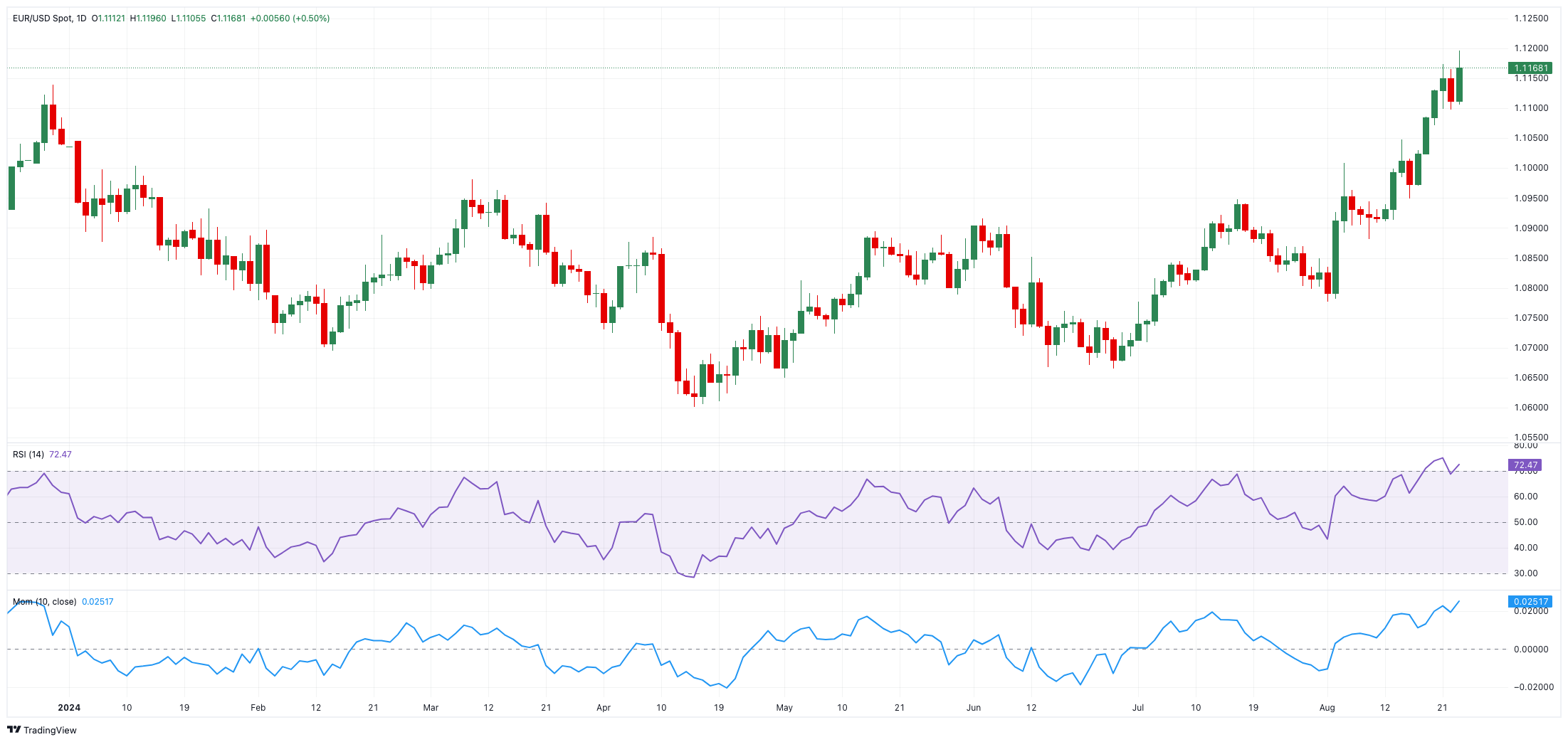
- EUR/USD reached a new 2024 high near 1.1200 and retargets 1.1275.

Another solid weekly performance saw EUR/USD clinch its fourth consecutive week of gains, including a new 2024 peak in the 1.1180–1.1185 band. The strong move higher in the pair came in response to the heightened downward bias hitting the US Dollar (USD).
Powell cemented the case for a rate cut next month
It was a positive week for EUR/USD all along, as market participants continued to punish the Greenback on the basis that the Federal Reserve (Fed) might start cutting its interest rates as soon as September.
This view was addressed by some Fed officials, as well as by the FOMC Minutes, earlier in the week, although the final say came from Chair Jerome Powell on Friday. Indeed, in his highly anticipated speech at the Jackson Hole Symposium, Powell signalled that the time for a change in the monetary policy stance has come, adding that he is now more confident that US inflation is heading toward the bank’s goal on a sustainable path.
The issue regarding the potential size of the rate cut seems to be leaning towards a quarter-point reduction, as US recession fears have rapidly fizzled out in response to relatively firm data releases as of late.
The ECB is also expected to reduce rates in September
Despite the ongoing radio silence from the European Central Bank (ECB), investors continue to pencil in two more interest rate cuts by the central bank for the remainder of the year, most likely in September and December, which should take the deposit facility rate to 3.25% by year-end.
The logic behind further easing by the ECB can be found in the worsening conditions of economic and business activity in Germany and the whole euro bloc. While a recession on the old continent may be overstated, the probability of a period of slowdown in economic activity appears more suitable.
It can’t be said the same of inflation in the region, which remains stubbornly elevated, particularly regarding services. However, according to the ECB’s latest survey, wage growth in the Eurozone slowed last quarter, strengthening the argument for another interest rate cut in the next few months and easing policymakers' concerns that rising labour costs would keep driving inflation higher.
Furthermore, growth in negotiated wages decelerated to 3.55% in the second quarter, down from 4.74% in the previous three months, largely due to a significant slowdown in Germany, the bloc's largest economy.
All in all, while the Fed-ECB policy divergence appears to dwindle in the next few months, the focus of attention is expected to be on the real economy, where the US has an advantage over its European peer, thus keeping the downside of the Greenback somewhat contained in the long run.
What’s next for the EUR/USD?
Moving forward, Germany is expected to take centre stage next week, with the releases of the IFO’s Business Climate (August 26), final Q2 GDP Growth Rate (August 27), GfK’s Consumer Confidence (August 28), the advanced Inflation Rate for the current month (August 29), Retail Sales, and the labour market report (August 30). In addition, the preliminary Inflation Rate in the broader euro area is also expected on August 30.
EUR/USD technical outlook
From a technical perspective, EUR/USD is positioned to continue its uptrend. On the weekly chart, spot left behind the key 200-week SMA at 1.1063, which bodes well for the continuation of the ongoing bullish trend for the time being.
On the daily chart, technical indicators remain in the overbought region, while the momentum indicates that the current upside bias remains strong. Both the provisional 55-day and 100-day SMAs continue to point northward at 1.0857 and 1.0820, respectively. Spot, in the meantime, maintains its business above the critical 200-day SMA at 1.0847, therefore, keeping the short-term constructive bias well in place. Further advances, in the meantime, are likely, with the YTD peak at 1.1194 (August 23) emerging as the immediate upside barrier. A move beyond this level could lead to an advance towards the 1.1200 milestone, ahead of the 2023 peak of 1.1275 (July 18).
In the event of a pullback, immediate support lies at 1.0881 (weekly low from August 8), followed by the 200-day SMA and the August bottom of 1.0777 (August 1).
Economic Indicator
Harmonized Index of Consumer Prices (YoY)
The Harmonized Index of Consumer Prices (HICP) measures changes in the prices of a representative basket of goods and services in the European Monetary Union. The HICP, released by Eurostat on a monthly basis, is harmonized because the same methodology is used across all member states and their contribution is weighted. The YoY reading compares prices in the reference month to a year earlier. Generally, a high reading is seen as bullish for the Euro (EUR), while a low reading is seen as bearish.
Read more.Last release: Tue Aug 20, 2024 09:00
Frequency: Monthly
Actual: 2.6%
Consensus: 2.6%
Previous: 2.6%
Source: Eurostat
Euro PRICE Today
The table below shows the percentage change of Euro (EUR) against listed major currencies today. Euro was the strongest against the US Dollar.
| USD | EUR | GBP | JPY | CAD | AUD | NZD | CHF | |
|---|---|---|---|---|---|---|---|---|
| USD | -0.53% | -0.70% | -1.00% | -0.74% | -1.08% | -1.42% | -0.08% | |
| EUR | 0.53% | -0.17% | -0.49% | -0.22% | -0.56% | -0.66% | 0.45% | |
| GBP | 0.70% | 0.17% | -0.34% | -0.04% | -0.38% | -0.46% | 0.39% | |
| JPY | 1.00% | 0.49% | 0.34% | 0.25% | -0.09% | -0.20% | 0.70% | |
| CAD | 0.74% | 0.22% | 0.04% | -0.25% | -0.35% | -0.43% | 0.44% | |
| AUD | 1.08% | 0.56% | 0.38% | 0.09% | 0.35% | -0.10% | 0.77% | |
| NZD | 1.42% | 0.66% | 0.46% | 0.20% | 0.43% | 0.10% | 0.87% | |
| CHF | 0.08% | -0.45% | -0.39% | -0.70% | -0.44% | -0.77% | -0.87% |
The heat map shows percentage changes of major currencies against each other. The base currency is picked from the left column, while the quote currency is picked from the top row. For example, if you pick the Euro from the left column and move along the horizontal line to the US Dollar, the percentage change displayed in the box will represent EUR (base)/USD (quote).
Author

Pablo Piovano
FXStreet
Born and bred in Argentina, Pablo has been carrying on with his passion for FX markets and trading since his first college years.