EUR/USD Weekly Forecast: Federal Reserve’s words under the spotlight
- The US Dollar collapsed after US inflation data hinted at another delay in Fed rate cuts.
- FOMC Meeting Minutes and Fed’s speakers will dominate the spotlight next week.
- EUR/USD lacks bullish momentum, but broad US Dollar’s weakness hints at no big slides ahead.

The EUR/USD pair advanced for a fourth consecutive week, comfortably trading around 1.0860 ahead of the close. Progress had been shallow, as the pair is up roughly 250 pips from the year low of 1.0600 posted mid-April. The Euro lacks self-strength as economic progress in the area has been relatively limited, partially due to tight monetary conditions. The pair’s rally is a good indication of the broad US Dollar’s (USD) weakness.
United States inflation disappoints again
EUR/USD peaked at 1.0894 early on Thursday in the aftermath of United States (US) inflation figures reported a day before. The US April Consumer Price Index (CPI) figures pretty much met expectations, not enough to twist Federal Reserve (Fed) officials’ hands on monetary policy.
The US CPI rate declined to 3.4% on a yearly basis in April from 3.5% in March, according to the US Bureau of Labor Statistics (BLS). The core annual inflation reading, which excludes volatile food and energy prices, retreated to 3.6% from 3.8%, while the monthly CPI rose 0.3%, slightly below the previous 0.4% increase. More worrisome, the US reported on Tuesday that the Producer Price Index (PPI) was up 0.5% MoM in April, much higher than the previous -0.1%. Price pressures at wholesale levels would likely spread into retail in the upcoming months, which means the Fed could decide to maintain interest rates at current levels for longer.
Other than that, the US released Retail Sales, which remained unchanged in April and missed the 0.4% anticipated by market players.
Across the pond, the Eurozone unveiled the second estimate of the Q1 Gross Domestic Product (GDP) growth, confirming it at 0.3% QoQ, while the final estimate of the April Harmonized Index of Consumer Prices (HICP) matched the preliminary estimate of 2.4% increase YoY. Germany reported the April HICP rate at 2.4% YoY and the May ZEW Survey on Economic Sentiment, which showed a continued improvement, both in sentiment and assessment of the current situation. As said, modest signs of economic progress in the EU are short of supporting a Euro rally.
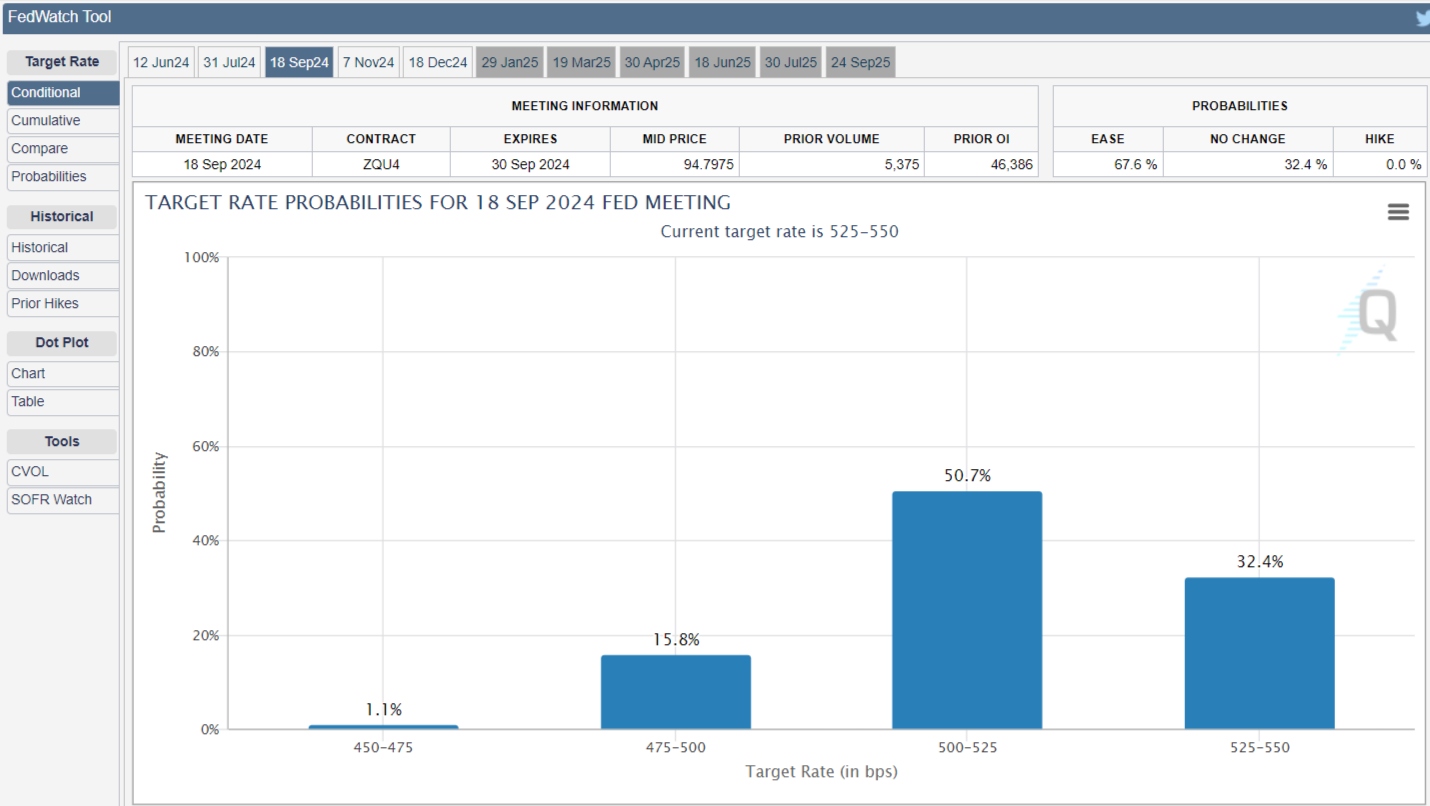
The upcoming week will bring multiple Fed speakers, while on Wednesday, the Federal Open Market Committee (FOMC) will release the Minutes of the latest Fed meeting. Fed officials deserve a separate chapter. Policymakers have been quite busy these days, but the messages keep lacking substance. None of them has been able to deliver fresh clues on what the central bank may do next on monetary policy. For the most, officials are aligned behind Chairman Jerome Powell, tilting to the hawkish side and expressing concerns about inflation’s impact on future decisions. FOMC meeting Minutes may shed some light on it, but market players do not anticipate rate cuts in the next two meetings, according to the CME FedWatch Tool, and bets for a September decision are roughly 50%.
The macroeconomic calendar also includes de Hamburg Commercial Bank's (HCOB) preliminary estimates of the May European Purchasing Managers Indexes (PMIs), while S&P Global will release US PMIs. By the end of the week, Germany will publish a revision of the Q1 GDP, while the US will offer April Durable Goods Orders.

EUR/USD technical outlook
According to the weekly chart, the EUR/USD pair is technically neutral. The pair is hovering around a mildly bearish 20 Simple Moving Average (SMA) while also standing midway between directionless 100 and 200 SMAs. The latter provides dynamic resistance at around 1.1130. At the same time, technical indicators have extended their advances for a fourth consecutive week but stand within neutral levels, still battling to run beyond their midlines, reflecting reluctant buying interest.
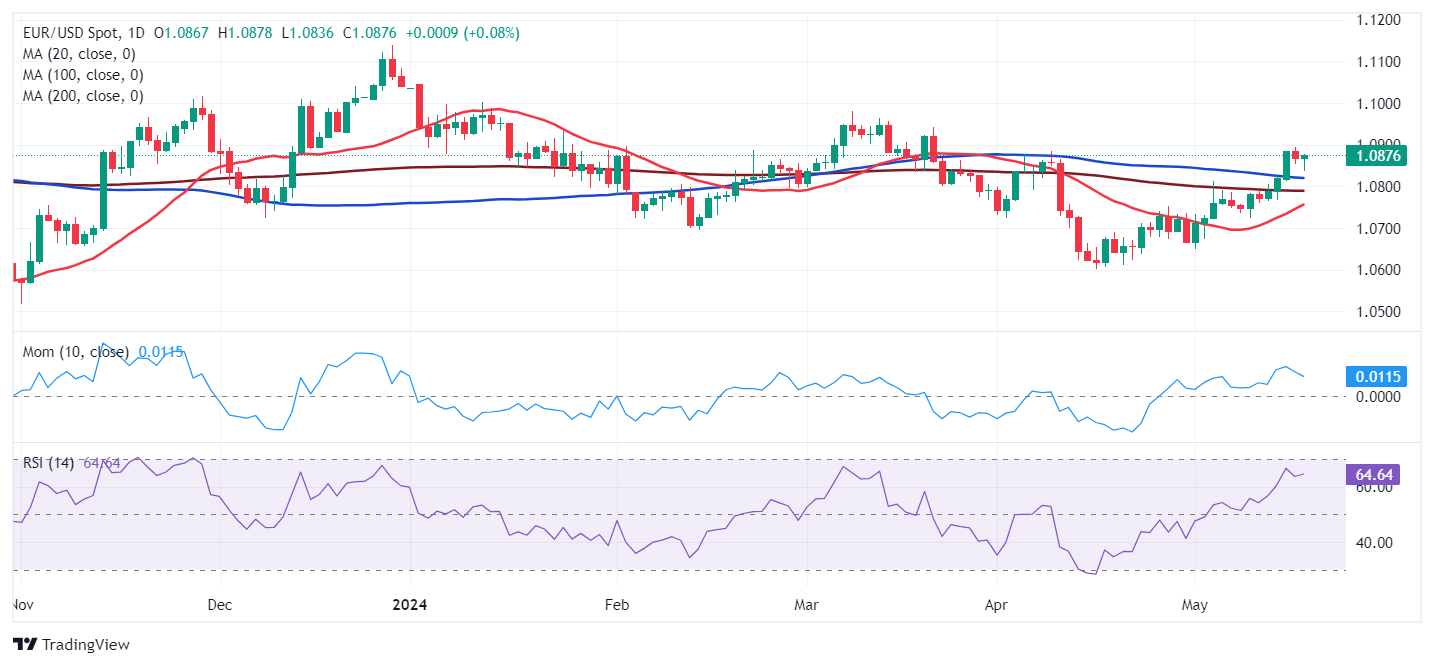
The daily chart shows a decreased bullish potential, although EUR/USD is far from suggesting an upcoming slide. The pair develops far above its moving averages, although only the 20 SMA heads north and below bearish longer ones, also suggesting limited buying interest. Finally, technical indicators have lost their upward slopes but remain far above their midlines.
Renewed buying interest will face resistance around the 1.0890 price zone, while beyond the latter, the next line of sellers could come in the 1.0980 - 1.1000 area. A run past the 1.1000 critical threshold exposes the 1.1120 region. Support, on the other hand, comes at 1.0800, 1.0740 and the 1.0650 price zone.
Economic Indicator
FOMC Minutes
FOMC stands for The Federal Open Market Committee that organizes 8 meetings in a year and reviews economic and financial conditions, determines the appropriate stance of monetary policy and assesses the risks to its long-run goals of price stability and sustainable economic growth. FOMC Minutes are released by the Board of Governors of the Federal Reserve and are a clear guide to the future US interest rate policy.
Read more.Last release: Wed Apr 10, 2024 18:00
Frequency: Irregular
Actual: -
Consensus: -
Previous: -
Source: Federal Reserve
Minutes of the Federal Open Market Committee (FOMC) is usually published three weeks after the day of the policy decision. Investors look for clues regarding the policy outlook in this publication alongside the vote split. A bullish tone is likely to provide a boost to the greenback while a dovish stance is seen as USD-negative. It needs to be noted that the market reaction to FOMC Minutes could be delayed as news outlets don’t have access to the publication before the release, unlike the FOMC’s Policy Statement.
Author

Valeria Bednarik
FXStreet
Valeria Bednarik was born and lives in Buenos Aires, Argentina. Her passion for math and numbers pushed her into studying economics in her younger years.

















