EUR/USD Price Forecast: US data hardly a game changer


EUR/USD Current price: 1.0947
- FOMC Meeting Minuted provided near-term support to the US Dollar.
- United States inflation resulted higher than anticipated, while employment figures disappointed.
- EUR/USD flirted with 1.0900 before bouncing, chances of a steeper advance still low.
The EUR/USD pair kept approaching the 1.0900 mark throughout the first half of Thursday. The US Dollar (USD) retained its strength following the release of the Federal Open Market Committee (FOMC) Meeting Minutes. The document fell short of surprising investors, although it included some interesting headlines. On the one hand, it showed almost all participants agreed that the upside risks to inflation had diminished and that a “substantial” majority backed a half-point interest rate cut, although some preferred 25 basis points (bps).
The FX Board showed no reaction to the news, albeit Wall Street edged higher, with the S&P500 reaching a new all-time high. As a result, Asian shares rose, also helped by news coming from China. The People Bank of China (PBoC) said it would start accepting applications from financial institutions to join a newly created funding scheme. Next Saturday, the Chinese Finance Minister is expected to deliver a press conference with detailed plans on fiscal stimulus.
The positive mood persists in Europe, with all local indexes trading in the green. United States (US) futures, however, trade with a softer tone ahead of the opening.
Data-wise, Germany published Retail Sales data, with the annual increase printing at 2.1% YoY in August. Additionally, the European Central Bank (ECB) published the Monetary Policy Meeting Accounts, which showed that ECB policymakers expect inflation to rise again before declining towards their target in the second half of 2025. Additionally, officials noted potential headwinds to the near-term outlook but considered a recession “unlikely.”
Ahead of Wall Street’s opening, the US published the September Consumer Price Index (CPI). The index rose 2.4% from a year earlier and by 0.3% compared to the previous month. The figures were higher than anticipated, spurring some concerns. At the same time, the country published Initial Jobless Claims for the week ended October 4, which rose to 258K higher than anticipated.
Hotter inflation and poor employment-related figures weighed on the market mood. US indexes are under pressure while demand for safe-haven increased, albeit it is still far from notable.
EUR/USD short-term technical outlook
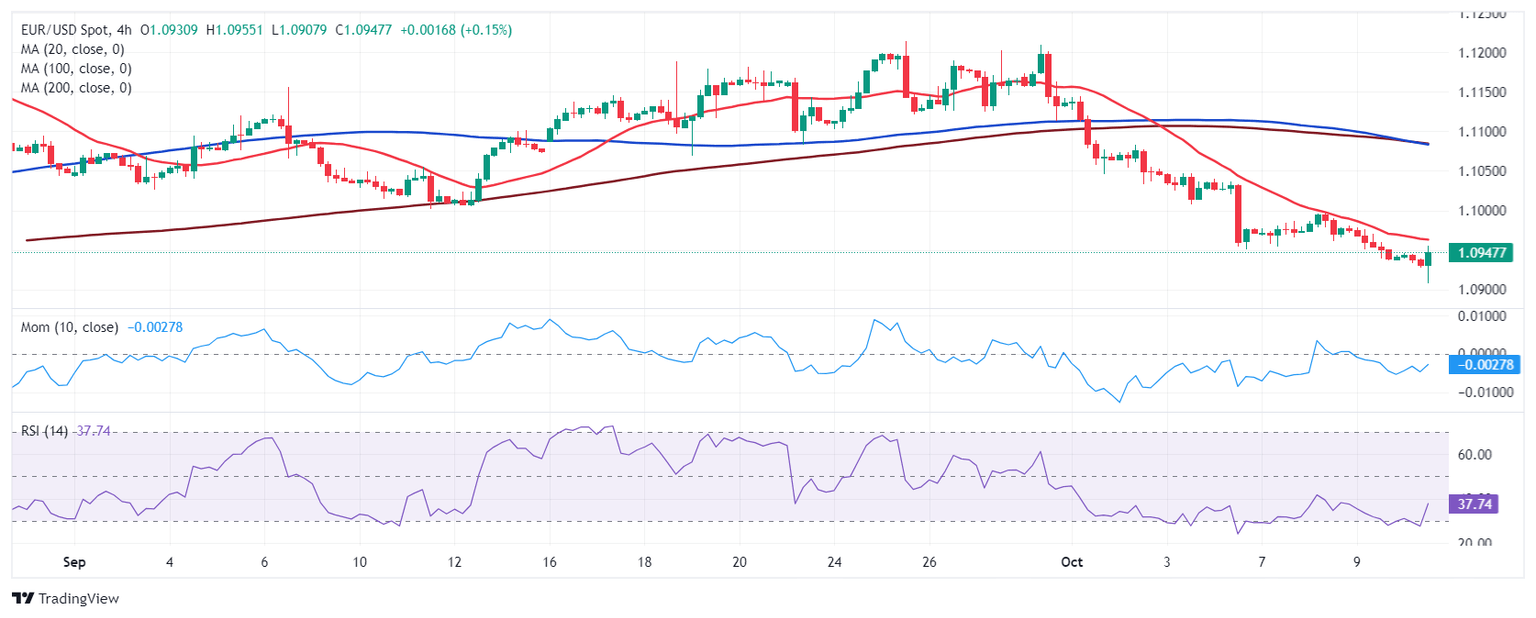
The EUR/USD pair trades at around 1.0940 after bottoming at 1.0907 with the news, a fresh weekly low. From a technical point of view, the daily chart shows the pair is far below a bearish 20 Simple Moving Average (SMA) while currently battling at around a mostly flat 100 SMA. Technical indicators, in the meantime, maintain their sharp bearish slopes near oversold readings, which are in line with the predominant downward bias.
In the near term, and according to the 4-hour chart, the risk skews to the downside, although the pair may correct higher. Technical indicators are recovering, with the Relative Strength Index (RSI) indicator accelerating higher from oversold readings. Still, a bearish 20 SMA offers dynamic resistance at around 1.0960. Beyond this, the 100 SMA is crossing below the 200 SMA, which usually means that sellers are in control.
Support levels: 1.0920 1.0885 1.0840
Resistance levels: 1.0960 1.1000 1.1045
Premium
You have reached your limit of 3 free articles for this month.
Start your subscription and get access to all our original articles.
Author
Valeria Bednarik
FXStreet
Valeria Bednarik was born and lives in Buenos Aires, Argentina. Her passion for math and numbers pushed her into studying economics in her younger years.