EUR/USD Price Forecast: There is a minor hurdle near 1.0530
- EUR/USD dropped to weekly lows near 1.0380 on Wednesday.
- The US Dollar printed humble gains amid higher yields.
- The Federal Reserve left its rates unchanged, as widely expected.
The Euro (EUR) remained on the defensive for yet another day on Wednesday, this time retreating to four-day lows around 1.0380. This decline came as the US Dollar (USD) maintained its recovery well in place, driven by renewed concerns over potential US trade tariffs and following the neutral tone from the FOMC event.
In addition, the US Dollar Index (DXY) climbed above 108.00 once again, hitting fresh four-day peaks alongside the continuation of the rebound in US yields across the curve.
Trade tariff jitters weigh on sentiment
Speculation about President Trump’s trade tariff policies has been keeping markets on edge since Inauguration Day on January 20. While the delay in imposing eurozone tariffs provided some short-term relief for the Euro, the lingering uncertainty continues to cloud the currency’s outlook.
Central banks in focus
The Federal Reserve kept interest rates unchanged on Wednesday, leaving markets with few hints about when borrowing costs might come down. Despite solid economic growth, inflation remains above target, and unemployment is still low, giving the central bank little urgency to act.
In a notable shift, the Fed dropped its previous statement that inflation "has made progress" toward its 2% goal. Instead, officials now describe price pressures as "elevated," signalling caution as they wait for more evidence of cooling inflation. While policymakers still expect inflation to ease over time, they have put rate cuts on hold until data confirms the trend.
The decision to keep the federal funds rate at 4.25%–4.50% was unanimous, reinforcing the Fed’s wait-and-see approach. With inflation and job market data still in focus, officials are also assessing the potential economic impact of President Trump’s trade and fiscal policies before making their next move.
Across the Atlantic, the ECB faces its own challenges. Led by President Christine Lagarde, the bank is expected to cut rates further on Thursday but is treading carefully to avoid overshooting its 2% inflation target or exacerbating economic slowdowns in the eurozone. Germany’s economic struggles and broader political uncertainties remain significant hurdles.
Tariff tensions could tip the scales
The ongoing threat of US trade tariffs looms large over the Euro’s prospects. If implemented, such tariffs could drive US inflation higher, potentially prompting a more hawkish stance from the Fed, which would strengthen the Dollar and pressure the Euro further. In such a scenario, the psychologically critical parity level (1.0000) for EUR/USD could re-enter the picture.
Technical outlook: Mixed signals
From a technical perspective, EUR/USD is navigating choppy waters:
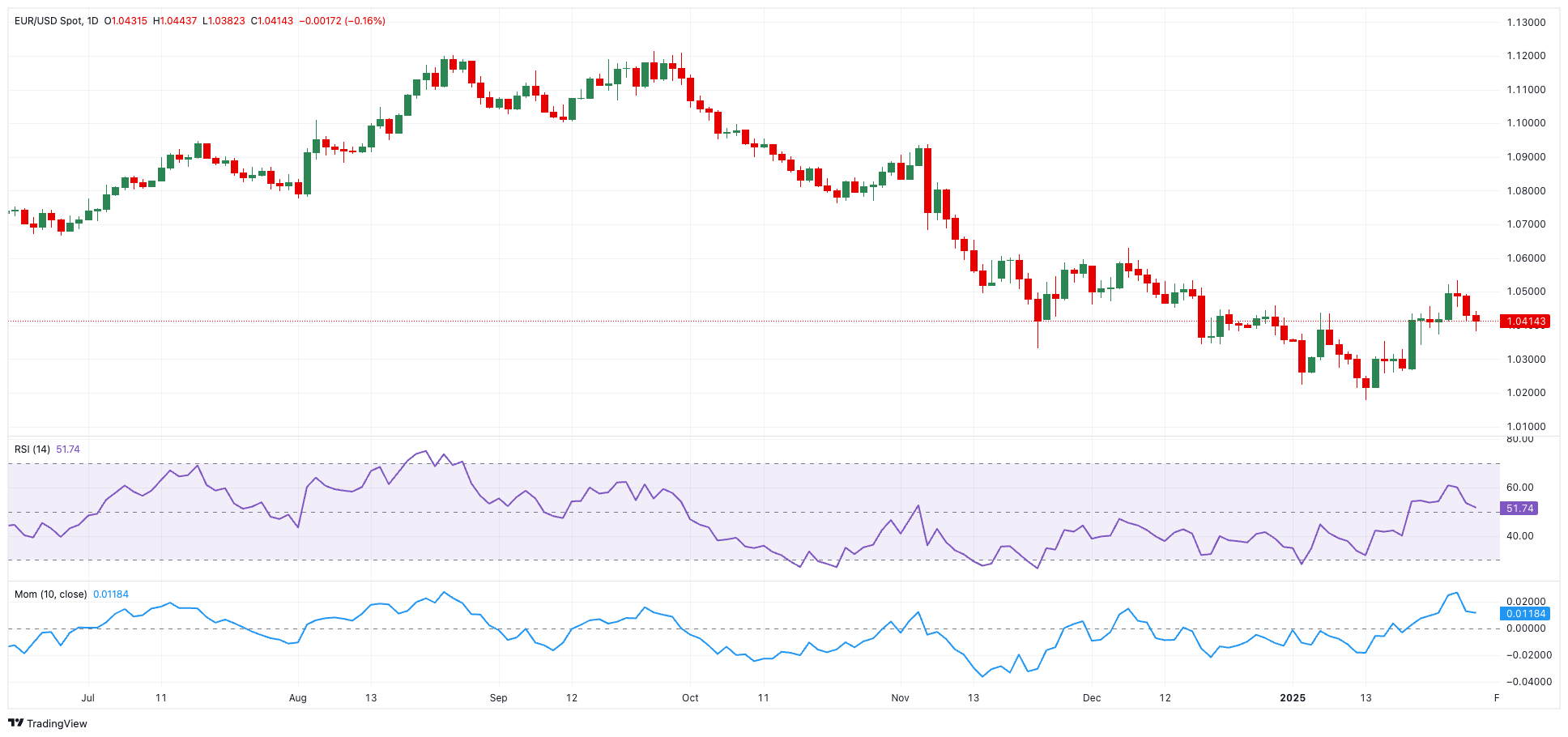
- Support lies at 1.0176, the YTD low from January 13, with the critical 1.0000 parity level below that.
- Resistance sits at the 2025 high of 1.0532 (January 27), followed by the December 2024 top of 1.0629 and the 100-day SMA at 1.0672.
- The broader bearish trend remains intact as long as the pair trades below the 200-day SMA at 1.0768.
Short-term indicators offer a mixed outlook. The RSI has dropped below 53, signalling waning bullish momentum, while the ADX near 24 suggests fading trend strength.
EUR/USD daily chart
The road ahead for the Euro
The Euro faces stiff headwinds, including the Dollar’s resilience, divergent ECB-Fed policies, and structural challenges within the eurozone, such as Germany’s slowdown. While short-term rallies remain possible, sustained gains for the Euro may prove elusive in the current environment.
What’s next for EUR/USD?
With the first major rate decisions of the year from both the Fed and the ECB, this week could set the tone for EUR/USD. Investors will also closely monitor key economic data, particularly inflation updates and any new developments in trade policies. For now, the battle between a resilient Dollar and the Euro’s internal struggles is likely to dominate the narrative in the weeks ahead.
Author

Pablo Piovano
FXStreet
Born and bred in Argentina, Pablo has been carrying on with his passion for FX markets and trading since his first college years.