EUR/USD Price Forecast: Some near-term consolidation could be on the cards
- EUR/USD resumed its recovery and retested the 1.0300 region once again.
- The US Dollar traded poorly amid another decline in US yields.
- Market participants now look at EMU inflation and more US data.

The Euro (EUR) continued its recovery against the US Dollar (USD) on Thursday, briefly climbing above 1.0300 as the price action in the Greenback remained depressed.
On the latter, the US Dollar Index (DXY) succumbed to disappointing data releases from US Retail Sales and Initial Jobless Claims, while dovish comments from FOMC Governor Christopher Waller also weighed on the currency after they left the door open to further rate cuts by the Federal Reserve (Fed).
This back-and-forth movement in the Greenback reflected investor uncertainty, with markets reassessing the likelihood of a Fed rate cut at its January meeting.
Meanwhile, market caution persisted as President-elect Donald Trump will take office on Monday.
Central banks in focus
Monetary policy remains a key driver for markets. Strong December Nonfarm Payrolls (+256K) have prompted traders to adjust their expectations for Fed actions in 2025, with most now anticipating either a modest 25-basis-point rate cut or no change at all.
In December, the Fed lowered interest rates by 25 basis points to a range of 4.25%–4.50%. However, it signalled a more cautious approach to easing in 2025 due to concerns about inflation rebounding. Fed Chair Jerome Powell reaffirmed the central bank’s commitment to its 2% inflation target, acknowledging that inflation remained higher than expected throughout 2024. Powell emphasised the importance of vigilance, noting that while the labour market is softening, the adjustment has been gradual, allowing the Fed to balance its goals of price stability and full employment.
Meanwhile, the European Central Bank (ECB) is expected to maintain its rate-cutting strategy, even as eurozone inflation edged higher in December. The ECB remains focused on supporting economic growth, particularly in Germany, while navigating risks of political instability. In his latest remarks, ECB Vice President Luis de Guindos confirmed that further rate cuts would depend on inflation easing as expected but stressed the importance of caution, citing uncertainties such as global trade tensions, fiscal policy shifts and geopolitical risks.
Trade policy and its impact
Adding to the uncertainty is President-elect Donald Trump’s proposal to reintroduce trade tariffs, which could drive up US inflation. This may force the Fed to maintain a more aggressive monetary policy stance, potentially strengthening the US Dollar and putting additional pressure on EUR/USD.
Key events to watch
Moving forward, the final eurozone Inflation Rate and Current Account figures are due on Friday.
Technical outlook for EUR/USD
EUR/USD remains under pressure, with key support at 1.0176 (YTD low on January 13) and the parity level (1.0000). Resistance is seen at 1.0436 (2025 high on January 6), 1.0506 (55-day SMA) and 1.0629 (December peak).
The broader bearish trend persists as long as the pair stays below the 200-day SMA at 1.0779. In shorter timeframes, interim resistance lies at 1.0354 and 1.0434, while support can be found at 1.0176, 0.9935 and 0.9730. Momentum indicators show the RSI near 41, suggesting some range bound trade, while the ADX near 35 points to a strengthening bearish trend.
EUR/USD daily chart
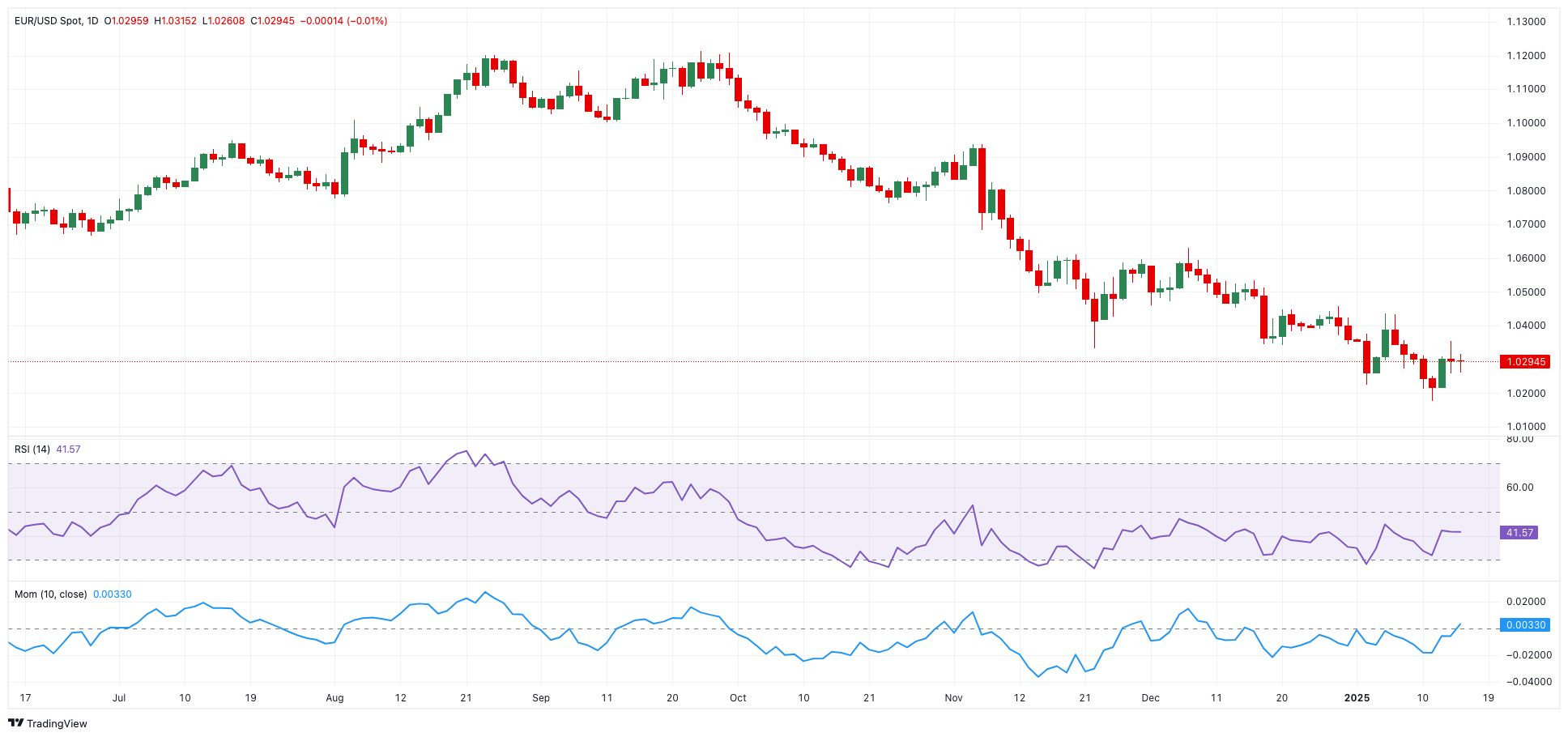
Outlook: EUR/USD faces an uphill battle
EUR/USD is weighed down by a strong US Dollar, contrasting monetary policies between the Fed and ECB, and ongoing economic and political uncertainties. With eurozone growth—particularly in Germany—facing challenges, the euro remains under pressure. While a short-term recovery is possible, the pair is likely to struggle for sustained gains in this challenging environment.
Author

Pablo Piovano
FXStreet
Born and bred in Argentina, Pablo has been carrying on with his passion for FX markets and trading since his first college years.

















