EUR/USD Price Forecast: Outlook remains negative for the time being
- EUR/USD rose further and surpassed the 1.0300 hurdle on Tuesday.
- The US Dollar came under extra downside pressure amid tariffs, US PPI.
- The ECB’s Holzmann said the bank can’t lower rates too quickly.


Another bearish day for the US Dollar allowed EUR/USD to extend its recovery from Monday’s fresh cycle lows in the 1.0180-1.0175 range, reclaiming the 1.0300 level and pushing higher.
Meanwhile, the US Dollar Index (DXY) slipped into the low 109.00s, continuing its pullback from Monday’s highs above the 110.00 mark. The Greenback’s weakness came as investors digested reports suggesting the incoming Trump administration might implement tariffs gradually. Adding to the pressure, disappointing US Producer Price data dampened hopes for a continued Dollar rally.
Caution prevailed in markets as traders awaited key US data later in the week, including the Consumer Price Index (CPI), Retail Sales figures and remarks from Federal Reserve (Fed) officials.
Central banks in focus
Monetary policy remains a key driver of market sentiment. Strong US Nonfarm Payrolls data for December (+256K) have caused market participants to scale back their expectations for Federal Reserve rate cuts. Many now believe the Fed will either trim rates by 25 basis points in 2025 or leave them unchanged.
On December 18, the Fed reduced its benchmark rate by 25 basis points to 4.25%-4.50%. However, it signalled a slower pace of easing for the coming year. Fed officials have expressed concerns about inflation potentially rebounding.
During his final press conference of 2024, Fed Chair Jerome Powell reaffirmed the central bank’s commitment to reducing inflation to its 2% target. He acknowledged that inflation had exceeded expectations for the year, emphasising the need for ongoing vigilance. Powell also noted that while the labor market is softening, the adjustment has been gradual, keeping the Fed’s dual mandates—low inflation and full employment—balanced.
In Europe, the European Central Bank (ECB) is expected to maintain its rate-cutting cycle despite a recent uptick in December inflation across the eurozone and Germany. The ECB aims to revive economic growth, particularly in Germany, while mitigating the risk of political instability spilling over into the economy.
ECB policymaker Robert Holzmann remarked that rate cuts could not happen too quickly due to persistent core inflation. He added that any future decisions would depend on incoming data.
Trade policy and the Dollar
The potential reintroduction of trade tariffs, as proposed by President-elect Donald Trump, adds another layer of complexity to the economic outlook. Tariffs could push US inflation higher, potentially forcing the Fed to adopt a more aggressive stance. This scenario could strengthen the US Dollar further, adding downward pressure on EUR/USD in the months ahead.
Key events to watch
The eurozone’s Industrial Production figures are due on Wednesday, followed by Germany’s final Inflation Rate and the ECB’s meeting accounts on Thursday. The week wraps up with the eurozone’s final inflation report and Current Account data.
Technical outlook for EUR/USD
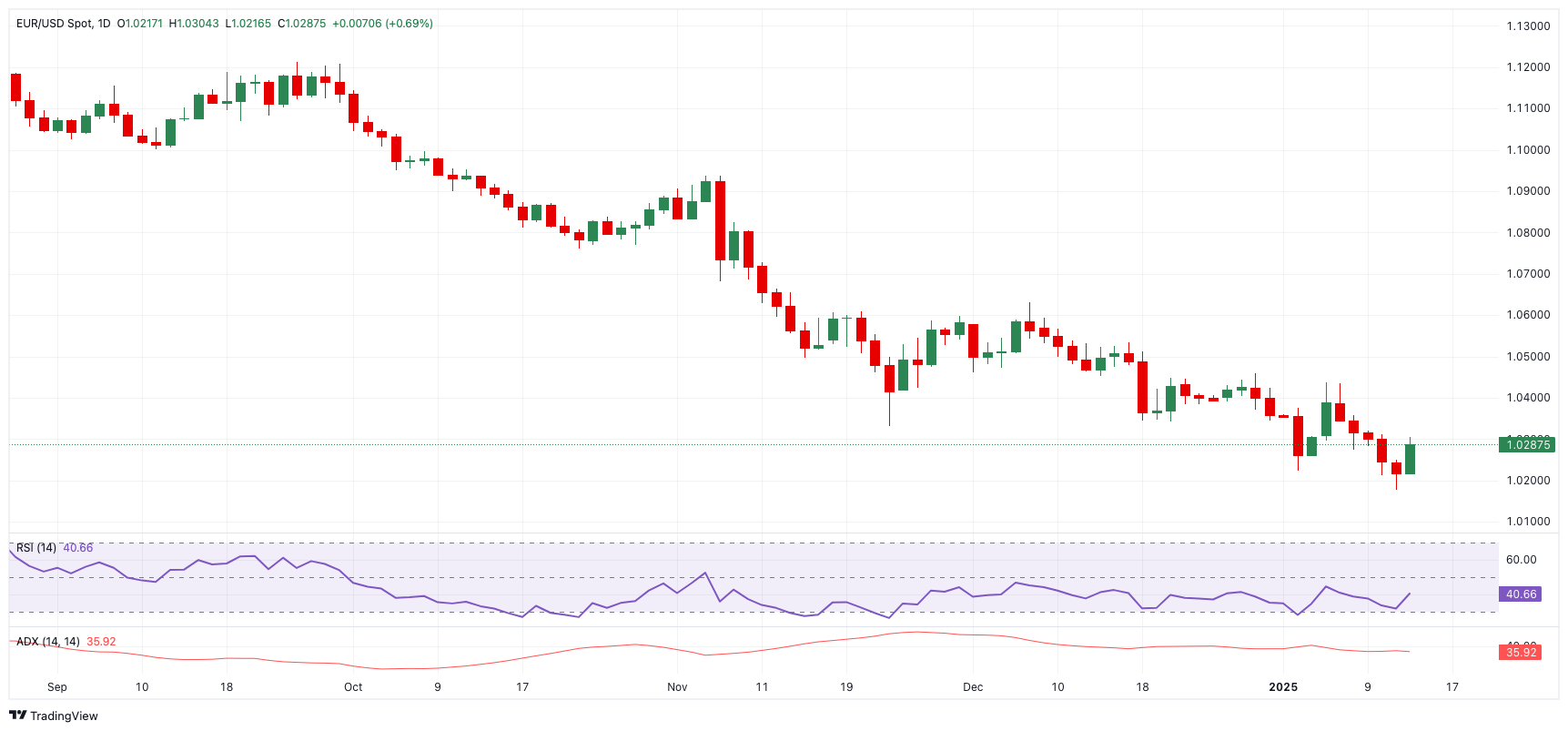
EUR/USD remains under pressure, with key support at the year-to-date low of 1.0176 (January 13) and the critical parity level. On the upside, immediate resistance lies at the 2025 high of 1.0436 (January 6), followed by the 55-day SMA at 1.0525 and the December peak of 1.0629 (December 6).
The broader bearish trend persists as long as the pair trades below the 200-day SMA at 1.0785. On shorter timeframes (4-hour), resistance levels are seen at 1.0304, 1.0350 and 1.0434, with support at 1.0176, 0.9935 and 0.9730.
Momentum indicators reflect some rebound in momentum, with the RSI approaching the 40 level, signalling further upside potential. The ADX near 38 indicates a strengthening bearish trend.
EUR/USD daily chart
Bottom line
EUR/USD continues to face headwinds from a strong US Dollar, ongoing political uncertainties and diverging monetary policies between the Fed and ECB. Additionally, the eurozone’s bleak economic outlook—especially Germany’s slowdown—casts a shadow over the euro’s recovery prospects in the months ahead. For now, the pair struggles to gain a solid footing amidst these challenges.
Premium
You have reached your limit of 3 free articles for this month.
Start your subscription and get access to all our original articles.
Author
Pablo Piovano
FXStreet
Born and bred in Argentina, Pablo has been carrying on with his passion for FX markets and trading since his first college years.