EUR/USD Price Forecast: Next on the upside comes 1.1200
- EUR/USD challenged 1.1100 amidst the resumption of the selling pressure.
- The Dollar made a sharp comeback and maintained the pair subdued.
- Germany’s flash Inflation Rate will be published on Thursday.

EUR/USD faced renewed and quite marked downward pressure on Wednesday, coming all the way down to retest the 1.1100 neighbourhood on the back of the robust U-turn in the US Dollar (USD).
In fact, the Greenback regained balance after Tuesday’s decline from recent 2024 lows near 100.50, when tracked by the US Dollar Index (DXY). The firm performance of the US Dollar came despite mixed US yields across the curve, and a drop in German 10-year bund yields.
Meanwhile, investors remained attentive to the possibility of an interest rate cut by the Federal Reserve (Fed) in September, following Chair Jerome Powell's suggestion that it might be time to adjust monetary policy. Powell also noted that the labour market is unlikely to contribute to rising inflationary pressures soon and emphasized that the Fed does not wish for further cooling in labour market conditions.
In line with Powell's remarks, San Francisco Federal Reserve Bank President Mary Daly stated on Monday that "the time is upon us" to cut rates, echoing Powell's sentiments from the previous week. However, she mentioned that the size of the initial rate cut would depend on forthcoming data.
Reflecting these potential rate cuts, the CME Group’s FedWatch Tool shows nearly a 63% probability of a 25 bps reduction at the September 18 event.
Regarding the European Central Bank (ECB), its recent Accounts revealed that while policymakers saw no immediate need to lower interest rates last month, they cautioned that the issue might be revisited in September due to the ongoing impact of high rates on economic growth.
Board member Klass Knot suggested on Tuesday that the ECB might gradually reduce interest rates if inflation continues to decline, though he emphasized the need for more data before deciding on a potential cut in September. He advocated for a cautious approach, indicating that while there might be a rationale for easing policy, a final decision has not yet been made.
In summary, if the Fed opts for additional or larger rate cuts, the policy gap between the Fed and the ECB may narrow in the medium to long term, potentially boosting EUR/USD, especially since markets anticipate the ECB to lower rates twice more this year.
However, in the longer term, the US economy is expected to outperform Europe, suggesting that any prolonged weakness in the dollar may be limited.
Additionally, further gains in the euro appear supported by position sizing. Net long positions in the EUR have risen to levels not seen since early June, according to the latest CFTC report, indicating continued bullish sentiment among speculators. Meanwhile, commercial traders (hedge funds) maintained their net short positions, with contracts reaching multi-week highs. EUR/USD began a strong rebound during the period under review, decisively breaking past the psychological 1.1000 barrier and setting new yearly highs, driven by the renewed and significant decline in the US Dollar.
Looking ahead, Germany will be in focus on this week’s calendar, with the release of Retail Sales, advanced Inflation Rate, and the labour market report. In the broader Eurozone, the flash Inflation Rate will also attract attention.
EUR/USD daily chart
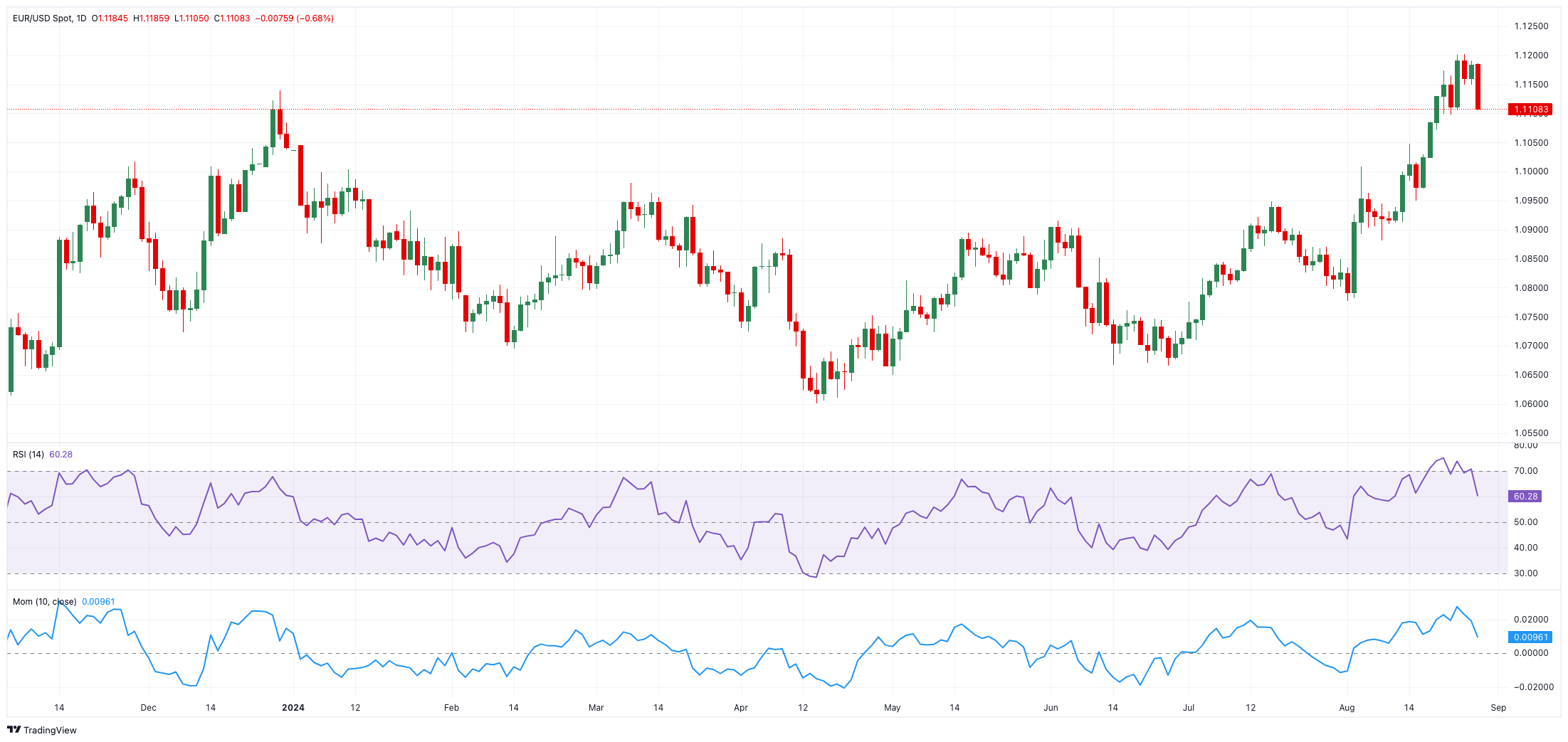
EUR/USD short-term technical outlook
Further north, the EUR/USD is expected to challenge its 2024 top of 1.1201 (August 26), which comes ahead of the 2023 peak of 1.1275 (July 18) and the 1.1300 round level.
The pair's next downside target is the weekly low of 1.0881 (August 8), prior to the crucial 200-day SMA at 1.0851 and the weekly low of 1.0777 (August 1). From here, the low of 1.0666 (June 26) comes before the May low of 1.0649 (May 1).
Looking at the larger picture, the pair's upward trend should continue as long as it remains above the important 200-day SMA.
So far, the four-hour chart shows a side-lined theme near the higher end of the present range. The initial resistance is 1.1201, before 1.1275. Instead, there is immediate support at 1.1098, followed by the 100-SMA at 1.1035, and the 200-SMA at 1.0953. The relative strength index (RSI) retreated to around 40.
Author

Pablo Piovano
FXStreet
Born and bred in Argentina, Pablo has been carrying on with his passion for FX markets and trading since his first college years.

















