EUR/USD Price Forecast: Initial support is seen at 1.0760
- EUR/USD regained some balance and reclaimed the 1.0800 mark.
- The march north in the US Dollar seems to have hit some resistance.
- Business activity in the euro bloc remained far from upbeat in October.


EUR/USD regained some composure and managed to partially reverse its steep multi-week decline on Thursday after bottoming out in new lows around 1.0760 during the previous trading session.
In the meantime, the pair maintained its business below the critical 200-day Simple Moving Average (SMA) at 1.0869.
Meanwhile, the US Dollar (USD) saw its rally running out of some steam, motivating the US Dollar Index (DXY) to trim part of its weekly advance and dispute the 104.00 neighbourhood amidst a corrective decline in US yields across the spectrum.
It is worth noting that the Greenback's strength has been underpinned by rising US yields, driven by solid economic fundamentals and cautious signals from Federal Reserve (Fed) officials. Additionally, lingering uncertainty ahead of the November 5 US election has further fuelled the bid for the US Dollar.
Looking ahead, many Fed policymakers appear inclined towards a 25-basis-point rate cut next month, although officials like FOMC Governor Michelle Bowman and Atlanta Fed President Raphael Bostic have expressed some hesitation. Bostic even hinted that the Fed might opt to skip the November rate cut. According to the CME Group’s FedWatch Tool, there is currently a 90% probability of a quarter-point cut next month.
Across the Atlantic, the European Central Bank (ECB) met market expectations by cutting policy rates by 25 basis points at its October 17 meeting, lowering the Deposit Facility Rate to 3.25%. However, ECB officials have not provided a clear outlook for future moves, remaining committed to a data-dependent approach.
ECB President Christine Lagarde emphasised on Wednesday that the central bank would need to be cautious in deciding on further rate reductions, with future actions guided by incoming data. This statement was in response to questions about market expectations for additional, possibly larger, rate cuts.
Meanwhile, the ECB is likely to cut interest rates by a quarter-point in December, according to ECB policymaker Robert Holzmann. Other ECB officials expressed varying views on future rate cuts. Bostjan Vasle emphasised the need for "measured" rate cuts, dismissing the idea of undershooting the inflation target or stimulating growth prematurely. Joachim Nagel urged caution, stating that the ECB should not end its inflation fight too soon despite September’s low inflation reading and should instead focus on incoming data. Martins Kazaks noted that while eurozone inflation may decline faster than expected, the ECB should continue with gradual rate cuts due to the high level of uncertainty.
Eurozone inflation, measured by the Harmonised Index of Consumer Prices (HICP), fell below the ECB’s target, landing at 1.7% year-on-year in September. Combined with stagnant GDP growth, this could strengthen the case for further ECB rate cuts in the coming months.
Adding to the case for further central bank easing, business activity in Germany and across the eurozone, as indicated by preliminary Manufacturing and Services PMIs for October, remains unpromising. The manufacturing sector, in particular, continues to struggle in contraction territory.
As both the Fed and ECB contemplate their next policy moves, the direction of EUR/USD will be shaped by broader macroeconomic factors. With the US economy currently outperforming the eurozone, the Greenback may continue to find support in the short to medium term.
EUR/USD daily chart
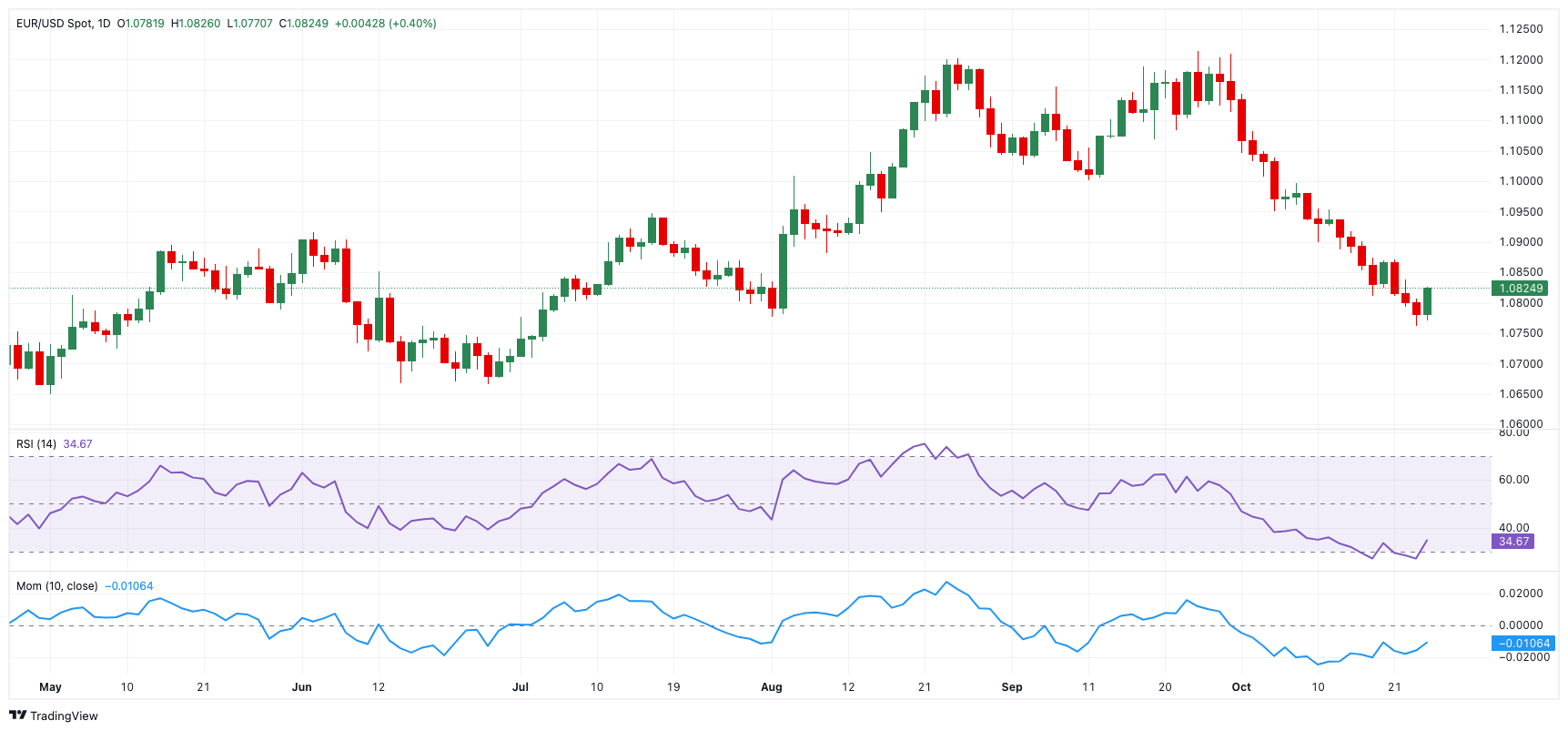
EUR/USD short-term technical outlook
Further loss could bring EUR/USD to its October low of 1.0760 (October 23), paving the way for a possible test of the round level at 1.0700 ahead of the June low of 1.0666 (June 26).
On the upside, the 200-day SMA at 1.0870 is first, followed by the preliminary 100-day and 55-day SMAs at 1.0932 and 1.1031, respectively. Further up is the 2024 high of 1.1214 (September 25), followed by the 2023 high of 1.1275 (July 18).
Meanwhile, if the pair continues to trade below the important 200-day SMA, the outlook will stay bearish.
The four-hour chart shows some gradual recovery. Nonetheless, the initial support is at 1.0760, followed by 1.0666. On the upside, the 55-SMA at 1.0849 leads, seconded by 1.0954 and 1.0996. The relative strength index (RSI) rose past 52.
Premium
You have reached your limit of 3 free articles for this month.
Start your subscription and get access to all our original articles.
Author
Pablo Piovano
FXStreet
Born and bred in Argentina, Pablo has been carrying on with his passion for FX markets and trading since his first college years.

















