EUR/USD Forecast: Will Powell propel the pair higher? The bullish case for the euro on Fed Day
- EUR/USD has been hovering around 1.21 as tensions mount ahead of the critical Fed decision.
- The bank is unlikely to hint at tapering, thus depressing the dollar.
- Tuesday's four-hour chart is showing that bears still have the upper hand.

The wait is almost over – it is only a matter of hours until the Federal Reserve speaks out and unleashes volatility. Where will the dollar go to? There are reasons to believe the world's most powerful central bank will deal its currency a blow, but the road there could be choppy.
The bank first releases its statement, where no major surprises are on the cards – no change to interest rates. At the same time, at 18:00, it also publishes updated quarterly forecasts, aka "the dot plot."
Investors will likely be focused on projections for interest rates. Back in March, a large majority saw the lift-off coming only in 2024, beyond market estimates of higher borrowing costs already in 2023. As conditions improve, there is a chance that the minority of hawks has grown. Any speculation that rates could rise sooner than later would boost the dollar.
The updated outlook for inflation – which has substantially risen – is also of high interest, and without a significant upgrade, any spike in the dollar could prove temporary.
Even if the greenback comes on top at 18:00 GMT, Fed Chair Jerome Powell's press conference at 18:30 could send it back down. Reporters will likely ask Powell if the bank discussed tapering down its bond-buying scheme during the meeting. If he says no, the greenback could suffer. Another blow would come if the world's most powerful central banker dodges questions about the timing of such a debate.
Federal Reserve Preview: First up, then down? Playbook for trading the Fed
The Fed purchases $120 billion worth of debt every month, with newly created currency. Hints of a reduction could trigger a "taper tantrum" – a market decline – and also a boost to the dollar. However, this may have to wait for later this year. Why?
Fed Interest Rate Decision Preview: Chair Powell will determine market response
The Fed has two mandates, full employment, and price stability. On the labor front, the bank will likely focus on roughly 7.6 million Americans who are out of work. On price rises, Powell is set to reiterate the case that inflation is "transitory." The headline Consumer Price Index hit 5% YoY in May, but that was mostly driven by base effects and jitters related to the quick reopening. He is likely to shrug off leaps in airfare costs, prices of used cars and also apparel.
Even the latest figures seem to have failed to cause worries – Retail Sales dropped by 1.3% in May, more than expected.
US Data: Trio of figures are insufficient to trigger Fed tapering, dollar to suffer
Apart from the Fed decision, the EU raised €20 billion in its fresh 10-year bond issuance. The funds are designated for the bloc's stimulus package and the successful auction is encouraging for the European economy, still recovering from the virus.
Overall, the keys to the next moves lie with the Fed, and the dovish case is strong.
EUR/USD Technical Analysis
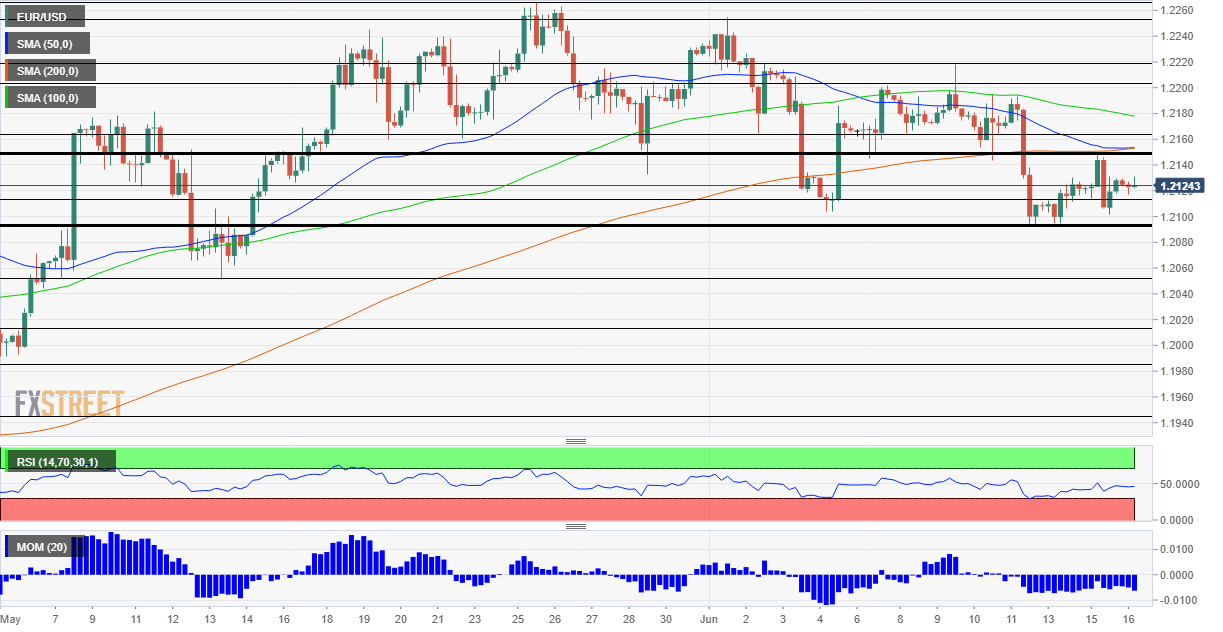
Euro/dollar is suffering from downside momentum on the four-hour chart and is capped at 1.2150 by the 50 and 200 simple moving averages. That is critical resistance.
Above 1.2150, the next lines to watch are 1.2160, a cushion from early in the month, followed by 1.22 and 1.2220, which capped EUR/USD last week. The next lines are 1.2250 and 1.2266.
Some support awaits at 1.2110, a support line from earlier in the week, and then by 1.2090, June's low. Further down, 1.2055 and 1.2015 are eyed.
Author

Yohay Elam
FXStreet
Yohay is in Forex since 2008 when he founded Forex Crunch, a blog crafted in his free time that turned into a fully-fledged currency website later sold to Finixio.