EUR/USD Forecast: Three reasons for the rise and one scary figure that can bring it down
- EUR/USD has topped 1.09 amid relative stability and two other coronavirus-related developments.
- US jobless claims may be in the millions, triggering a sell-off.
- Thursday's four-hour chart is showing an improving picture for the bulls.


"The dollar against everything" – not anymore. The greenback used to either demolish all rivals when investors sought havens or succumb to pressure when markets recovered. This easy-to-grasp mentality has now changed, with more nuanced trading.
Is this a sign of normality? Perhaps, and it is one of the reasons supporting EUR/USD – at least for now.
1) Some calm after massive US stimulus
The US Senate has passed the $2 trillion stimulus plan in a unanimous vote, yet after intense negotiations. Some are skeptical about the details of the massive package that includes a large chunk of loans and does not provide enough assistance to states such as New York.
Nevertheless, the massive fiscal injection – backed by the Federal Reserve's open-ended Quantitative Easing scheme – is flooding markets with cash and relative stability.
On this background, currencies backed by current account surpluses – with more money coming in than leaving – are on the rise. The Japanese yen and the euro are rising. Following the flows of money is a phenomenon reserved for times when speculation is limited. It is hard to see quiet times persist.
2) Flashing the cash in Europe
France, Italy, Spain, and six other EU nations have called on leaders to go for issuing "corona-bonds" – all-European debt to be shared among members. While Germany and the Netherlands reportedly oppose it, growing pressure from nations struggling with Covid-19 may win the day.
The parliament in Berlin approved a €750 billion stimulus package, which includes suspending the debt-brake. Finance Minister Olaf Scholz said that his country has "unlimited firepower," showing flexibility from the country that led austerity policies in the euro crisis.
The European Central Bank – which unveiled a €750 billion new QE program last week – is ready to take additional steps as well. In a new legal text, the ECB has revealed that it will abandon its self-imposed capital key limits from its new bond-buying scheme. That allows the bank to buy more than 33% of one country's debt.
Moreover, the Frankfurt-based institution is dusting off its Outright Monetary Transactions (OMT) – a scheme designed in 2012 and that was never used. The "bazooka" allows buying government debt from a specific country.
All in all, policymakers are going in the right direction also in the old continent. The EU's 27 leaders will hold a videoconference later in the day. If they adopt ambitious palns, it would be positive for the euro.
3) More signs of hope from Italy
The eurozone's third-largest economy remains the epicenter of the crisis, but there are signs of hope. The number of new mortalities has dropped to 683 and new cases have been stable around 5,000. In the nation's northern Lombardy region – the hardest-hit and where the lockdowns were first imposed – the figures are more encouraging.
Italy may be showing the way forward and providing hope for containing the spread in Europe and boosting the euro.
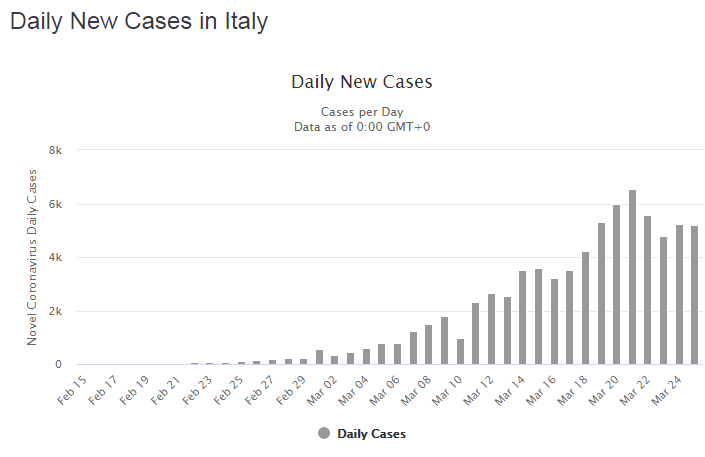
Source: WorldInfoMeters
However, cases in Spain continue hitting new records, with 738 deaths reported on Wednesday. The government in Madrid said that the worst is yet to come. New figures are due out during the day.
Focus on US jobless claims
Contrary to Europe, there are few protections for workers in the US, and this has already triggered significant layoffs. The number of jobless claims jumped last week from 211,000 to 281,000.
It will likely get much worse with the consensus standing at around 1.5 million and estimates reaching as high as four million. A terrible number may weigh on stocks and perhaps trigger a rush to the safe-haven dollar.
See: Jobless Claims Preview: Recessionary timelines
$2 trillion may be insufficient to battle a leap in unemployment.
The US also releases final Gross Domestic Product figures for the fourth quarter, which are expected to confirm annualized growth at 2.1%. However, any figures predating the crisis are ignored by markets.
Overall, the focus is on coronavirus headlines – health and policy responses.
EUR/USD Technical Analysis
-637208075469789790.png&w=1536&q=95)
Euro/dollar has surpassed the 50 Simple Moving Average on the four-hour chart and continues benefiting from upside momentum. The currency pair remains below the 100 and 200 SMAs. All in all, the picture is improving.
Some resistance awaits at 1.0980, where the 200 SMA hits the price. It is followed by 1.1050, which separated ranges in mid-March. It converges with the 100 SMA. The next levels to watch are 1.11 and 1.1240.
Support awaits at 1.09, which was a swing high earlier this week, followed by 1.0840, a cap from last week. Next, 1.0750 and 1.0640 await EUR/USD.
More Coronavirus: How Trump's shortcuts could lengthen and exacerbate stocks' suffering
Author
Yohay Elam
FXStreet
Yohay is in Forex since 2008 when he founded Forex Crunch, a blog crafted in his free time that turned into a fully-fledged currency website later sold to Finixio.