EUR/USD Forecast: Ready to for a new really? Another poor US figure could spark the next surge
- EUR/USD is trading close to two-year highs as weak US data weighs on the dollar.
- Jobless claims, fiscal stimulus updates, and Sino-American tensions are in play.
- Thursday's four-hour chart is showing bulls are in control.

Another day, another dose of dollar weakness? Wednesday's dural disappointments have created a double-top and another miss could send EUR/USD beyond the fresh high of 1.1916, a minor breach of the previous 1.1909 peak.
ADP reported an increase of only 167,000 private-sector jobs in July, far below 1.5 million expected. While America's largest payroll provider has found it hard to project the official Non-Farm Payrolls figure, it has been pointing to the direction of travel. The employment component of the ISM Non-Manufacturing Purchasing Managers' Index also pointed to weakness in hiring. That hurt the dollar, despite an upbeat headline number.
See:US Data Analysis: Big jobs number? Negative NFP looks more likely, trends could extend in gold, dollar
The highlight of Thursday's economic calendar is weekly jobless claims. While the figures are for the weeks after the one in which the Non-Farm Payrolls surveys are conducted, investors will want to see if the unsettling uptrend continues. High-frequency figures have been receiving more attention of late and another increase could send the greenback down.
See US Initial Jobless Claims: Can claims and payrolls rise at the same time?
Tension is already rising toward Friday's Non-Farm Payrolls with analysts set to provide updates to their estimates. President Donald Trump touted a "big number" coming, yet he may have not received the data just yet. Presidents often have early access to the NFP statistics late on Thursday. Expectations will likely suffer a downgrade, thus weighing on the dollar.
Looking ahead: US Non-Farm Payrolls Preview: A dual-track labor market or imperfections in the data?
Trump said he would use an executive order to extend federal unemployment claims if Democrats and Republicans fail to reach an agreement on a new fiscal package. Senators are negotiating but it seems that the power lies with the president and also with Nancy Pelosi, Speaker of the House.
Markets are pricing in a multi-trillion boost from the government despite politicians blaming each other for stalled talks. Several programs expired on Friday and those out of work may already be feeling the pinch. Developments on that front are set to move the dollar.
Stocks remain upbeat amid high hopes for a coronavirus vaccine. Anthony Fauci, America's top immunologist, said that tens of millions of doses could become available already this year to Americans. Another encouraging development is that the coronavirus case-curve is falling in the US.
COVID-19 infections are on the rise in the old continent, especially in Spain, France, and Belgium. Markets are shrugging it off, and continue seeing these flareups as local. If worries increase, the euro has room to fall. However, so far things seem under control.
All in all, the wind continues blowing in favor of EUR/USD bulls, at least for now.
EUR/USD Technical Analysis
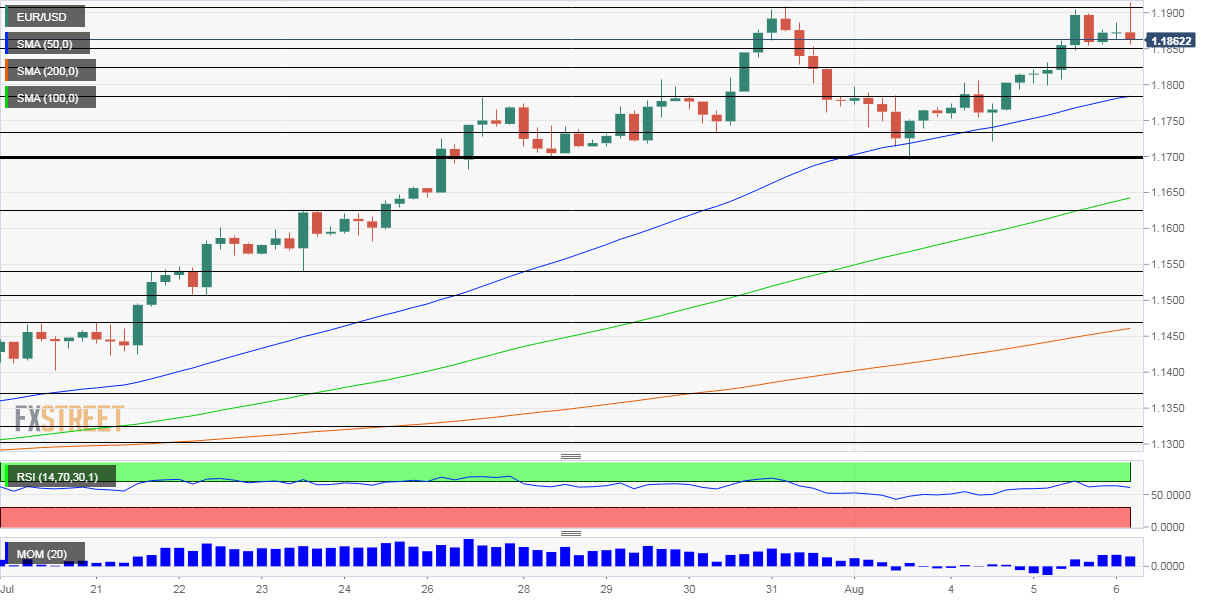
EUR/USD failure to hold onto the break above 1.1909 does not take away from its bullish bias. Momentum on the four-hour chart remains to the upside and the world's most popular currency pair is trading above the 50, 100, and 200 Simple Moving Averages. Moreover, the Relative Strength Index is below 70, thus outside overbought conditions.
July's high of 1.1909 is still in play and the it is followed by the round 1.20 level. Higher above, 1.2040 and 1.2110 – last seen in 2018 – are the next tentative targets.
Support awaits at the daily low of 1.1855, followed by 1.1780, a temporary peak on the way up. Next, 1.1735 and the robust 1.17 line await EUR/USD.
Author

Yohay Elam
FXStreet
Yohay is in Forex since 2008 when he founded Forex Crunch, a blog crafted in his free time that turned into a fully-fledged currency website later sold to Finixio.
















