EUR/USD Forecast: Next relevant hurdle comes at the 200-day SMA
- EUR/USD bounced off yearly lows near 1.0600.
- The Dollar’s loss of momentum lent legs to the risk complex.
- The ECB-Fed policy divergence dominates the scenario.

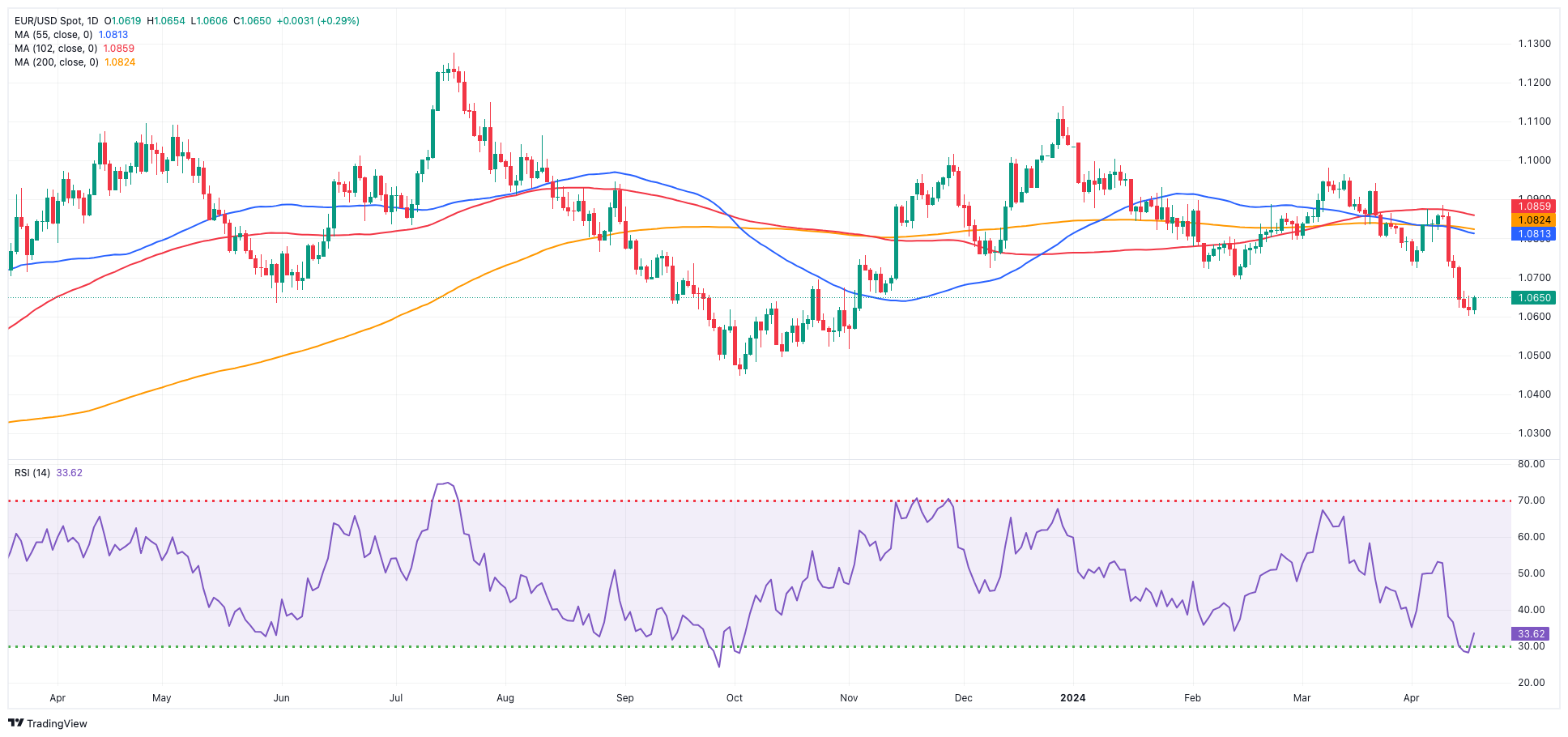
A decent bounce in EUR/USD left behind six consecutive daily drops, including a new YTD bottom near 1.0600 the figure, regaining the mid-1.0600s in response to some loss of impetus in the Dollar’s rally.
The recent multi-session strong rally in the greenback occurred as investors re-evaluated the timing of a potential rate cut by the Federal Reserve (Fed), now anticipated to occur later than previously thought, potentially in December.
This reassessment coincided with a move lower in US yields across the curve and a steady narrative regarding the divergence of monetary policy between the Fed and other G10 central banks, particularly the European Central Bank (ECB).
Regarding the ECB, Board member Holzmann highlighted the differing inflation dynamics between Europe and the US, emphasising the need to await developments until June before considering any cuts. He cautioned against premature speculation on the frequency of potential cuts by the ECB in 2024, noting that moving ahead of the Fed could diminish the effectiveness of such measures.
Echoing this sentiment, the ECB's Cipollone observed a rapid decline in inflation, expressing expectations for a return to the 2% path next year and attainment of the target by mid-2025. Should data in June and July confirm growing confidence in achieving the target, consideration would be given to easing some of the restrictive measures imposed in 2023. Additionally, the impact of the Middle East conflict on energy costs remains a significant risk factor.
Around the Fed, at an event hosted at The Wilson Center in Washington on Tuesday, Chair Powell stated that recent data have not instilled increased confidence in them; rather, they suggest that it will likely take more time than anticipated to gain that confidence.
Looking forward, the relatively subdued economic fundamentals in the eurozone, coupled with the resilience of the US economy, reinforce expectations for a stronger Dollar in the medium term, particularly considering the prospect of the ECB lowering rates before the Fed. In such a scenario, EUR/USD is anticipated to experience a more pronounced decline from a short-term perspective.
EUR/USD daily chart
EUR/USD short-term technical outlook
The fall of the 2024 low of 1.0601 (April 16) may signal a return to the November 2023 low of 1.0516 (November 1), prior to the weekly low of 1.0495 (October 13, 2023), the 2023 bottom of 1.0448 (October 3), and the round milestone of 1.0400.
On the upside, EUR/USD is projected to find initial resistance at the crucial 200-day SMA of 1.0822, followed by the April high of 1.0885 (April 9), the March top of 1.0981 (March 8), and the weekly peak of 1.0998 (January 11), all before hitting the psychological barrier of 1.1000. Further advances from here could threaten the December 2023 high of 1.1139 (December 28).
The 4-hour chart shows that the bearish trend seems to have met some contention around the 1.0600 neighbourhood. Against it, the initial support is at 1.0601, followed by 1.0516. In the opposite direction, the initial up-barrier is at 1.0665, ahead of 1.0756 and the 100-SMA at 1.0767. The Moving Average Convergence Divergence (MACD) rebounded from recent lows, while the Relative Strength Index (RSI) advanced past 45.
Author

Pablo Piovano
FXStreet
Born and bred in Argentina, Pablo has been carrying on with his passion for FX markets and trading since his first college years.
















