EUR/USD Forecast: Further gains now look at US NFP
- EUR/USD briefly retested the 1.0900 region post-ECB.
- The US Dollar traded with mild losses ahead of Payrolls.
- The ECB cut its interest rates by 25 bps, matching expectations.

The US Dollar (USD) saw modest losses on Thursday, encouraging EUR/USD to regain some balance, briefly surpass the 1.0900 barrier, and end the session with decent gains around 1.0880.
The move lower in the Greenback favoured further buying interest in the risk complex, although EUR/USD’s gains were also underpinned by the cautious stance by the European Central Bank (ECB) at its event on Thursday.
On the latter, the ECB reduced its interest rates by a quarter percentage point, as expected, and indicated that the Governing Council (GC) would “continue to follow a data-dependent and meeting-by-meeting approach to determining the appropriate level and duration of restrictions without pre-committing to a particular rate path." It is worth noting that the bank’s decision to reduce rates was not unanimous, as board member Holzmann voted to keep the current status quo unchanged.
At her press conference, President Christine Lagarde remarked that interest rates are currently far from neutral levels. Additionally, she mentioned that the Governing Council’s confidence in its inflation outlook had increased due to the stability of its medium-term projections in recent quarters. While the statement did not provide any guidance on the timing of a future move, Lagarde suggested that a move in September would be likely.
Back to the Fed: Recent hawkish comments from Fed officials have fueled speculation that the Federal Reserve (Fed) might keep its tight monetary policy stance longer than expected. However, disappointing US JOLTs Job Openings data for April (Tuesday), along with discouraging May ADP Employment Change (Wednesday) and higher-than-expected Initial Jobless Claims (Thursday), have all reignited speculation of potential rate cuts in September and December.
The CME Group's FedWatch Tool now indicates nearly a 70% chance of lower interest rates by the September 18 meeting, up from around 50% a week ago.
In the very near term, the recent rate cut by the ECB widened further the policy gap with the Fed, exposing EUR/USD to potential extra weakness. In the longer run, however, the incipient economic recovery in the Eurozone, combined with a perceived slowdown in the US economy, should reduce the banks’ divergence, lending some support to the pair.
Moving forward, the imminent US Nonfarm Payrolls figures for the month of May due on June 7 should shed further light regarding the potential timing of the Fed’s interest rate cut. If prints come on the soft side, investors would most likely start to further price in a rate reduction at the September gathering, therefore maintaining the downward bias on the Greenback well in place.
EUR/USD daily chart
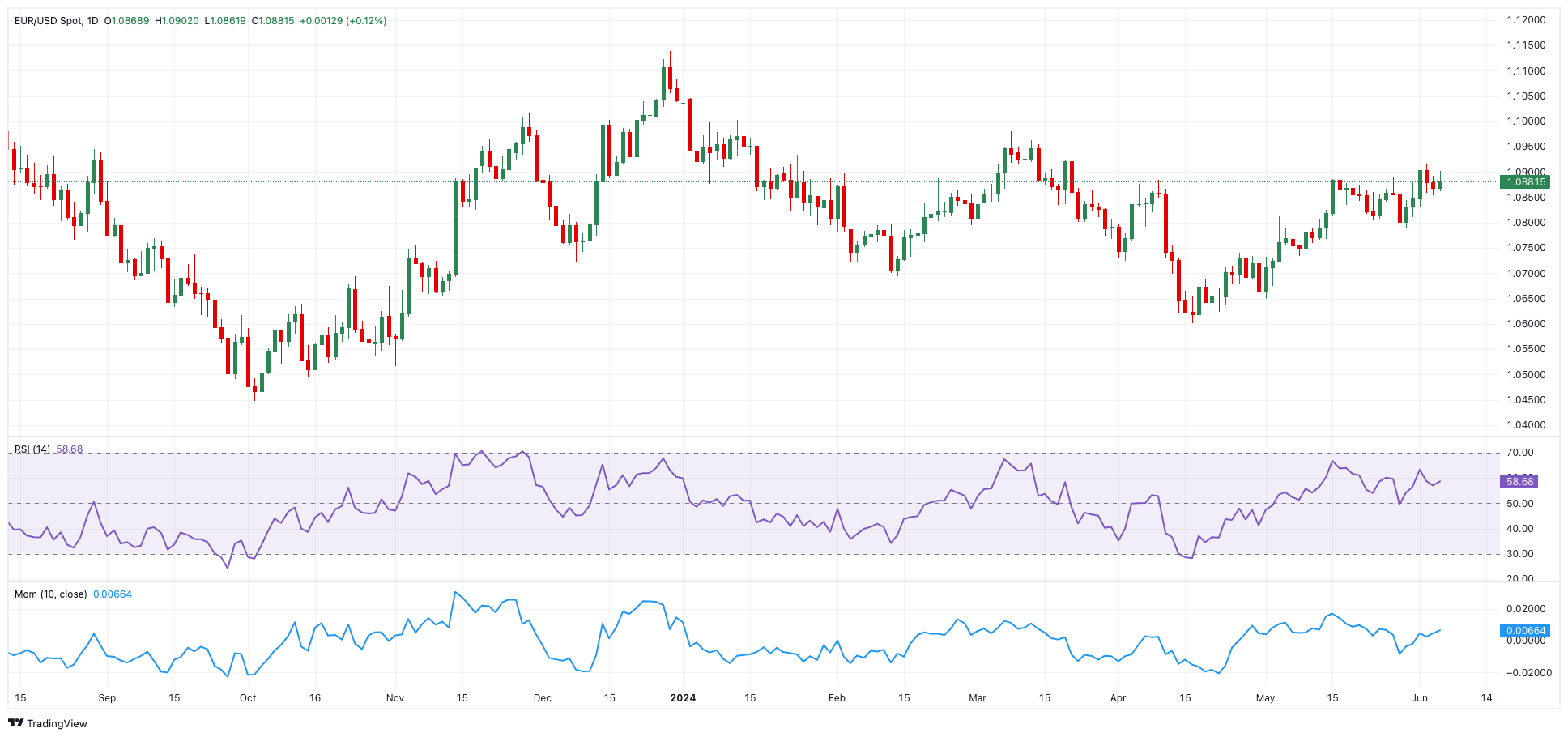
EUR/USD short-term technical outlook
If bulls retain control, EUR/USD may test the June high of 1.0916 (June 4), then the March top of 1.0981 (March 8), and finally the weekly peak of 1.0998 (January 11), all before hitting the key 1.1000 level.
If the bearish tone regains poise, the pair may first target the weekly low of 1.0788 (May 30), which is supported by the 200-day SMA. A decline below this level might send the pair to the May low of 1.0649 (May 1), ahead of the 2024 bottom of 1.0601 (April 16).
So far, the 4-hour chart shows some consolidative activity in the short future. The 55-SMA (1.0858) is the next descending obstacle, followed by 1.0788 and 1.0766. On the plus side, 1.0916 comes out ahead of 1.0942. The relative strength index (RSI) settled around 54.
Author

Pablo Piovano
FXStreet
Born and bred in Argentina, Pablo has been carrying on with his passion for FX markets and trading since his first college years.