EUR/USD Forecast: Euro holds above key support level ahead of important data releases
- EUR/USD holds steady above 1.0800 following Wednesday's decline.
- ECB will release Negotiated Wage Rates data for Q1 on Thursday.
- Weekly Jobless Claims and PMI reports will be featured in the US economic docket.


EUR/USD turned south and declined below 1.0850 on Wednesday. The pair struggles to gather recovery momentum early Thursday but holds comfortably above 1.0800.
The negative shift seen in risk mood and the hawkish tone of the minutes of the Federal Reserve's (Fed) April 30-May 1 policy meeting helped the US Dollar (USD) find demand in the American session on Wednesday, causing EUR/USD to decline to a weekly low.
Euro PRICE This week
The table below shows the percentage change of Euro (EUR) against listed major currencies this week. Euro was the weakest against the British Pound.
| USD | EUR | GBP | JPY | CAD | AUD | NZD | CHF | |
|---|---|---|---|---|---|---|---|---|
| USD | 0.39% | -0.20% | 0.72% | 0.50% | 1.12% | 0.43% | 0.62% | |
| EUR | -0.39% | -0.61% | 0.39% | 0.12% | 0.77% | 0.05% | 0.24% | |
| GBP | 0.20% | 0.61% | 0.84% | 0.74% | 1.38% | 0.65% | 0.82% | |
| JPY | -0.72% | -0.39% | -0.84% | -0.24% | 0.40% | -0.28% | -0.12% | |
| CAD | -0.50% | -0.12% | -0.74% | 0.24% | 0.57% | -0.08% | 0.09% | |
| AUD | -1.12% | -0.77% | -1.38% | -0.40% | -0.57% | -0.73% | -0.55% | |
| NZD | -0.43% | -0.05% | -0.65% | 0.28% | 0.08% | 0.73% | 0.16% | |
| CHF | -0.62% | -0.24% | -0.82% | 0.12% | -0.09% | 0.55% | -0.16% |
The heat map shows percentage changes of major currencies against each other. The base currency is picked from the left column, while the quote currency is picked from the top row. For example, if you pick the Euro from the left column and move along the horizontal line to the US Dollar, the percentage change displayed in the box will represent EUR (base)/USD (quote).
Early Thursday, the data from Germany showed that the business activity in the private sector expanded at an accelerating pace in early May, with the preliminary HCOB Composite PMI improving to 52.5 from 50.6 in April. Commenting on the PMI surveys' findings, “those predicting a prolonged weakness in the German economy might be proven wrong soon," said Dr. Cyrus de la Rubia, Chief Economist at Hamburg Commercial Bank. "The service sector, in particular, showed robust growth in May, expanding for three consecutive months. There's more reason for optimism as it's not just output that's improving, but also new business and demand from abroad, which includes tourism."
Meanwhile, the Manufacturing PMI for the Eurozone rose to 47.4 from 45.7 in the same period, while the Services PMI held steady at 53.3. Upbeat PMI readings seem to be helping the Euro hold its ground in the European morning.
Later in the session, the European Central Bank (ECB) will release the Negotiated Wage Rates data for the first quarter, which is a key metric that could influence the market pricing of the ECB's rate outlook. Following the 4.46% increase recorded in the previous quarter, a reading above 4.5% could revive expectations about the ECB adopting a cautious approach to policy easing, even if they opt for a 25 basis points cut in key rates in June, and provide a boost to the Euro. On the other hand, a noticeable decline could put additional weight on the Euro's shoulders and open the door for a leg lower in EUR/USD.
In the American trading hours, the US Department of Labor will publish the weekly Initial Jobless Claims data. Additionally, S&P Global will release preliminary Manufacturing and Services PMI reports. If PMI data come in better than forecast, the USD could stay resilient against its rivals. On the flip side, the USD could come under renewed selling pressure if the Composite PMI comes in below 50 to show a contraction in the private sector's activity.
EUR/USD Technical Analysis
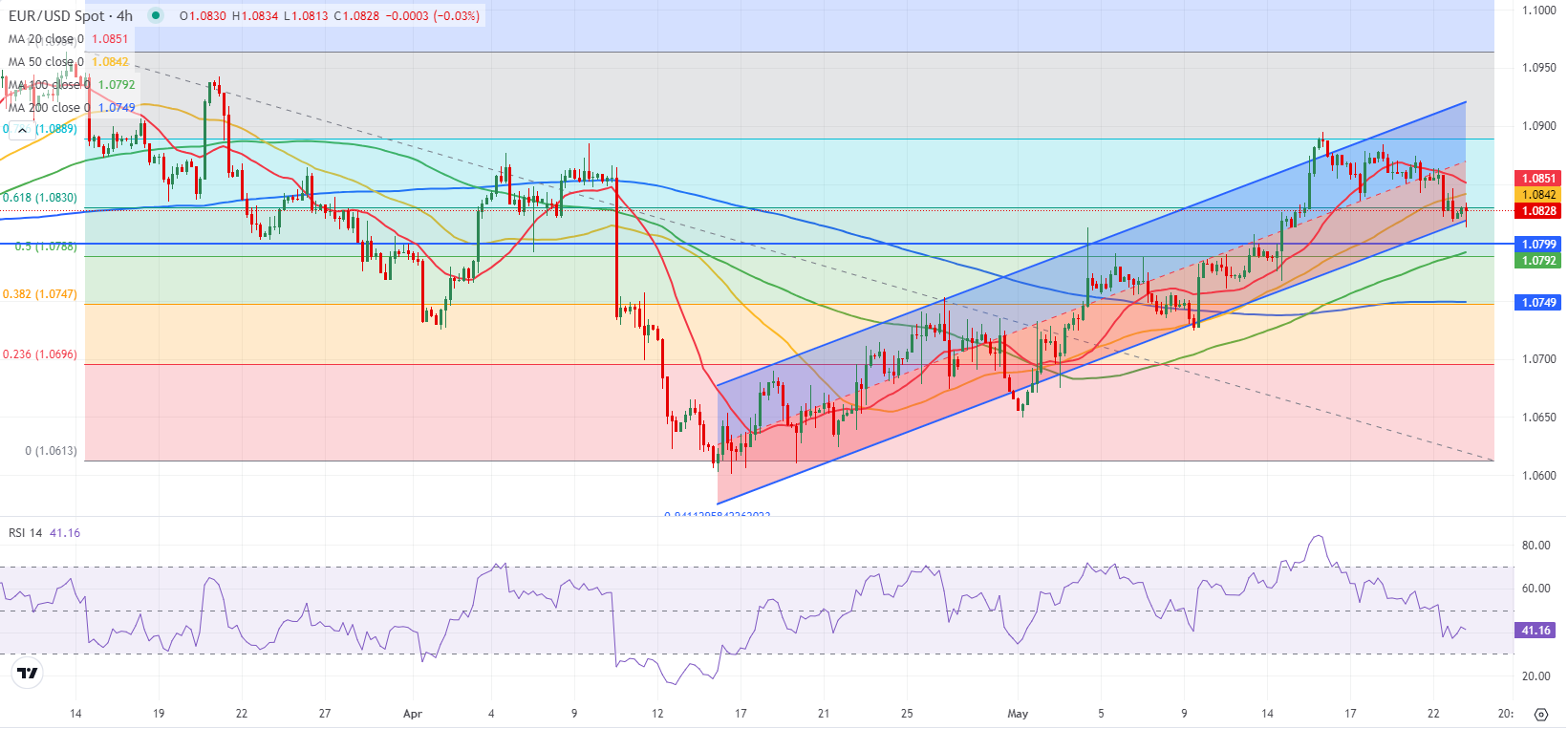
EUR/USD trades slightly above 1.0820, where the lower limit of the ascending regression channel coming from mid-April is located. If the pair drops below that level, 1.0800-1.0790 (static level, 100-period Simple Moving Average (SMA) on the 4-hour chart and Fibonacci 50% retracement of the latest downtrend) could act as strong support before 1.0750 (Fibonacci 38.2% retracement, 200-period SMA).
On the upside, 1.0840 (50-period SMA) aligns as immediate resistance before 1.0870 (mid-point of the ascending channel) and 1.0900 (psychological level, static level).
Economic Indicator
Negotiated Wage Rates (QoQ)
Negotiated Wage Rates, published by the European Central Bank (ECB) on a quarterly basis, is a data designed for the purpose of estimating wage drift in the Euro area and it's considered to provide a useful statistical representation of contractual basic pay. A steady increase in this data could be seen as an inflationary development and influence the ECB to cling to a tight monetary policy, supporting the Euro, and vice versa.
Read more.Last release: Tue Feb 20, 2024 10:00
Frequency: Quarterly
Actual: 4.46%
Consensus: -
Previous: -
Source: European Central Bank
Premium
You have reached your limit of 3 free articles for this month.
Start your subscription and get access to all our original articles.
Author
Eren Sengezer
FXStreet
As an economist at heart, Eren Sengezer specializes in the assessment of the short-term and long-term impacts of macroeconomic data, central bank policies and political developments on financial assets.