EUR/USD Forecast: Bulls need a strong catalyst to retest 1.0800
- EUR/USD’s upside impetus faltered around 1.0760.
- The Greenback navigated an unconvincing range in the low-105.00s.
- Economic Sentiment in Germany fell short of estimates in June.

The US Dollar (USD) added to the negative start to the week and receded marginally on Tuesday, lending some tepid support to the risk complex and lifting EUR/USD to as high as the 1.0760 zone, where some initial resistance seems to have emerged.
The pair’s marginal advance also found support in somewhat subsiding political concerns in France, while poor data in the US docket weighed on the Greenback and re-ignited speculation of two interest rate cuts by the Federal Reserve (Fed) this year.
Back to the Fed, the broad-based cautious tone from Fed policymakers on Tuesday seems to have limited the downside in the US Dollar. On this, Boston Federal Reserve President Susan Collins warned against overstating recent inflation data, stating that it was not the appropriate moment for the Fed to reduce interest rates. In addition, Federal Reserve Governor Adriana Kugler noted that inflation is showing promising signs of moderating, but suggested that if economic conditions continue to improve, it would be suitable to consider lowering interest rates later this year. Her colleague, Richmond Fed President Thomas Barkin, said he needed to analyze more months of economic data before supporting a rate cut.
According to the CME Group's FedWatch Tool, the probability of lower interest rates by the September 18 meeting now stands at nearly 67%.
In the near term, the recent rate cut by the European Central Bank (ECB) in contrast to the Federal Reserve's decision to hold rates has widened the policy divergence between the two central banks, potentially exposing EUR/USD to additional weakness.
However, looking ahead, the Eurozone's emerging economic recovery and perceived slowdowns in the US economy are expected to help mitigate this discrepancy, offering some support to the currency pair.
Meanwhile, ECB Vice President Luis de Guindos emphasized that the optimal timing for rate decisions aligns with the release of the bank's updated macroeconomic projections, scheduled for September.
Turning to domestic developments, Economic Sentiment in Germany saw a marginal improvement to 47.5 in June, while it rose to 51.3 for the broader euro area. Still in the region, final Inflation Rate figures indicated that the headline Consumer Price Index (CPI) increased by 2.6% YoY in May, with the core CPI rising by 2.9% over the same period.
EUR/USD daily chart
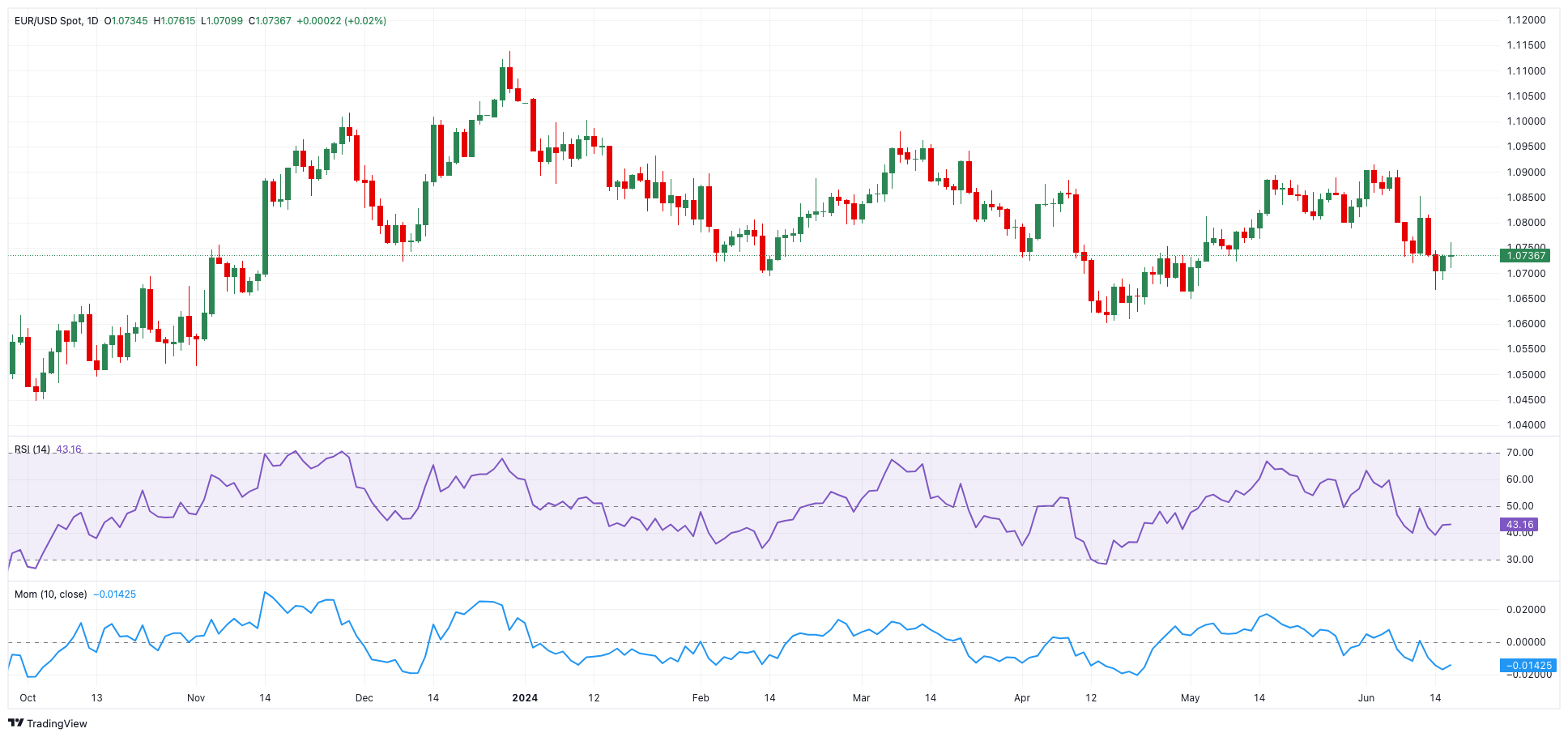
EUR/USD short-term technical outlook
If the downturn continues, EUR/USD might retest the June low of 1.0667 (June 14), ahead of the May low of 1.0649 (May 1), and finally the 2024 bottom of 1.0601 (April 16).
Looking higher, the 200-day SMA is at 1.0788, ahead of the weekly high of 1.0852 (June 12), followed by the June top of 1.0916 (June 4) and the March peak of 1.0981 (March 8). Further north, the weekly high of 1.0998 (January 11) precedes the critical 1.1000 level.
The 4-hour chart thus far indicates some signs of healing. Bulls should aim for 1.0810 before 1.0852, then 1.0916, and finally 1.0942. 1.0667 is the first number to fall, followed by 1.0649 and 1.0601. The Relative Strength Index (RSI) dropped to around 48.
Author

Pablo Piovano
FXStreet
Born and bred in Argentina, Pablo has been carrying on with his passion for FX markets and trading since his first college years.

















