EUR/USD Forecast: Another move to 1.1000 remains on the cards
- EUR/USD came under pressure and challenged 1.0900.
- The Dollar regained traction and weighed on the risk complex.
- Germany’s Factory Orders expanded more than expected in June.

EUR/USD came under renewed selling pressure and set aside two straight days of gains on Tuesday, all against the backdrop of the resurgence of some upside traction in the greenback as well as a generalized better tone in the stock markets worldwide.
On the USD side of the equation, the USD Index (DXY) reclaimed the 103.00 barrier and beyond after Monday’s steep retracement to the 102.00 neighbourhood, helped by renewed selling in the Japanese yen as well as a decent rebound in US yields across the spectrum.
Contributing to the better mood around the Greenback, some Fed officials (A. Goolsbee and M. Daly) somehow suggested that markets could have exaggerated the recent results from the US labour market, therefore ruling out a US recession, although they were leaning towards rate reductions to avoid such a scenario.
In the German money market, 10-year bund yields added to Monday’s small recovery and surpassed the 2.20% level, in tandem with the rest of their global peers.
Also adding to the Dollar’s momentum, the likelihood of an emergency rate cut by the Fed has dissipated, although markets now see an increased probability of a 50 bps rate cut in September.
According to CME Group’s FedWatch Tool, there is a nearly 64% chance of that scenario materializing at the September 18 meeting, while around 36% gyrates around a quarter-point rate reduction.
If the Fed implements more substantial rate cuts, the policy divergence between the Fed and the ECB carries the potential to narrow in the medium-term horizon, which should be supportive of further gains in EUR/USD.
A glimpse at the longer run, however, sees the US economy outperforming its European counterpart, a prospect pointing to only transitory weakness in the Greenback.
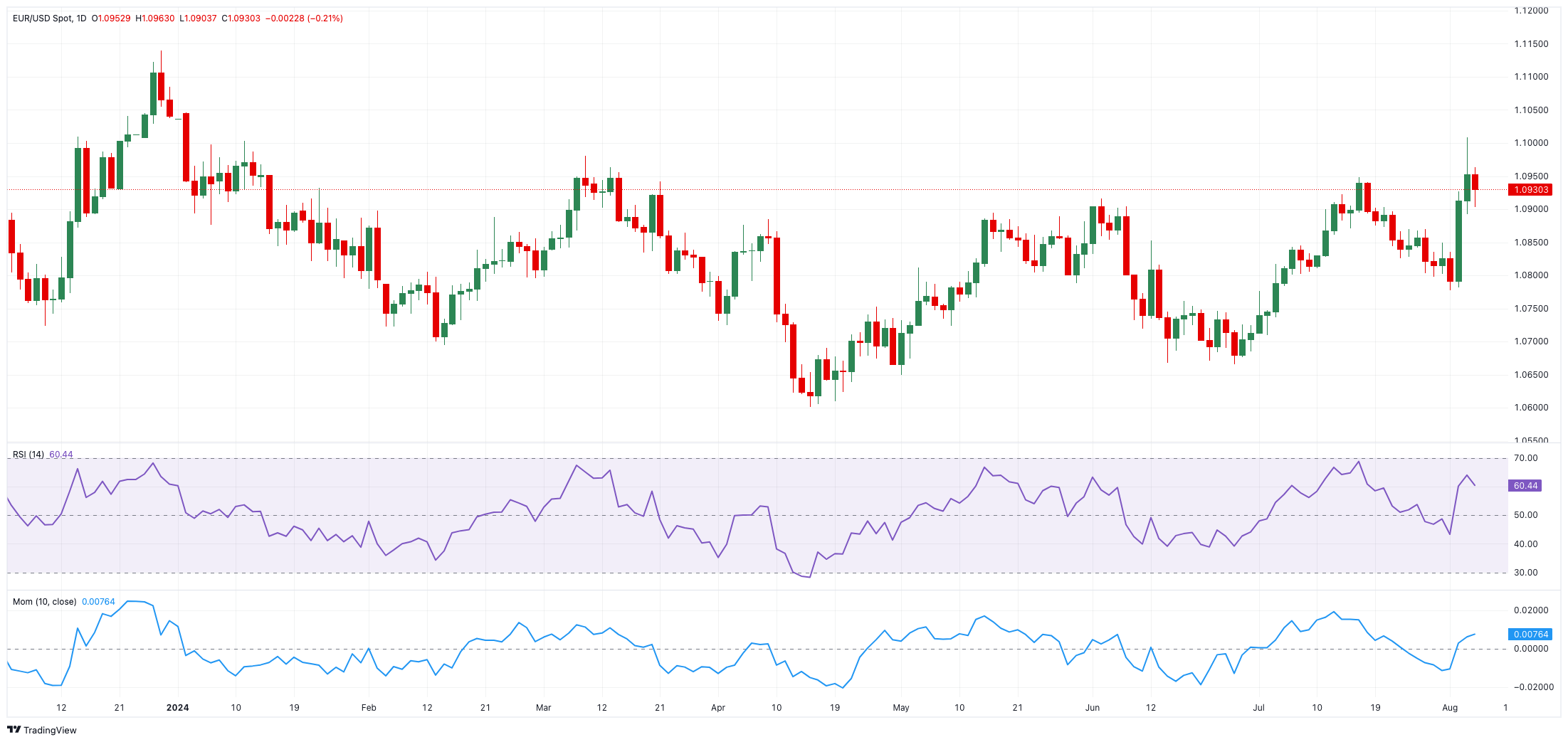
EUR/USD daily chart
EUR/USD short-term technical outlook
Further north, EUR/USD faces the August high of 1.1008 (August 5), followed by the December 2023 top of 1.1139 (December 28).
On the downside, the pair's next target is the 200-day SMA at 1.0828, ahead of the weekly low of 1.0777 (August 1) and the June low of 1.0666 (June 26), all of which came before the May bottom of 1.0649 (May 1).
Looking at the big picture, the pair's positive bias should remain in place if it stays above the key 200-day SMA on a sustainable fashion.
So far, the four-hour chart indicates some loss of upside momentum. The initial resistance is at 1.1008, prior to 1.1139. On the other hand, first support is at the 200-SMA of 1.0822 ahead of 1.0777, and 1.0709. The relative strength index (RSI) settled around 58.
Author

Pablo Piovano
FXStreet
Born and bred in Argentina, Pablo has been carrying on with his passion for FX markets and trading since his first college years.