Economic downturn is gathering pace, rally in Gold prices?
Business activity declined sharply in December. It signals an upcoming recession – a time that suits gold particularly well.
The economic downturn is gathering pace. The flash US PMI Composite Output Index came at 44.6 in December, down from 46.4 in November. It was the sharpest decline in business activity since May 2020 or, excluding the initial pandemic period, since the Great Recession. The decline in business activity was driven by the strong decrease in new orders, as inflation and higher interest rates dampened demand.
Both services and manufacturing are suffering. The S&P Global Flash US Services Business Activity Index registered 44.4 in December, compared to 46.2 in November. The fall in the services was the fastest in four months and among the quickest in the series history that started in October 2009. Meanwhile, the S&P Global Flash US Manufacturing PMI posted 46.2 in December, down from 47.7 in November. It was the fastest downturn since the initial pandemic period in 2020, which was driven by one of the sharpest declines in new orders since the global financial crisis of 2008-9.
PMI signals recession
There is a silver lining to the report. The inflationary pressures softened importantly at the end of Q4 2022. It seems that the Fed’s tightening cycle has the desired effect on inflation. However, it comes at significant economic costs. Inflationary pressure subsided partially because of the weakening demand. In other words, the PMI shows that a recession is coming! Actually, according to Chris Williamson, Chief Business Economist at S&P Global Market Intelligence:
Business conditions are worsening as 2022 draws to a close, with a steep fall in the PMI indicative of GDP contracting in the fourth quarter at an annualized rate of around 1.5%.
Implications for Gold
What does it all mean for the gold market? Well, the softening inflationary pressure combined with the economic downturn is fundamentally positive for gold and silver prices. They imply that the U.S. monetary policy will be less and less hawkish and more and more dovish. Additionally, the recessionary conditions should at some point increase the safe-haven demand for gold.
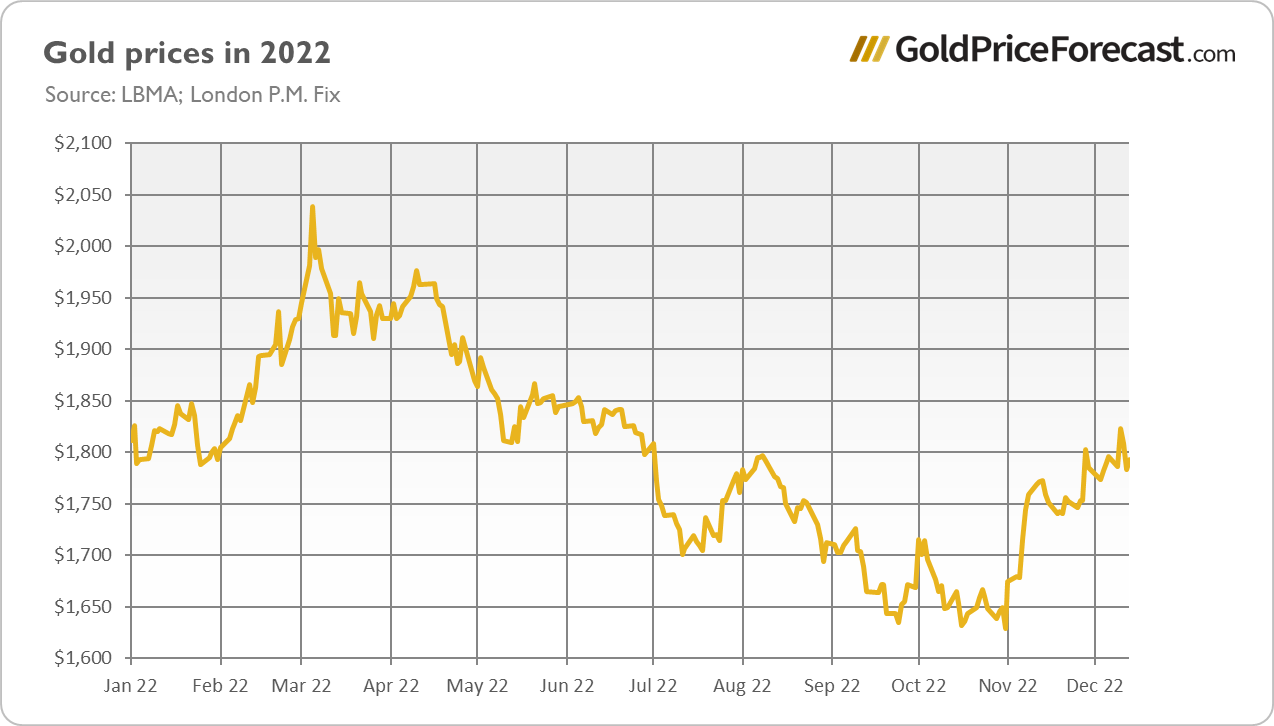
So far, the price of gold has fluctuated slightly below $1,800, as the chart above shows. It’s possible that it declines further amid a still hawkish Fed or the rush towards cash during the initial phase of the next economic crisis. But when this period passes, gold could rally amid recessionary or even stagflationary worries.
Want free follow-ups to the above article and details not available to 99%+ investors? Sign up to our free newsletter today!
Want free follow-ups to the above article and details not available to 99%+ investors? Sign up to our free newsletter today!
Author

Arkadiusz Sieroń
Gold Price Forecast
Arkadiusz Sieroń received his Ph.D. in economics in 2016 (his doctoral thesis was about Cantillon effects), and has been an assistant professor at the Institute of Economic Sciences at the University of Wrocław since 2017.

















