Canada Net Change in Employment January Preview: Is this the month?
- Job creation expected to moderate after volatile second half in 2019
- Unemployment rate to be stable near 45 year low
- US-China trade pact could help Canadian employment

Statistics Canada will issue its Labour Force Survey for January on Friday February 7th at 13:30 GMT, 8:30 EDT.
Forecast
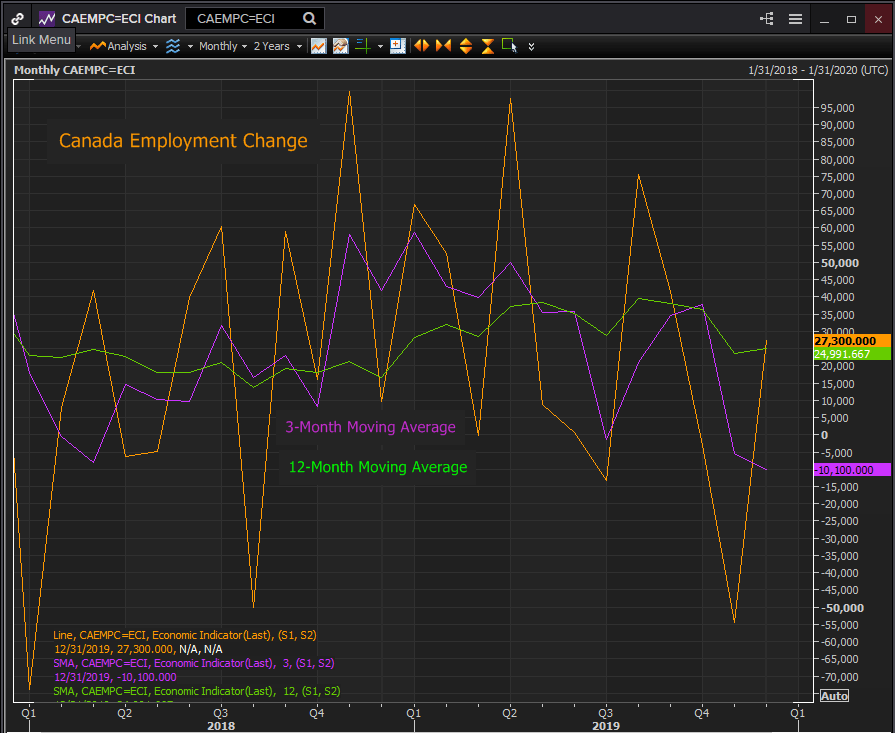
The Canadian labor economy is predicted to add 15,000 new jobs in January after gaining a revised 27,300 in December and losing 71,200 in November. The unemployment rate will be unchanged at 5.6%. The participation rate will rise 0.1% to 65.6%. Annual average hourly wages increased 3.84% in December and 4.36% in November.
Canadian labor economy
The Canadian labor market had a good 2019. Job creation averaged 25,000 a month for the year, but this record disguised considerable volatility between the first half of the year and the second and from month to month.
In June the average monthly employment change since the start of the year was 38,000. In December the change for the second half was 12,000. The three-month moving average had a high of 58,000 in January and a low of -10,000 in December.
Reuters
Wage gains ebbed toward the end of the year but the average of 3.35% was the best in a decade. The unemployment rate at 5.4% in May was a 45 year low and average for the year was the same four and a half decade record.

Reuters
GDP, PMI and inflation
Annualized quarterly GDP was 0.8% in the first three months, 3.5% in the second and 1.3% in the third for a 1.9% average. Final quarter figures will be reported on February 28th.
The Ivey purchasing managers’ index plunged to 43.6 in December its lowest since the final quarter of 2015 and the three month average ran from a low of 48.9 to 58.7 just three month later in May. The discrepancy between the halves of the year was minor, 54.7 in June and 53.2 in December.
Median core inflation was 2.2% in December and 2.1% over the year essentially removing prices from policy consideration.
Bank of Canada
The Bank Canada (BOC) under Governor Stephen Poloz was one of two major central banks, the other was the Bank of England, that did not cut rates at mid-year or provide additional liquidity to their economies in 2019.
BOC Overnight Rate
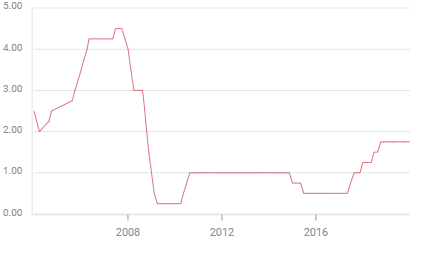
However the bank's latest economic assessment at the January 22nd meeting, that it expected weaker growth ahead, overshadowed the maintenance of the 1.75% base rate. With the US, Australian and New Zealand institutions in neutral, the BOC’s partial change of heart has weakened the Canadian dollar against the US and is likely to remain the policy directive until at least the next meeting on March 4th.
Canadian dollar
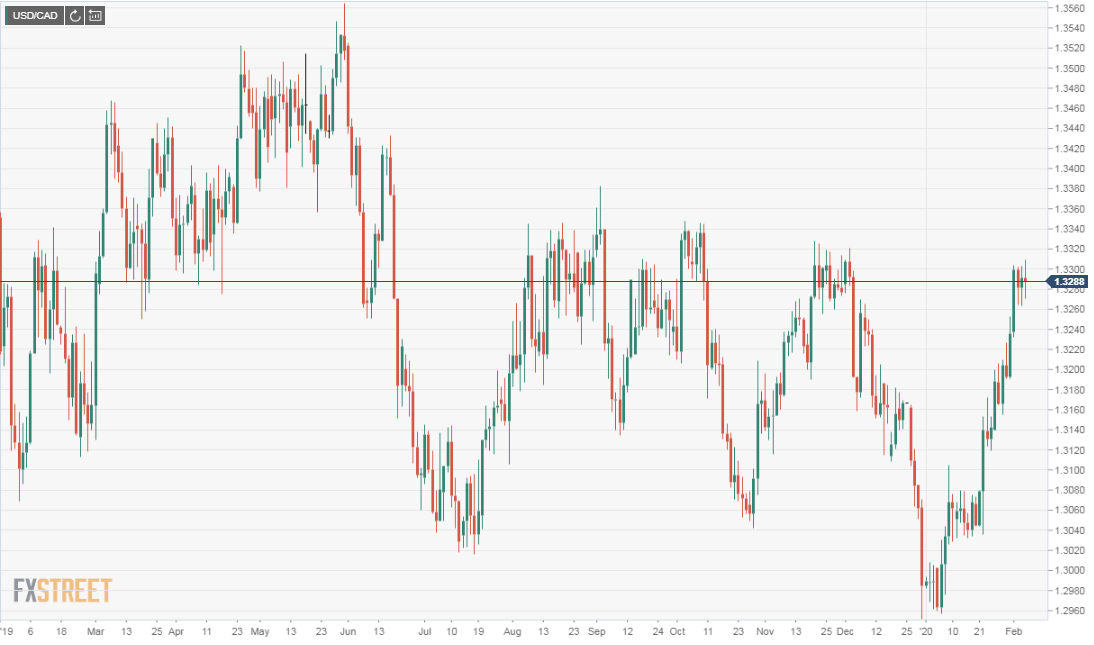
Since the January BOC meeting the greenback has gained 1.6% against the Canadian dollar. It has moved to the upper portion of its range since mid-June under the assumption that if the Canadian economy does not improve the next bank move could be a rate cut.
Conclusion
The doldrums that struck the Canadian economy in the second half should be mitigated by the US-China trade pact, though improvement may be delayed by the impact of the corona virus on the Chinese economy.
Canada’s resource based economy and position as the United States largest trading partner should let it benefit on two fronts if the trade agreement prospers. Anticipation of this change, as in the strong ADP private payrolls reports in December and January in the US, could be duplicated in Canada in a better than forecast employment report. .
Author

Joseph Trevisani
FXStreet
Joseph Trevisani began his thirty-year career in the financial markets at Credit Suisse in New York and Singapore where he worked for 12 years as an interbank currency trader and trading desk manager.

















