AUD/USD Price Forecast: There is transitory support near 0.6200
- AUD/USD reversed three consecutive daily declines on Thursday.
- The US Dollar faded part of the weekly recovery following poor data.
- Bets for a potential rate cut by the RBA in February continued to rise.

On Thursday, the US Dollar came under renewed downside pressure, giving away some of its earlier weekly gains mostly in response to disheartening prints from the US calendar.
That said, the US Dollar Index (DXY) dropped from weekly tops hit in the previous day north of the 108.00 hurdle, while the Australian Dollar (AUD) managed to regain a small smile, prompting AUD/USD to set aside a three-day negative streak.
China’s influence on the Aussie
Adding to the Australian Dollar's woes, weak business data from China published over the weekend has dampened investor sentiment and was almost exclusively behind the Aussie’s retracement in the previous days. In fact, January’s business activity figures were disappointing, with the NBS Manufacturing PMI falling to 49.1, signalling contraction, and the Non-Manufacturing PMI barely holding steady at 50.2. With China’s recovery showing signs of stalling, the Australian Dollar faces significant challenges ahead.
Was the AUD’s rally just a flash in the pan?
Last week, the AUD witnessed a marked rally, briefly surpassing the 0.6300 level not seen earlier in the year. However, this bounce back seemed more a result of a cooling US Dollar rather than any underlying strength in Australia’s economy. Speculation is growing about the Reserve Bank of Australia’s (RBA) next move, especially as recent data indicate that inflationary pressures in Australia are losing steam.
That said, recent data pointed out that Australia’s latest Q4 Consumer Price Index (CPI) data supports the case for an RBA rate cut in the upcoming meeting on February 18. Headline inflation rose by 2.5% from a year earlier, slightly below the previous quarter’s 2.8%. More importantly, the trimmed mean CPI inflation, a key measure for the RBA, dropped to a three-year low of 3.2%, underperforming both expectations (3.3%) and the RBA’s own forecast (3.4%) from Q3’s 3.6%.
This softer inflation data has led markets to fully price in a 25 basis point rate cut by the RBA in February, up from an 80% probability just a day earlier. Looking ahead, markets now anticipate a total of 85 basis points of easing over the next year, reflecting increasing confidence in a more dovish policy approach.
Commodities support the daily gains iin AUD
In the meantime, persistent weak demand from China remains problematic for Australian exports like iron ore and copper, offering little support for the Aussie. However, iron ore prices jumped to yearly peaks on Thursday, and copper prices managed to partially leave behind the weekly retracement, all underpinning the daily uptick in spot.
Challenges ahead for the Aussie Dollar
The outlook for AUD/USD remains challenging. The possibility of looser monetary policy, combined with ongoing sluggishness in China’s economy, puts additional pressure on the currency. Furthermore, with the Federal Reserve (Fed) maintaining a relatively tighter policy stance, the divergence between the RBA and the Fed could exert further downward pressure on the Australian Dollar in the near term.
What’s Next for AUD/USD?
The Australian Dollar faces a tough road ahead. The US Dollar is expected to stay strong, especially if the Fed maintains its restrictive narrative. At the same time, uncertainties surrounding China’s economic recovery and Australia’s own economic momentum will continue to weigh on the AUD. However, occasional hints of a shift to a more dovish stance from the Fed could provide some relief for the Aussie.
Technical outlook: Proceed with caution
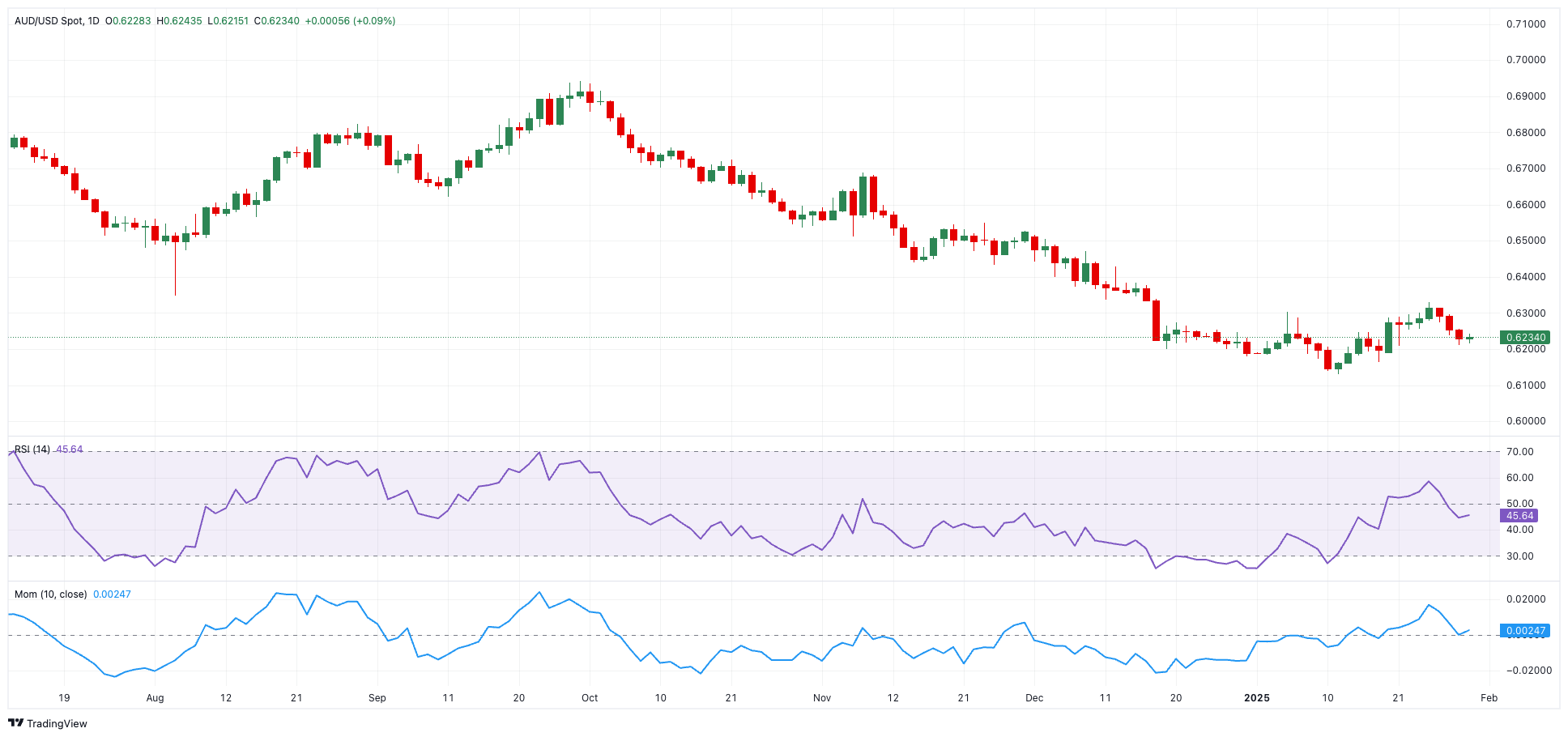
From a technical perspective, AUD/USD is showing mixed signals. Key support is identified at 0.6130, the lowest point in 2025. A drop below this level could open the door to the psychological 0.6000 mark. On the upside, resistance is seen at 0.6330, the YTD peak, with the next hurdle at the weekly high of 0.6549.
Momentum indicators are uncertain— the Relative Strength Index (RSI) has fallen below 45, suggesting some bearish momentum, while the Average Directional Index (ADX) near 20 indicates a weakening trend.
AUD/USD daily chart
Key data to watch this week
As the week is drawing to a close, Producer Prices, Housing Credit, and Private Sector Credit will close the domestic calendar.
Author

Pablo Piovano
FXStreet
Born and bred in Argentina, Pablo has been carrying on with his passion for FX markets and trading since his first college years.