AUD/USD Price Forecast: The next upside target emerges at the 200-day SMA
- AUD/USD regained the smile and bounced off lows near 0.6530.
- Fresh selling pressure on the US Dollar allowed the recovery in risky assets.
- Australian inflation figures showed further loss of momentum.

After three consecutive daily declines, AUD/USD met some fresh upside impulse on Wednesday, printing decent gains and climbing to as high as the boundaries of 0.6600 the figure.
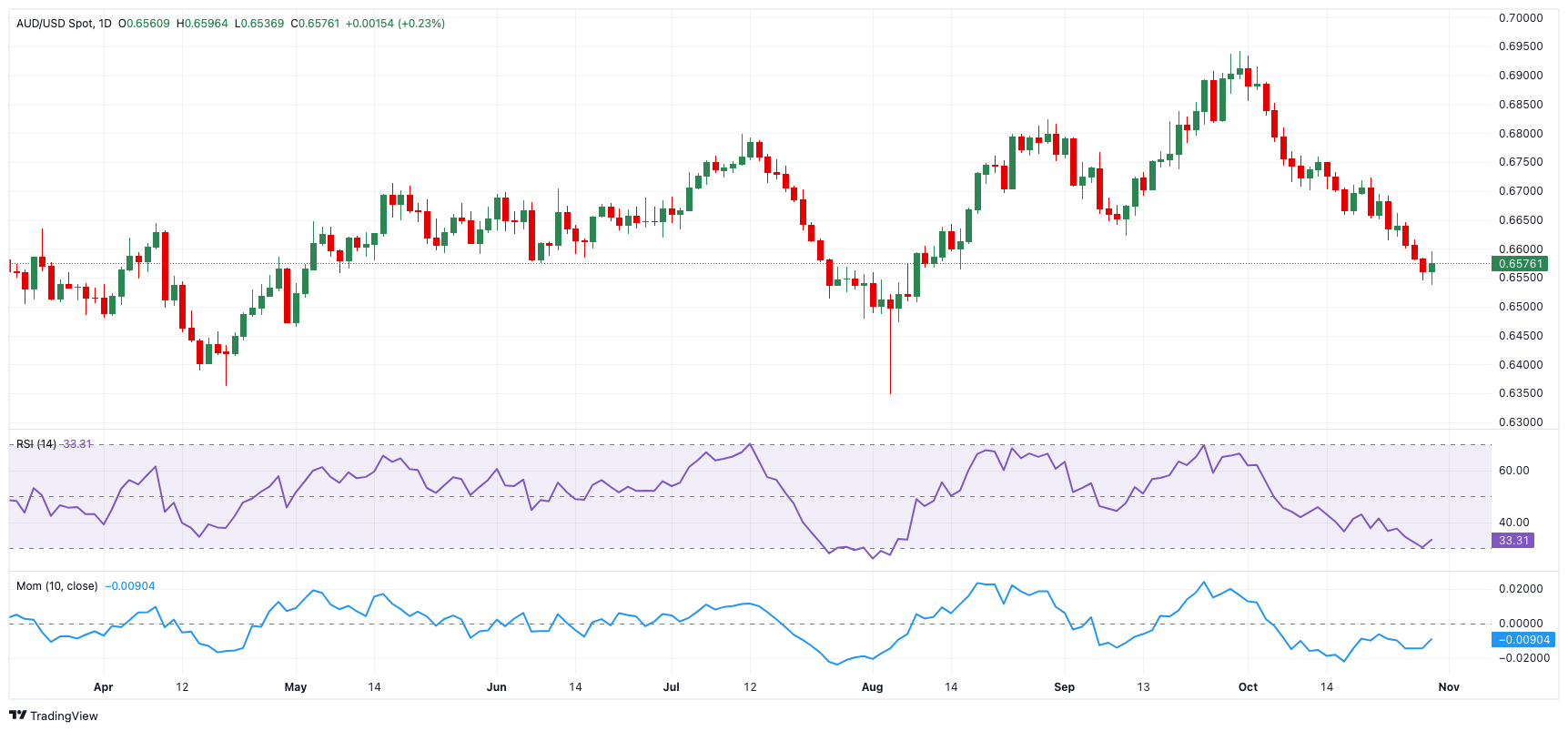
This rebound allowed the pair to refocus its target on the critical 200-day simple moving average (SMA), currently at 0.6627. Above this region, the pair’s outlook is expected to shift to a more constructive one.
The Australian Dollar’s (AUD) rebound from multi-week lows in the 0.6540-0.6535 band came amidst extra weakness in the US Dollar (USD), which sponsored a decent recovery in most risk-sensitive assets.
Beyond USD-selling, the AUD’s bounce came despite ongoing doubts over the effectiveness of China’s stimulus measures announced earlier in the month.
A knee-jerk in copper prices, in the meantime, coupled with marginal price action around iron ore prices, reflected the market's mixed sentiment on China’s economic outlook.
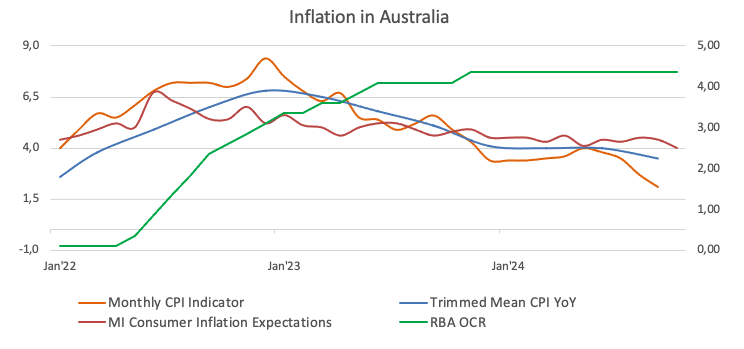
On the policy front, the Reserve Bank of Australia (RBA) held its cash rate steady at 4.35% at its September meeting. Governor Michele Bullock acknowledged persistent inflation risks but downplayed the likelihood of an imminent rate hike.
The meeting minutes indicated a more cautious tone than in August, signalling that interest rates might stay steady for the foreseeable future. Current market sentiment points to a 50% probability of a 25-basis-point rate cut by year-end. The RBA is expected to be one of the last G10 central banks to lower rates as growth and inflation gradually ease.
However, Deputy Governor Andrew Hauser recently cautioned against overly optimistic expectations for substantial RBA rate cuts, noting that the neutral rate range of 3% to 4% suggests the current 4.35% rate is not overly restrictive.
While potential rate cuts by the Federal Reserve later this year could provide some support for AUD/USD, persistent uncertainty around China’s economic direction is likely to maintain downward pressure on the pair.
Recent data from Australia showed the RBA’s Monthly CPI Indicator increasing by 2.1% in September, down from 2.7%. Meanwhile, the Inflation Rate rose by 2.8% YoY in the third quarter, and the RBA’s Trimmed Mean CPI advanced by 3.5% from a year earlier, a decrease from 4.0%. Although disinflationary pressures are building, they may not be sufficient for the central bank to initiate its easing cycle just yet.
AUD/USD daily chart
AUD/USD short-term technical outlook
Extra losses might bring the AUD/USD to its October low of 0.6536 (October 30), ahead of the 2024 bottom of 0.6347 (August 5).
On the upside, there is intermediate resistance at the 200-day SMA of 0.6627, followed by the interim 100-day and 55-day SMAs of 0.6693 and 0.6738, respectively, before hitting the 2024 top of 0.6942 (September 30).
The four-hour chart shows a mild reversal in the ongoing negative trend. The initial support is at 0.6536, followed by 0.6347. On the upswing, the initial resistance level is the 55-SMA at 0.6635, then the 100-SMA at 0.6672, and finally 0.6723. The RSI rose to nearly 44.
Author

Pablo Piovano
FXStreet
Born and bred in Argentina, Pablo has been carrying on with his passion for FX markets and trading since his first college years.















