AUD/USD Price Forecast: Still trying to find its feet
- AUD/USD kept the erratic performance still below the 0.6300 level.
- The US Dollar managed to extend Wednesday’s bounce.
- President Trump’s policies on trade still need clarity.


On Thursday, the Australian Dollar (AUD) alternated gains with losses in the upper and lower parts of the weekly range, faltering once again just ahead of the key 0.6300 barrier. The pair maintained this erratic performance in the last three days, while a convincing trespass of 0.6300 remains elusive.
Meanwhile, the US Dollar (USD) advanced modestly, adding to Wednesday’s bullish attempt near the 108.00 zone when gauged by the Dollar Index (DXY) and finding extra support on rising US yields across the spectrum.
The Aussie Dollar looks exhausted
After weeks of grappling with a surging US Dollar, the Aussie has finally shown signs of life, although that advance has so far met strong resistance around the 0.6300 neighbourhood. Its recent rebound has been supported by a noticeable retreat in the Greenback, which had been bolstered since October by the so-called “Trump trade” narrative. The shift has provided some breathing room for risk-sensitive currencies like the AUD.
Adding to the momentum, market chatter suggests the Reserve Bank of Australia (RBA) might cut interest rates at its February meeting, with a 60% probability priced in. The move aims to stimulate Australia’s slowing economy and tame softer inflation.
However, challenges remain. Domestically, economic growth is sluggish, confidence among consumers and businesses is fading, and concerns about China’s slow recovery loom large. Given China’s position as Australia’s biggest trading partner, any weakness there tends to ripple across the AUD.
Commodity prices offer mixed support
The commodity markets haven’t been entirely kind to the Aussie, either. While copper prices managed to regain some upside traction on Thursday, iron ore prices still look consolidative near yearly peaks.
Some bright spots in the data
Australia’s job market brought some encouraging news in December, with a better-than-expected gain of 56.3K jobs. However, the unemployment rate edged up slightly to 4.0% from 3.9%. On the inflation front, consumer expectations for January dropped to 4.0% from December’s 4.2%, potentially signalling easing price pressures, according to the Melbourne Institute.
RBA’s cautious approach
At its December meeting, the RBA opted to keep interest rates steady at 4.35%, adopting a “wait-and-see” stance. Governor Michele Bullock stressed that future decisions would depend on how economic data evolves in the months ahead.
AUD/USD: Challenges and opportunities
AUD/USD faces significant headwinds: a strong US Dollar, mixed domestic economic signals, and lingering uncertainty over China’s recovery. However, if the Federal Reserve (Fed) leans toward further rate cuts, a weaker USD could give the Aussie some much-needed support.
The technical picture
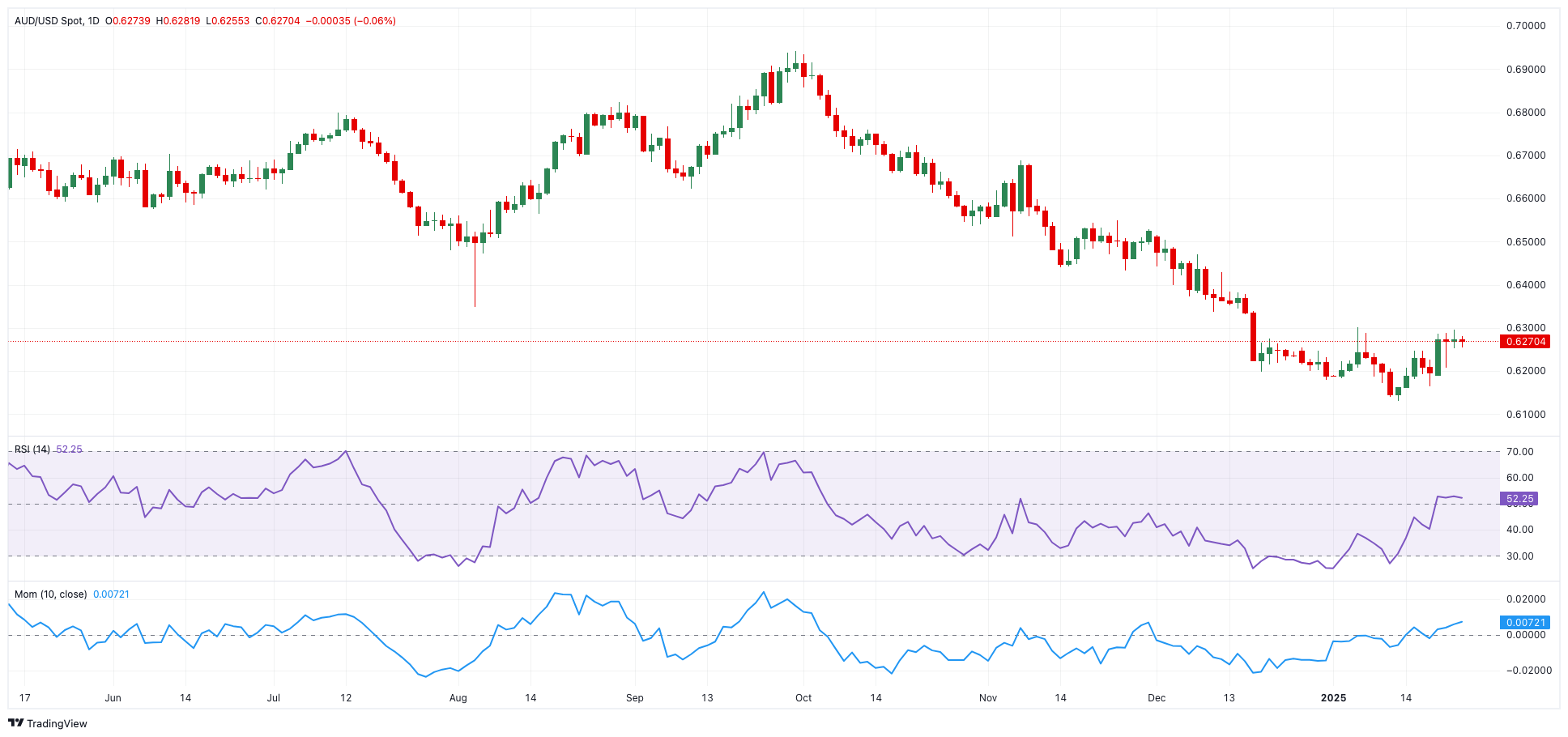
Technically, AUD/USD remains under pressure. Key support lies at 0.6130, and a break below this level could open the door to the psychological 0.6000 mark. On the upside, resistance sits at 0.6301, followed by 0.6401 and 0.6549. Momentum indicators offer a mixed outlook—while the RSI looks flat around 51, the ADX has been consistently losing ground and approaches 25, indicative of a weakening strength of the trend.
AUDUSD daily chart
What’s next for the Aussie?
This week’s Australian economic calendar is relatively quiet, with the Westpac Leading Index staying unchanged in December. Traders will likely keep their eyes on global developments, particularly any Fed hints and updates from China’s economy, to gauge the AUD’s next move.
Premium
You have reached your limit of 3 free articles for this month.
Start your subscription and get access to all our original articles.
Author
Pablo Piovano
FXStreet
Born and bred in Argentina, Pablo has been carrying on with his passion for FX markets and trading since his first college years.

















