AUD/USD Price Forecast: Near-term outlook should shift to bullish above 0.6600
- AUD/USD advances to two-week highs near the 0.6580 level.
- Strong risk-appetite favoured the move higher in AUD.
- Attention now shifts to Chinese inflation figures due on Friday.


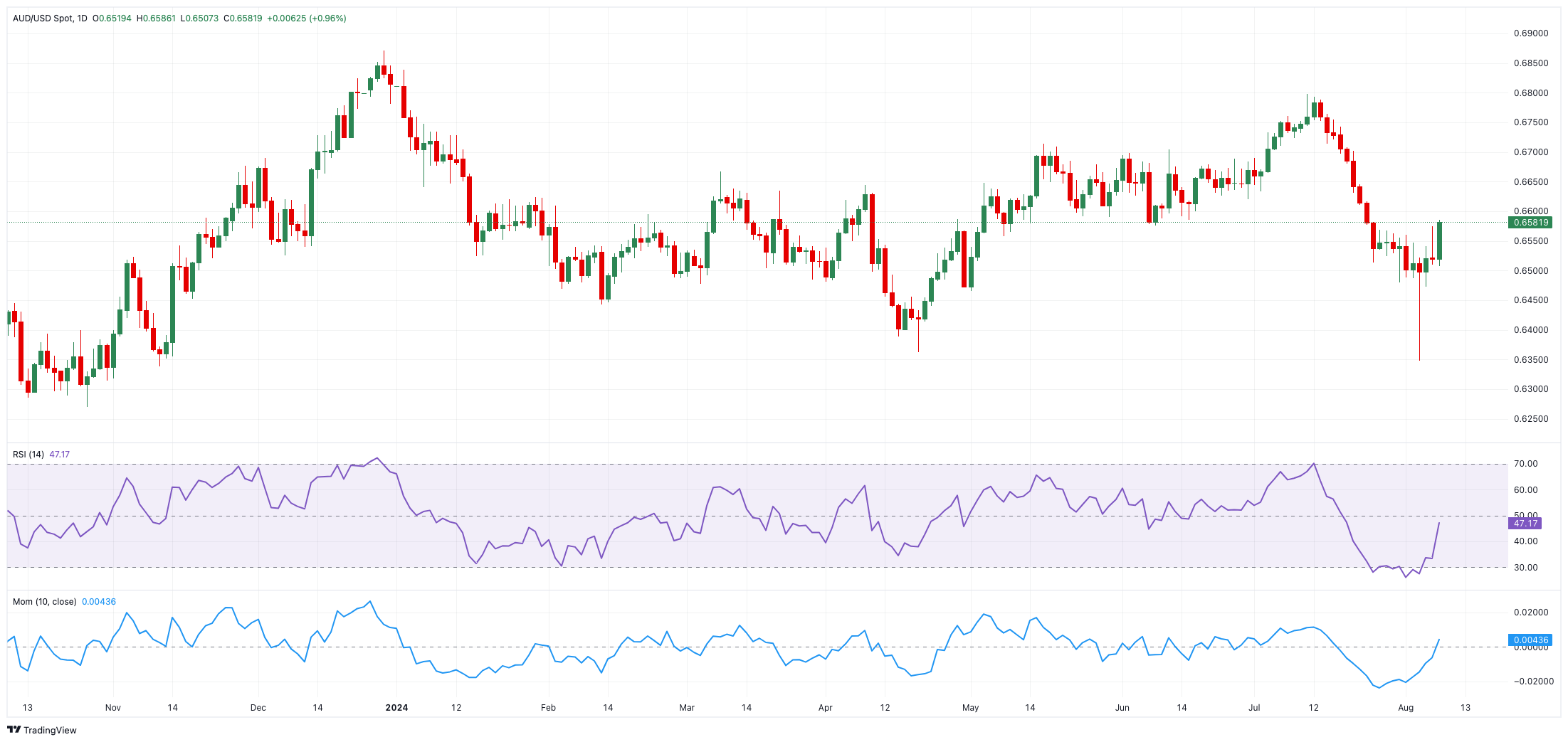
AUD/USD rapidly left behind Wednesday’s inconclusive price action and gathered extra steam on Thursday, reaching multi-day highs near 0.6580 and distancing itself from Monday's 2024 lows around 0.6350.
The Australian dollar's primary focus remains on the crucial 200-day SMA, currently at 0.6594. A decisive break above this level is necessary to restore a more constructive outlook for the pair.
In the meantime, Thursday’s pronounced rebound in the Aussie dollar came in tandem with some tepid recovery in the commodity complex, with copper prices up modestly vs. a move lower in iron ore prices.
The Australian dollar also remained buoyed by investor reactions to the Reserve Bank of Australia's (RBA) recent decision to maintain its current policy stance. The RBA reiterated that it is in no hurry to ease policy, anticipating that domestic inflation will be more persistent, with both trimmed-mean and headline CPI inflation now expected to approach the mid-point of the 2-3% range by late 2026 instead of the previous estimate of June 2026.
During her press conference, RBA Governor Michele Bullock mentioned that the Board considered a rate hike and stressed that rate cuts are not imminent. She also noted that expectations for rate cuts are premature.
Still around Governor Bullock, she argued on Thursday that the central bank would not hesitate to raise interest rates if necessary to control inflation, emphasizing a hawkish stance as underlying inflation remained high. Bullock reaffirmed that the bank's board was attentive to the risks of rising inflation after opting to keep interest rates unchanged earlier in the week, noting that core inflation, which was 3.9% last quarter, is seen decreasing to its target range of 2% to 3% by late 2025.
Overall, the RBA is expected to be the last among the G10 central banks to start cutting interest rates. Potential easing by the Federal Reserve (Fed) in the medium term, contrasted with the RBA's likely prolonged restrictive stance, could support AUD/USD in the coming months.
However, sluggish momentum in the Chinese economy might impede a sustained recovery of the Australian dollar. China continues to grapple with post-pandemic challenges, deflation, and insufficient stimulus for a strong recovery. Concerns about demand from China, the world's second-largest economy, also arose following the Politburo meeting, where, despite pledges to support the economy, no specific new stimulus measures were introduced.
Of note, China will disclose its inflation figures for the month of July on Friday, which could have an impact on the PBoC’s decision to implement further stimulus in the near term.
AUD/USD daily chart
AUD/USD short-term technical outlook
Further increases should prompt the AUD/USD to test the important 200-day SMA of 0.6594, ahead of the transitory 100-day and 55-day SMAs of 0.6600 and 0.6640, respectively, before the July high of 0.6798 (July 8) and the December top of 0.6871.
The return of the bearish tone may drive the AUD/USD to retest the 2024 bottom of 0.6347 (August 5), ahead of the 2023 low of 0.6270 (October 26).
The four-hour chart indicates a gradual pick up of the bullish attitude. However, the initial support is around 0.6347, followed by 0.6338 and 0.6270. On the upside, the first resistance is at 0.6586, before 0.6610 and the 200-SMA of 0.6643. The RSI increased past 60.
Premium
You have reached your limit of 3 free articles for this month.
Start your subscription and get access to all our original articles.
Author
Pablo Piovano
FXStreet
Born and bred in Argentina, Pablo has been carrying on with his passion for FX markets and trading since his first college years.