AUD/USD Price Forecast: Near-term gains look capped by the 0.6300 region
- AUD/USD maintained its weekly bullish bias in place near the 0.6300 barrier.
- The US Dollar treaded water around the area of weekly lows.
- Uncertainty prevails around President Trump’s announcements.


Wednesday brought back some shine for the US Dollar (USD), with the Dollar Index (DXY) bouncing off earlier multi-week lows in the 107.40-107.35 band against the backdrop of further weakness in US yields across the board.
In contrast, the Australian Dollar (AUD) clung to gains in the area just below the key 0.6300 region, which has become quite an important hurdle for the time being.
What’s driving the Aussie’s comeback?
After struggling under the weight of a strong Greenback in recent weeks, the Aussie staged a decent recovery as the trading week began, aided by a noticeable pullback in the Dollar. The marked strength in the Dollar—bolstered since October by the so-called “Trump trade” narrative—had kept risk-sensitive currencies like the AUD under pressure.
Meanwhile, the Reserve Bank of Australia (RBA) is weighing the possibility of an interest rate cut at its February event. This move, aimed at supporting slowing economic growth and managing softer inflation, is currently seen as a 60% likelihood by market participants.
However, the road ahead for the Aussie isn’t without obstacles. Domestically, economic momentum is slowing, consumer and business confidence is faltering, and concerns linger over China’s sluggish recovery—a critical factor given China’s role as Australia’s largest trade partner.
Commodity prices have also played their part in the AUD’s challenges. So far, copper prices appeared subdued amid the relative stability in iron ore markets, all providing some much-needed support for the currency.
A silver lining in employment and inflation
Amid the challenges, there’s good news from Australia’s labour market. December’s jobs report revealed a stronger-than-expected addition of 56.3K jobs, though the unemployment rate inched up slightly to 4.0% from 3.9%. On the inflation front, consumer expectations eased in January, dropping to 4.0% from 4.2%, potentially signalling a slowdown in price pressures, as per the report by the Melbourne Institute.
RBA stays cautious
The RBA opted to keep interest rates steady at 4.35% during its December meeting, signalling a “wait-and-see” approach. Governor Michele Bullock emphasised that upcoming decisions will hinge on how economic data unfolds in the coming months.
Challenges and opportunities for AUD/USD
The AUD/USD pair faces headwinds, including the resilient US Dollar, mixed domestic economic signals, and uncertainties surrounding China’s recovery. On the flip side, if the Federal Reserve hints at further rate cuts, the resulting USD weakness could lend support to the Aussie.
Technical landscape
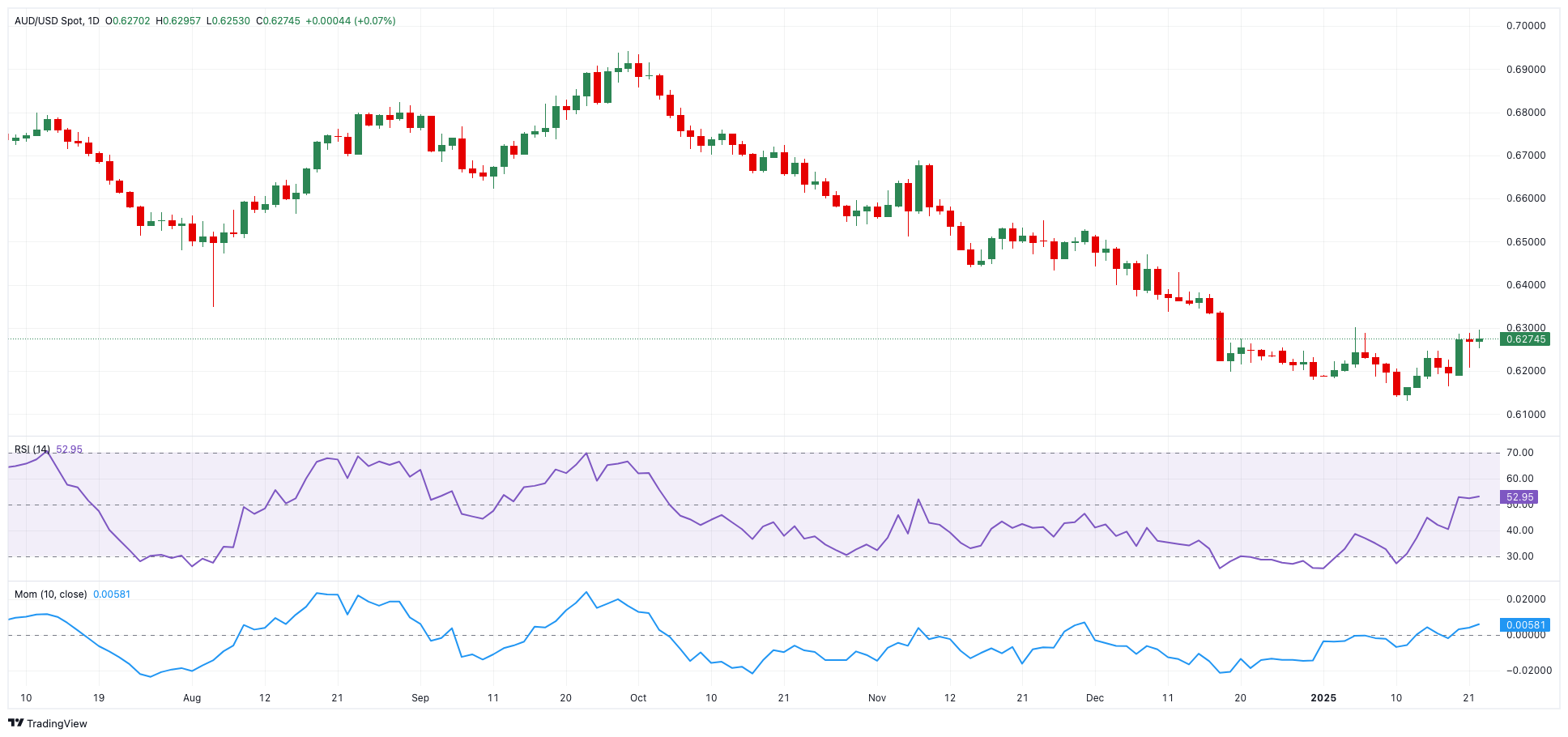
From a technical perspective, AUD/USD remains under pressure. A key support level lies at 0.6130, and breaking below this could push the pair toward the psychological 0.6000 mark. On the upside, resistance levels sit at 0.6301, followed by 0.6401 and 0.6549. Momentum indicators paint a mixed picture: while the RSI is advancing above the 53 level, a weaker ADX (below 27) hints at waning trend strength.
AUD/USD daily chart
What’s on the horizon?
Next week’s Australian economic calendar will bring the NAB Business Confidence Index on January 28, seconded by quarterly inflation figures and the RBA's Monthly CPI Indicator on January 29.
Premium
You have reached your limit of 3 free articles for this month.
Start your subscription and get access to all our original articles.
Author
Pablo Piovano
FXStreet
Born and bred in Argentina, Pablo has been carrying on with his passion for FX markets and trading since his first college years.