AUD/USD Price Forecast: Further retracements now seem likely
- AUD/USD maintained its bearish trend unchanged below 0.6700.
- The US Dollar kept its bullish bias in place and rose to multi-week tops.
- Next of relevance on the docket will be the Australian labour market report.

AUD/USD faced extra selling pressure on Wednesday, this time breaking below the key support at 0.6700 the figure and reaching new five-week lows.
The Australian Dollar’s bearish momentum was largely due to further gains in the US Dollar (USD) as well as incessant scepticism around China’s latest stimulus efforts, making traders cautious.
In addition, the Aussie Dollar failed to temper its decline despite slight gains in both copper prices and iron ore prices, always amidst doubts about how effective China’s stimulus will really be.
Looking at China, deflation concerns grew deeper in September, with official data underscoring the country’s ongoing economic struggles. Over the weekend, a press conference left investors unsure about the scope and impact of any upcoming stimulus efforts aimed at reviving the economy.
On the monetary policy front, the Reserve Bank of Australia (RBA) held its cash rate steady at 4.35% in its September meeting. While the RBA acknowledged inflation risks, Governor Michele Bullock emphasized that a rate hike is not on the table for now.
Minutes from the RBA’s meeting signalled a more dovish stance compared to August, when there was guidance suggesting stable rates for the near future.
Market sentiment currently suggests a 50% chance of a 25-basis-point rate cut by the end of the year. The RBA is expected to be one of the last G10 central banks to cut rates, likely in response to slowing economic growth and easing inflation pressures.
While potential rate cuts from the Federal Reserve could help the AUD/USD recover later this year, uncertainties surrounding China’s economic outlook and stimulus remain a major headwind.
In Australia, Westpac’s Leading Index for September showed no change on a monthly basis. Additionally, Assistant Governor Sarah Hunter noted that the RBA is closely watching data to see if inflation will stay persistent and is "very mindful and watchful" of central bank policies in other countries.
Next on tap in Oz will be the publication of the Leading Index gauged by Westpac, along with the speech of the RBA’s Hunter.
AUD/USD daily chart
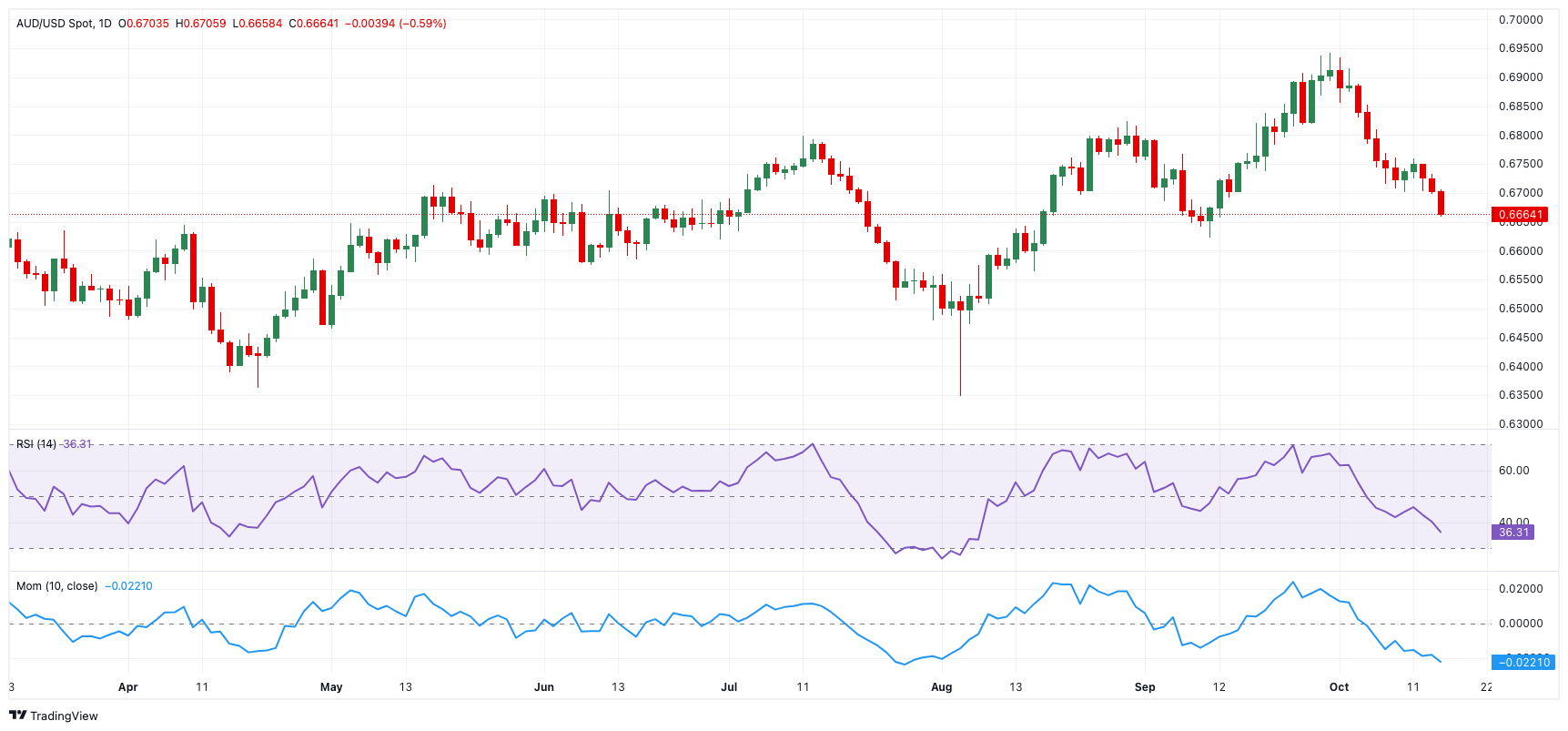
AUD/USD short-term technical outlook
Extra losses might send the AUD/USD down to its October low of 0.6657 (October 16), ahead of the September low of 0.6622 (September 11), which is still supported by the key 200-day SMA.
On the bright side, the first challenge arrives at the 2024 high of 0.6942 (September 30), just before the critical 0.7000 milestone.
The four-hour chart shows an acceleration of the downtrend. That said, the initial support is 0.6657, followed by 0.6622. On the upside, first resistance is at 0.6758, just ahead of the 200-SMA at 0.6772 and the 100-SMA at 0.6807. The RSI entered the oversold zone around 29.
Author

Pablo Piovano
FXStreet
Born and bred in Argentina, Pablo has been carrying on with his passion for FX markets and trading since his first college years.















