AUD/USD Price Forecast: Current outlook remains negative
- AUD/USD drops for the third session in a row and flirts with 0.6200.
- The US Dollar rose to four-day highs ahead of the Fed gathering.
- Inflation in Australia came in on the soft side in Q4.


The FX world saw another positive day for the US Dollar (USD) on Wednesday, with the US Dollar Index (DXY) clinching multi-day highs near the 108.30 region vs. the acceleration of the bearish trend in the Australian Dollar (AUD), prompting AUD/USD to slip back to the boundaries of the 0.6200 region.
China's shadow looms over the Aussie
Bolstering the AUD’s troubles, weak business data out of China over the weekend has been weighing heavily on sentiment. In fact, January’s business activity data disappointed, with the NBS Manufacturing PMI slipping to 49.1—dipping into contraction territory—and the Non-Manufacturing PMI barely holding at 50.2. It is worth noting that the Australian Dollar, closely tied to China's economic health, has extended its pullback from the yearly highs north of 0.6300 it achieved on January 24. With China’s recovery stalling, the Aussie faces a tough road ahead.
The AUD’s comeback: Short-lived?
Last week, the AUD managed an impressive rally, briefly climbing above 0.6300—a level not seen this year. However, this rebound appeared more tied to a cooling USD than to any inherent strength in Australia’s economy. As speculation grows over the Reserve Bank of Australia’s (RBA) next move, particularly after the latest data show a loss of momentum of inflationary pressure in Oz.
In fact, Australia’s latest Q4 CPI data seem to have reinforced the case for an RBA rate cut at the next meeting on February 18. Headline inflation met expectations, rising 2.5% YoY, down from 2.8% in Q3. More importantly for policy, the trimmed mean CPI inflation, a measure closely watched by the RBA, slipped to a three-year low of 3.2% YoY, undershooting expectations (3.3%) and the RBA’s own projection (3.4%) after registering 3.6% in Q3.
This softer inflation print has prompted markets to fully price in a 25 bps RBA rate cut in February, compared to an 80% probability just a day ago. Looking further ahead, markets are now factoring in 85 bps of easing over the next 12 months, reflecting growing confidence in a dovish policy path.
Commodities also hurt the AUD
The unabated struggles in the Chinese demand spell trouble for Australian exports like iron ore and copper and are doing little to support the Aussie. While iron ore prices remain relatively stable, copper prices have recently retreated to multi-day lows.
Headwinds for the Aussie Dollar
The prospect of looser monetary policy, coupled with ongoing sluggishness in China’s economic activity, puts AUD/USD under extra pressure. Additionally, with the Fed’s policy stance remaining comparatively tighter, the RBA-Fed divergence could add further pressure on the Australian Dollar in the near term.
What’s next for AUD/USD?
The Aussie faces a rocky path ahead. The USD is likely to maintain its strength, particularly if Fed policy remains hawkish. At the same time, uncertainties around China’s recovery and Australia’s economic momentum will continue to weigh on the AUD. However, any signs of a dovish shift by the Fed could offer the Aussie some breathing room.
Technical outlook: Cautious sentiment
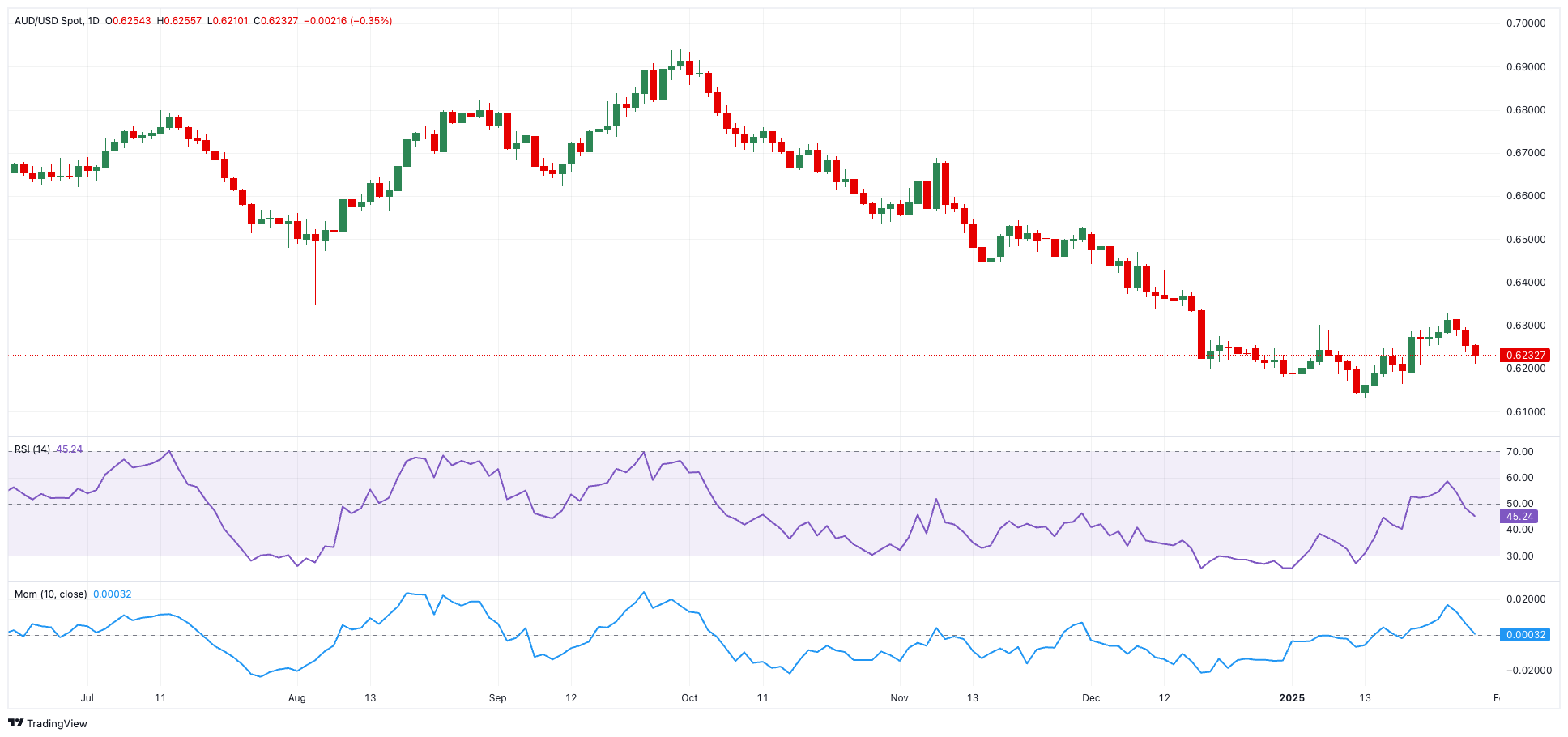
Technically, AUD/USD is showing mixed signals. Key support sits at 0.6130, the 2025 low, and a break below could open the door to the psychological 0.6000 level. On the upside, resistance is seen at 0.6330, the YTD peak, with further hurdles at the weekly high of 0.6549. Momentum indicators are uncertain—RSI has dropped to 45, indicating growing bearish momentum, while the ADX near 21 suggests a weakening trend.
AUD/USD daily chart
Key data to watch this week
While it’s a quieter week for Australian data, several key releases could influence AUD/USD sentiment:
- Export and Import Prices (January 30).
- Producer Prices, Housing Credit, and Private Sector Credit (January 31).
Premium
You have reached your limit of 3 free articles for this month.
Start your subscription and get access to all our original articles.
Author
Pablo Piovano
FXStreet
Born and bred in Argentina, Pablo has been carrying on with his passion for FX markets and trading since his first college years.