|

AUD/USD Forecast: Recovery from decade-low might be limited

Current Price: 0.6615

  • AUD/USD extends bounce from 11-year low, but technical view not that optimist.
  • Australian GDP data beats expectations and helps the AUD.
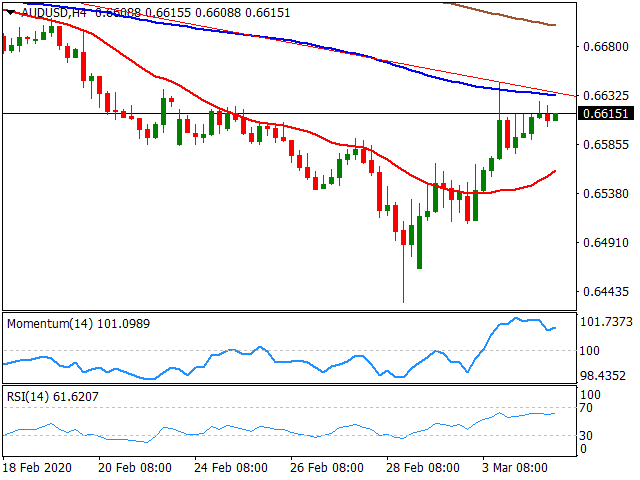
AUD/USD advanced for a third consecutive day on Wednesday, extending its recovery from an 11-year low struck on Friday, lifted by better market sentiment after the Federal Reserve and the Reserve Bank of Australia lowered borrowing costs to boost economic growth. During the Asian session, data published by the Australian Bureau of Statistics showed the economy grew by 2.2% on a yearly basis in the fourth quarter, beating expectations of a 1.9% increase.

AUD/USD short-term technical outlook

Following three days of gains, the AUD/USD short-term technical perspective has improved. However, the longer-term bias remains bearish, with daily indicators in the negative ground while the pair holds near a decade low. The Australian dollar needs a clear break above the 0.6635-40 zone, – where a descendent trend line coming from December’s high converges with the 20-day SMA – to ease the immediate pressure and approach the 0.6700 area. On the downside, the 0.6500 area could offer some support ahead of the mentioned low at 0.6433. Should it give up, AUD/USD could be up for a visit to January’s 2009 low at 0.6344. 

Support levels: 0.6500 0.6433 0.6400 

Resistance levels: 0.6635 0.6700 0.6750

Author

Valeria Bednarik

Valeria Bednarik was born and lives in Buenos Aires, Argentina. Her passion for math and numbers pushed her into studying economics in her younger years.


More from Valeria Bednarik
Share:

Editor's Picks

AUD/USD holds firm near 0.7000 after Chinese inflation, trade data

AUD/USD stays firm near 0.7000 in Wednesday’s Asian session, picking up some bids after China's mixed inflation and upbeat trade data. CPI rose less than expected in September, while PPI inflation picked up. Meanwhile, the Chinese trade surplus unexpectedly widened in September. The pair remains underpinned by a broadly subdued US Dollar, despite the Middle East escalation, as focus remains on US CPI data.

USD/JPY consolidates near 158.50; looks to US CPI for fresh impetus

USD/JPY stays range-bound near 158.50 in the Asian session on Wednesday, with looming intervention risks supporting the Japanese Yen and capping upside amid a softer US Dollar. However, geopolitical uncertainties act as a tailwind for the safe-haven USD and the pair. Traders also seem hesitant ahead of the release of the latest US inflation figures.

Gold looks to $4100 and US CPI inflation amid geopolitical risks

Gold falls for the third straight day on Wednesday, as the recent recovery falters ahead of US inflation. US Dollar pauses correction amid rising Oil prices and stabilizing US Treasury bond yields. The daily bearish RSI remains a headwind for Gold buyers, with $4,100 seen at risk.

Bitcoin eyes $85,000; ETH holds support, XRP stabilizes
Bitcoin (BTC), Ethereum (ETH), and Ripple (XRP) show signs of recovery on Wednesday as buyers try to regain control after their recent market weakness. BTC extends its rebound toward the $85,000 resistance, while ETH and XRP find support around key levels.
What happens after a US Treasury market crash
The global bond market is under severe pressure as US Treasury yields reach multi-decade highs, driven by persistent inflation risk, heavy government and corporate debt issuance, and expanding term premiums. Higher yields raise borrowing costs and tighten financial conditions, but a severe bond selloff can ultimately shift investor focus from inflation to growth and financial stability.
Has Bitcoin really escaped the macro forces it was built to fight?
Over 17 years ago, Satoshi Nakamoto designed Bitcoin (BTC) on the back of a global financial crisis as an alternative to the global monetary system outside the control of central banks, governments and traditional intermediaries. This raises a key question: has Bitcoin really become independent of the macroeconomic forces it was built to challenge?















