AUD/USD Forecast: Decline so far corrective, bearish below 0.6915

AUD/USD Current Price: 0.6953
- Australian December Commonwealth Bank Services PMI, foreseen at 49.5.
- Chinese Central Bank stated it will keep monetary policy prudent, flexible, and appropriate.
- AUD/USD at risk of extending its decline in the short-term, key support at 0.6915.
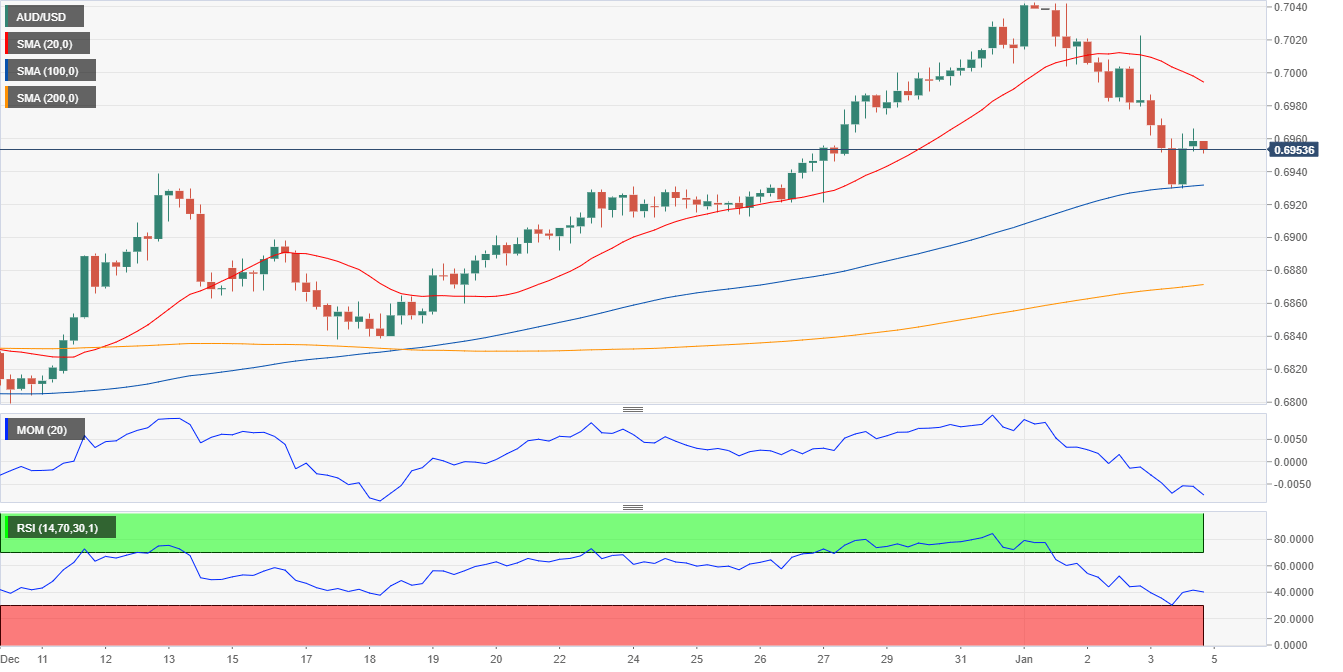
The AUD/USD pair continued retreating from 0.7031, a 5-month high, to close the week with modest losses around 0.6950. On Friday, the Aussie was dragged lower by collapsing equities amid the dominant risk-averse mood. The pair bottomed at 0.6929, bouncing from the level after a dismal US report interrupted the USD rally. Australia didn’t release macroeconomic data at the end of the week but will publish the December Commonwealth Bank Services PMI, foreseen at 49.5, and the Composite PMI for the same period this Monday.
During the weekend, the Chinese Central Bank stated that it will keep its monetary policy prudent, flexible, and appropriate, and continue to deepen financial reforms, repeating its well-known stance.
AUD/USD short-term technical outlook
The AUD/USD pair has corrected the 50% of its latest daily advance but didn’t yet offer a bearish stance, although the risk has increased. In the daily chart, the pair continues developing above all of its moving averages, and with the 20 DMA crossing above the 200 DMA, both around 0.6900, providing a critical dynamic support. Technical indicators have turned sharply lower, but so far holding above their midlines. In the 4-hour chart, however, the risk is skewed to the downside, as the 20 SMA heads south above the current level, while technical indicators resumed their declines after a modest correction, currently near oversold readings. The immediate support comes at 0.6915, where the pair has the 61.8% retracement of the mentioned rally.
Support levels: 0.6915 0.6880 0.6840
Resistance levels: 0.6960 0.7000 0.7035
Author

Valeria Bednarik
FXStreet
Valeria Bednarik was born and lives in Buenos Aires, Argentina. Her passion for math and numbers pushed her into studying economics in her younger years.