ADP Employment Change and Initial Jobless Claims Preview: Hope is not change
- Employment change for July private payroll estimated to be 950,000 workers.
- May and June payroll numbers subject to large revisions, July suspect.
- Manufacturing PMI and new orders better than forecast, employment lags.
- Initial claims forecast to drop to 950,000, continuing to 14 million.
- Dollar levels closely affected by the condition of the US labor market.

The slow improvement in the US labor picture is expected to continue in August as ebbing business closures enable more returning workers even as unemployment claims are forecast to be nearly a million for the 24th straight week.
Private payrolls from Automatic Data Processing are projected to add 950,000 new employees in August, far more than the 167,000 reported in July.
Hiring estimates for ADP client base from the Reuters survey of economists have been uncharacteristically off-mark in the past three months and the connections to the non-farm payrolls numbers has been equally weak.
ADP payrolls
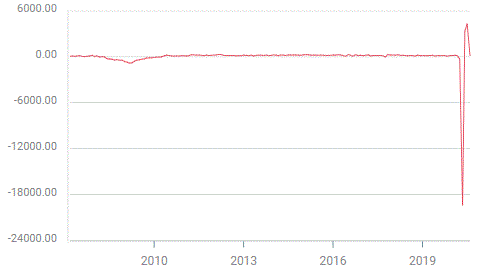
In July the estimate was ADP 1.5 million, the figures was, as above 167,000. The NFP figure was 1.763 million on a 1.6 million forecast.
In June the ADP forecast was 3 million, the first release was 2.369 million and the revision went to 4.314 million. The NFP estimate was 3 million with a 4.8 million first release and a 4.791 million revision.
May had similar problems. Consensus ADP estimate was -9 million, initial release was -2.760 million and the adjustment one month later was to 3.341 million. The NFP forecast was -8 million, reality was 2.509 million revised to 2.699 million.
Manufacturing PMI
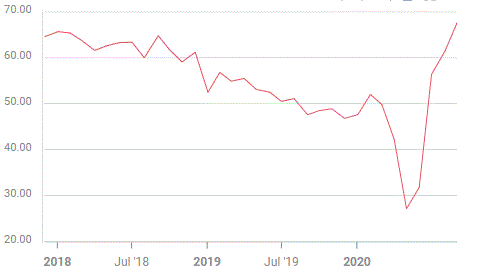
The August manufacturing purchasing managers’ index from the Institute for Supply Management came in at 56, better than the 54.6 forecast and July’s reading of 54.2. The new orders index jumped again to 67.6 from 61.5. They had been predicted to fall to 53.5. Employment lagged at 46.4, remaining in contraction though better than the 45.8 prediction and July’s 44.3.
Manufacturing new orders index
Initial jobless claims
Unemployment claims are expected to drop to 950,000 in the August 28 week, from 1.006 million previously, which would be just the second time below 1 million in the last six months. Continuing claims are estimated to fall to 14 million on August 21 from 14.535 million in the prior week.
Conclusion and the dollar
Dollar weakness was initially predicated on the economic drag anticipated from the second wave of the Covid infections in several large US states. With new cases, hospitalization and fatalities on the decline across the country the economic impact seems to be minor.
The Federal Reserve’s new inflation averaging policy will have no material effect on the actual fed funds rate but it has given the market a new reason to short the dollar. In June the rate was projected by the Fed to be unchanged through the end of 2022.
Until the US economy produces a string of good results, particularly from the labor market, it will be difficult to replace that double scenario against the dollar.
Author

Joseph Trevisani
FXStreet
Joseph Trevisani began his thirty-year career in the financial markets at Credit Suisse in New York and Singapore where he worked for 12 years as an interbank currency trader and trading desk manager.
















