|

USD/TRY climbs to all-time highs near 34.0000 post-CBRT

  • The Turkish currency sinks to record lows vs. the US Dollar.
  • The CBRT left its One-Week Repo Rate unchanged at 50.00%.
  • The central bank said it will maintain its restrictive stance.

The Turkish lira weakens further and sends USD/TRY to fresh all-time highs in levels shy of the 34.0000 barrier on Tuesday.

The CBRT kept rates unchanged, as expected

USD/TRY extended its uptrend for yet another session on Tuesday, marking its fifth daily gain in a row so far.

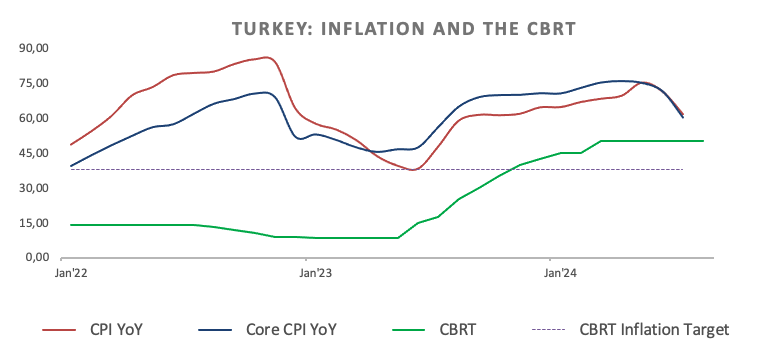
Extra losses in TRY accelerated after the Turkish central bank (CBRT) maintained its One-Week Repo Rate at 50.00% for the fifth month in a row at its meeting on Tuesday.

The bank indicated that the underlying trend of monthly inflation had edged up slightly in July but remained below its second-quarter average. It also reiterated its commitment to maintaining a tight monetary stance until it observes "a significant and sustained decline in the underlying trend of monthly inflation" and expectations align with the projected forecast range.

The statement also mentioned that the monetary policy stance would be tightened if a significant and persistent deterioration in inflation is anticipated.
It is worth mentioning that, since 2022, the pair only closed in negative territory in three months (November 2022, August 2023, and May 2024). During that period, the lira depreciated around 165% vs. the Greenback.

USD/TRY levels to watch

At the time of writing, USD/TRY is up by 0.49% to 33.8716 and faces the next barrier at the all-time peak of 33.8737 (August 20). On the downside, there is provisional support at the 55-day SMA of 32.9085, seconded by the weekly low of 32.7623 (July 26) and the July bottom of 32.4595 (July 3).

Author

Pablo Piovano

Born and bred in Argentina, Pablo has been carrying on with his passion for FX markets and trading since his first college years.


More from Pablo Piovano
Share:

Editor's Picks

EUR/USD onsolidates around mid-1.1800s as traders keenly await FOMC Minutes

The EUR/USD pair struggles to capitalize on the previous day's goodish rebound from the 1.1800 neighborhood, or a one-and-a-half-week low, and consolidates in a narrow band during the Asian session on Wednesday. Spot prices currently trade just below mid-1.1800s, nearly unchanged for the day.

GBP/USD seems vulnerable near mid-1.3500s; UK CPI/FOMC Minutes awaited

The GBP/USD pair struggles to capitalize on the previous day's late rebound from an over one-week low – levels below the 1.3500 psychological mark – and trades with a negative bias for the third consecutive day on Wednesday. The downside, however, remains cushioned as investors seem reluctant to place aggressive directional bets ahead of the release of the latest UK consumer inflation figures and FOMC Minutes.

Gold regains positive traction after Tuesday's over 2% slump as traders await FOMC Minutes

Gold gains some positive traction during the Asian session on Wednesday and recovers a part of the previous day's heavy losses more than 2%, to the $4,843-4,842 region or a nearly two-week low. The intraday move higher could be attributed to repositioning trade ahead of the release of the FOMC Minutes. 

Top Crypto Gainers: Jito drops, Morpho holds steady, Convex Finance climbs

Decentralized Finance tokens, including Jito, Morpho, and Convex Finance, rank among the top-performing crypto assets over the last 24 hours. Jito dips on Wednesday after rallying 22% the previous day on the launch of a new mainnet node.

UK jobs market weakens, bolstering rate cut hopes

In the UK, the latest jobs report made for difficult reading. Nonetheless, this represents yet another reminder for the Bank of England that they need to act swiftly given the collapse in inflation expected over the coming months. 

Ripple slides to $1.45 as downside risks surge

Ripple edges lower at the time of writing on Tuesday, from the daily open of $1.48, as headwinds persist across the crypto market. A short-term support is emerging at $1.45, but a buildup of bearish positions could further weaken the derivatives market and prolong the correction.