|

USD/JPY Price Forecast: Decisively breaches key resistance yet bearish signs persist

  • USD/JPY decisively breaks above a critical level in a bullish sign.  
  • It may also have completed a three-wave correction of the medium-term downtrend with more bearish implications. 

USD/JPY decisively pieces and closes above both its long-term trendline and key upside obstacle in the form of the 147.24 October 3 high. This lends credence to the bullish view and suggests a possible continuation of the short-term uptrend to a tentative target at the next key resistance level of 149.40, the August 15 high.  

USD/JPY Daily Chart 
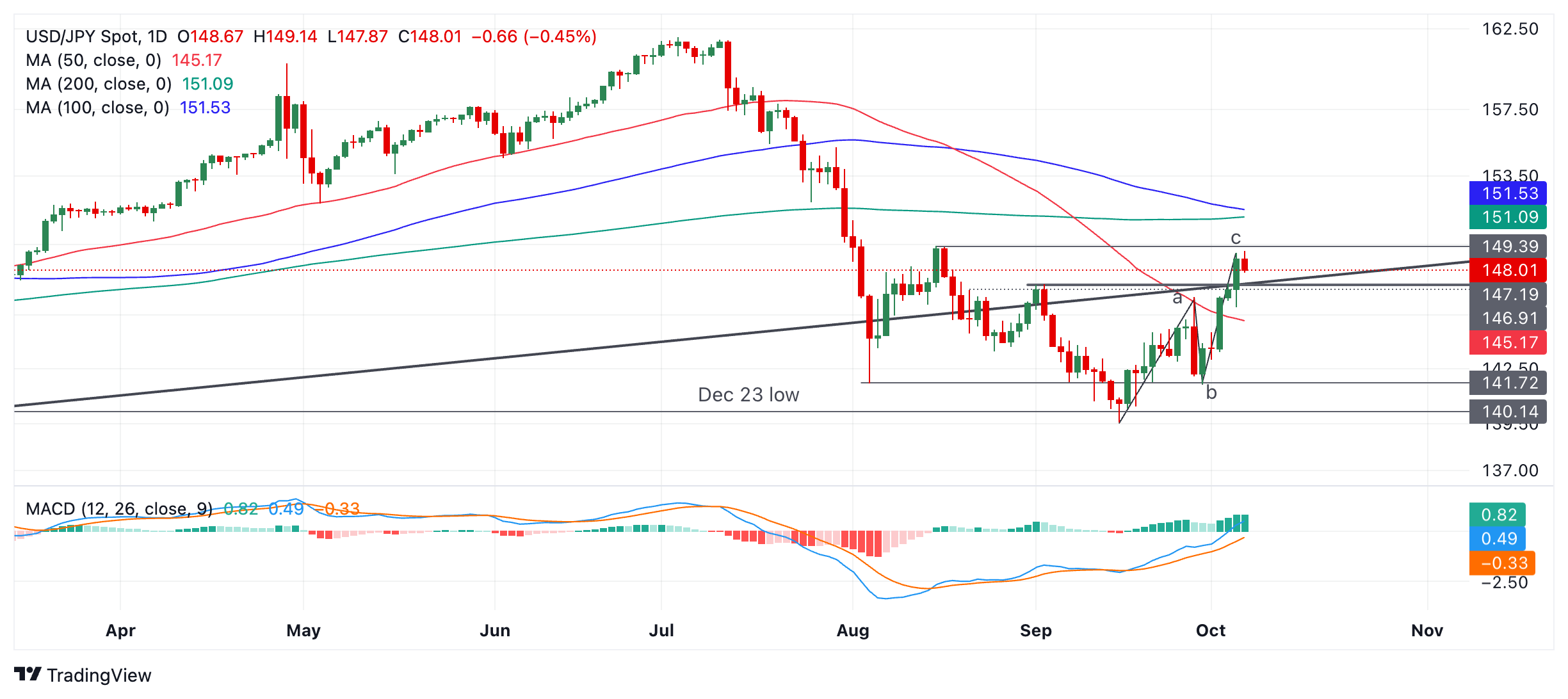
Momentum is broadly bullish since the August bottom and the Moving Average Convergence Divergence (MACD) indicator has consistently converged with price during September, and is now in positive territory. 

A close above 149.40 would provide more confirmation of an extension of the short-term uptrend higher, with the next target potentially at 151.09 and the 200-day Simple Moving Average (SMA).

Yet bullish enthusiasm should be tempered by the possibility that USD/JPY may have formed a three-wave “abc” corrective pattern of the medium-term downtrend during July. If so, the pair may start to decline again as the longer-term bearish cycle starts to take hold. However, it is still too early to say with any confidence and price action itself is not evidencing any weakness yet.
 

A close below the 50-day SMA at 145.24 would probably indicate a resumption of the medium-term downtrend from the summer. Such a move would be expected to reach the wave B lows at around 141.72. 

Author

Joaquin Monfort

Joaquin Monfort is a financial writer and analyst with over 10 years experience writing about financial markets and alt data. He holds a degree in Anthropology from London University and a Diploma in Technical analysis.


More from Joaquin Monfort
Share:

Editor's Picks

AUD/USD sits at two-month lows near 0.6950 after Australian CPI data

AUD/USD is sitting at two-month lows near 0.6950 in the Asian session on Wednesday, as below-expectations August Australian underlying CPI data pours cold water on expectations for further RBA interest rate hikes. Chinese PMI data also fail to inspire the Australian Dollar, despite a pause in the US Dollar advance.

USD/JPY stays weak below 157.00 amid Japanese intervention risks

USD/JPY keeps losses below 157.00 in the Asian session on Wednesday, as hawkish BoJ expectations, along with intervention risks, underpin the Japanese Yen, countering dismal domestic factory output and retail sales data. Meanwhile, a broad US Dollar retreat also collaborates to the pair's downside.

Gold flat lines below $4,200 as traders await US PCE data for Fed rate cues

Gold extends its consolidative price move heading into the European session, trading below the $4,200 mark amid mixed fundamental cues. Falling US bond yields drag the US Dollar away from the two-month high, touched on Tuesday, and act as a tailwind for the commodity. However, hawkish US Federal Reserve expectations cap the upside as traders await important US macro data before placing fresh directional bets on the non-yielding bullion.

Aave Price consolidates below $161 as profit-taking emerges after 10% surge

Aave slips below $161 on Wednesday after surging more than 10% the previous day, with on-chain data suggesting increased profit-taking. Meanwhile, Aave founder Stani Kulechov is considering an AAVE token-burn mechanism under Aavenomics 3.0, adding a potential catalyst for AAVE.

US core PCE inflation set to rise in August, pressuring the Federal Reserve

The United States Bureau of Economic Analysis will publish the Personal Consumption Expenditures Price Index data for August on Wednesday at 12:30 GMT. Market participants closely watch the PCE Price Index because it is the Federal Reserve’s preferred measure of inflation and could influence its policy outlook.

Silver is more volatile than Gold ahead of PCE and NFP. This chart shows the positioning gap
The market’s attention is focused on American data this week, but there’s something only those with a trained eye may be looking at: Gold and Silver positioning gap. Financial markets are moving on fears, mostly related to persistently high energy prices driven by the Middle East war. Sure, the US Dollar (USD) is strong, but at what cost?